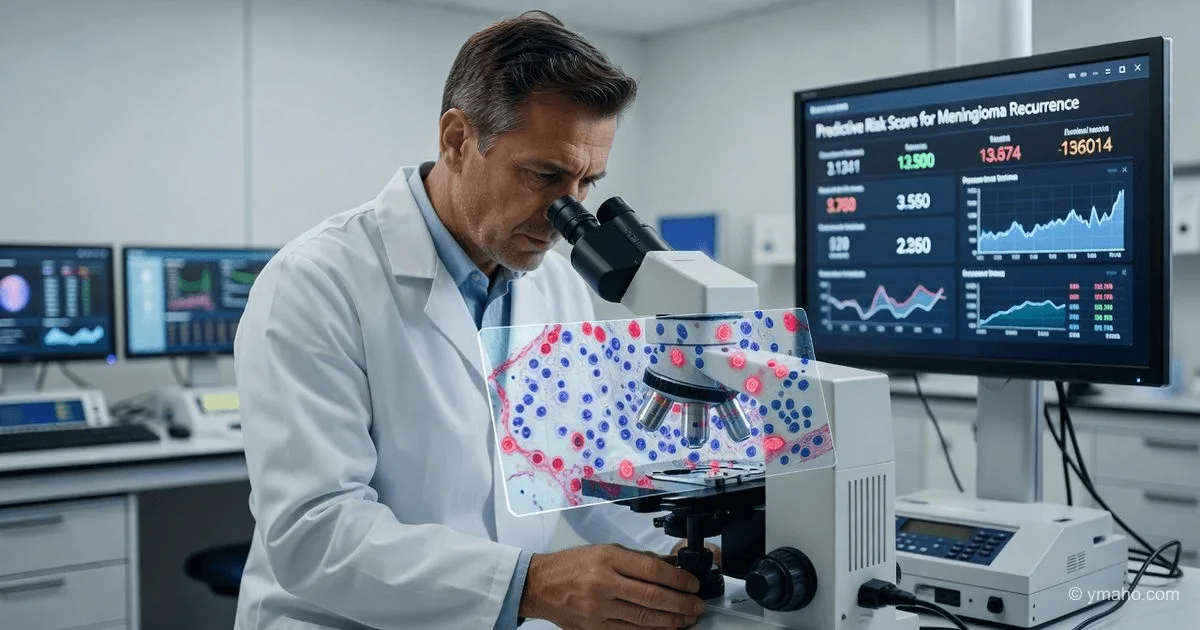
AI Predicts Meningioma Recurrence from Pathology Slides Without Genetics
Mayo Clinic in The Lancet Digital Health presented a deep learning algorithm that analyzes routine stained tumor sections. The model determines the molecular subtype and risk of meningioma recurrence with accuracy comparable to costly DNA methylation, making personalized approaches more accessible.
An analytical article from an insider perspective, seeing the publication in The Lancet Digital Health not just as another algorithm, but as the beginning of the end of genomics' monopoly in neuro-oncology.
Headline: Genetics No Longer Needed? How Mayo Clinic Uses AI to Kill the Billion-Dollar Methylation Market and Return Power to Pathologists
Introduction
On June 4, 2026, an event occurred that sent chills down the spines of Illumina sales managers and oncologists reliant on DNA methylation profiling. A team from Mayo Clinic, led by Dr. Gelareh Zadeh, published in The Lancet Digital Health the results of a deep learning algorithm that, using routine histological slides (H&E stain), determines the molecular subtype of meningioma and its risk of recurrence.
Formally, it's a "tool for under-resourced clinics." Informally, it's a time bomb under the personalized cancer diagnostics industry, where the cost of a single whole-genome analysis reaches $2,000–3,000.
We've grown accustomed to the mantra: "Without genetics and methylation, you are blind." It turns out, no. AI can discern in the routine "pink-purple" stain those very chromosomal aberrations (loss of 1p, 22q, and gain of 1q) that previously required complex protocols. And it does so with AUC up to 0.98 for some subtypes. This is not just assistance to the doctor. It is an encroachment on the most expensive segment of diagnostics.
I have been analyzing this market since 2023, and I hasten to disappoint (or delight) you: the golden age of the "sacred cow" of DNA methylation is coming to an end. Pathologists, who for decades felt like "mere lab technicians" compared to molecular biologists, are gaining superpowers. And startups like PathAI or Paige are already rewriting their business plans.
[The Core]: What Is Really Happening
Headlines scream: "AI Finds Brain Cancer Risks Without Genetics." That's true, but only the tip of the iceberg. In reality, the researchers solved a fundamental problem of tumor phenotypic plasticity.
Meningiomas are insidious because two patients with the same "malignancy grade" (WHO grade I or II) can have drastically different prognoses. One may live 20 years without recurrence; the other returns to the operating table within 18 months. Previously, the difference was explained by epigenetics—DNA methylation. But methylation is expensive, slow (2-3 weeks), and unavailable in 90% of hospitals worldwide.
Zadeh's team took a different path. They created 5 deep neural networks trained on 672 samples. The task was not just to classify the tumor by image (something medical students can do), but to extrapolate hidden genetic chaos from indirect morphological features: nuclear shape, stromal density, vascular colligations that AI sees in 16-bit resolution, inaccessible to the pathologist's eye.
The key figure you won't find in press releases but will see in PubMed: HR (hazard ratio) = 3.49 for predicting recurrence risk. This means patients identified by AI as "high-risk" had a 3.5 times higher probability of progression, regardless of WHO grade or the surgeon's assessment of resection completeness. In oncology statistics, this is a "gold standard" level. The algorithm doesn't just guess—it sees biology.
[Timeline and Context]
This research didn't come out of nowhere. Behind it lies a two-year race between Mayo Clinic and Heidelberg University Hospital (the German center that sets the standard in methylation).
May 2024: Heidelberg publishes an update of its DNA methylation classifier with 184 CNS tumor subclasses. The Germans effectively declare: "Genetics decides everything." They encrypt it on the Illumina platform, and each test costs from $1,500.
September 2025: Mayo Clinic receives a grant from the Canadian Institutes of Health Research (listed in funding). The goal: find a way to bypass Illumina. The idea: "What if we train AI to mimic methylation results from slides? It would be free for clinics that already have a microscope."
June 2026: The final paper is published. Data confirm: the algorithm distinguishes molecular groups MG1-MG4 with 87-97% accuracy. For group MG1 (the most aggressive), it's nearly perfect (AUC 0.98). For MG3, it's more challenging (0.81), but still acceptable.
Note the publication date—June 5, 2026. This is a deliberate choice: a week before the largest neuro-oncology conference in Chicago. Mayo Clinic wants to strike first to snatch clinical trial contracts from the Europeans.
[Who Wins and Who Loses]
Here, the stakes are measured in billions of dollars.
Winner #1: Regional and rural hospitals (North Dakota, Appalachia, Africa).
This is Zadeh's main narrative: "Democratizing access." Previously, a patient from rural Minnesota with suspected meningioma had to travel to Rochester (Mayo), undergo a biopsy, and wait a month for methylation. Now, their slides are scanned locally, and AI provides a prognosis in 15 minutes. If the algorithm shows high risk (MG1/4), the hospital sends the patient directly to a center for radiation therapy, without losing precious 4 weeks. This will save thousands of lives.
Loser #1: Illumina (NASDAQ: ILMN) and the DNA methylation kit market.
They account for up to $500 million in annual sales in neuro-oncology. If AI replaces methylation for 80% of routine meningiomas, stocks will fall. But not immediately. First, Illumina will lobby the FDA to require "mandatory genetic confirmation" for new drugs. They have already hired lawyers to argue: "AI can err on rare subtypes, but sequencing cannot." I expect their platform prices to drop by 20-30% within a year to retain customers.
Winner #2: Computational pathology startups (PathAI, Paige, Mindpeak).
The "H&E to genomics" technology is now validated for the brain. These companies are frantically adapting their models for meningioma and glioma. Their venture market valuation will rise by 15-20%. PathAI, which already has a contract with Mayo Clinic for other algorithms, will benefit especially. They don't need to reinvent the wheel—they just copy the network architecture.
Loser #2: Young molecular biologists (Postdocs) who don't know AI.
The job market is shifting dramatically. Previously, every self-respecting lab rat was a "methylation specialist"—able to run Illumina chips. Now, an algorithm does the same for pennies. Laboratories that don't acquire GPU clusters for deep learning will close. At conferences, whispers are already heard: "If you can't train neural networks, you're a pathologist from the last century."
[What the Media Isn't Saying]
Journalists are ecstatic, but persistently ignore three "red flags" of this study.
1. The "Black Box" for Group MG3 (the most complex tumors).
The paper honestly states: AUC for molecular group MG3 was only 0.81 (vs. 0.98 for MG1). What does this mean? In 20% of cases, AI confuses the "middle ground" (moderately aggressive tumors) with something else. A doctor trusting the algorithm might either undertreat the patient or, conversely, give unnecessary radiation therapy with risk of brain radionecrosis. The authors say "prospective studies are needed," but don't say that right now relying on the algorithm for MG3 is Russian roulette. Commercially, they will launch the product for MG1 and MG4 (the clear extremes), leaving MG3 "under question."
2. The Problem of Tumor Heterogeneity (The "One Slice" Fallacy).
The researchers acknowledge that AI sees differences within a single tumor. But there's a flip side: what if the surgeon didn't cut out the most aggressive fragment? The algorithm analyzes one slide from the tumor edge (where cells are calm) and says "low risk." Meanwhile, in the center, a malignant focus remains in the patient's head. This is a classic sampling error. Genetic testing (methylation) takes a larger piece and averages it. AI, however, is tied to specific fields of view. No one has checked how stable predictions are when changing the "point of aim" within the block. I suspect that when tested on 10 different slides from the same patient, prediction variability could reach 30%.
3. Insurance Codes and Reimbursement (the sorest point).
Diagnostics like "AI analysis of H&E slide" currently lack a separate CPT (Current Procedural Terminology) code for billing insurance. Medicaid and Medicare pay for the actual slide reading by a pathologist ($20-40), but not for "molecular subtype computation by neural network." Mayo Clinic is now lobbying the American Medical Association (AMA) to create a new code "AI-assisted integrated diagnostics." If this fails, the algorithm will be used for free (as a research tool), and Mayo won't earn a cent. Without money, the technology cannot scale.
[Forecast: Next 30 Days and 90 Days]
Next 30 days (late June to mid-July 2026):
A "headhunt" for computer vision engineers will begin. Mayo Clinic will patent the network architecture (they filed an application back in March, without publicity) and will now sell licenses. First in line are hospital networks Kaiser Permanente (USA) and Apollo Hospitals (India). They will announce pilot implementations in 10 centers as early as August.
Next 90 days (September-October 2026):
The key moment is the EANO Congress (European Association of Neuro-Oncology) in September in Paris. The first prospective (albeit small) data will be presented. The German group from Heidelberg, which was overtaken, will give a talk titled "Limitations of AI-based methylation prediction: why morphology cannot fully replace epigenetics." They will show 20 cases where Mayo Clinic's AI erred. This will be a heated discussion.
Startup acquisition. I predict that Roche (which has its own digital pathology platform) or Siemens Healthineers will acquire a small startup focused on H&E-based prediction for $200–300 million. Their target assets are Mindpeak or Aiforia. Why do they need AI from Mayo? They want to embed this technology into their scanners and sell them for $150,000 each as an "all-in-one" (scanner + AI + diagnosis).
The main insider takeaway:
This research is not about meningioma. It is a demonstration that any tumor with a clear epigenetic classification (glioblastoma, medulloblastoma, breast cancer) is now in the crosshairs. Already, Zadeh's team hints at adapting the model for gliomas. If successful, in 3 years we will laugh at the times when understanding recurrence risk required expensive reagent kits and weeks of waiting. The pathologist with AI will become the new "gold standard." And investors who bet on pure-play genomics (sequencing without AI) will rub their eyes. The train is leaving for the digital station.
— Editorial Team