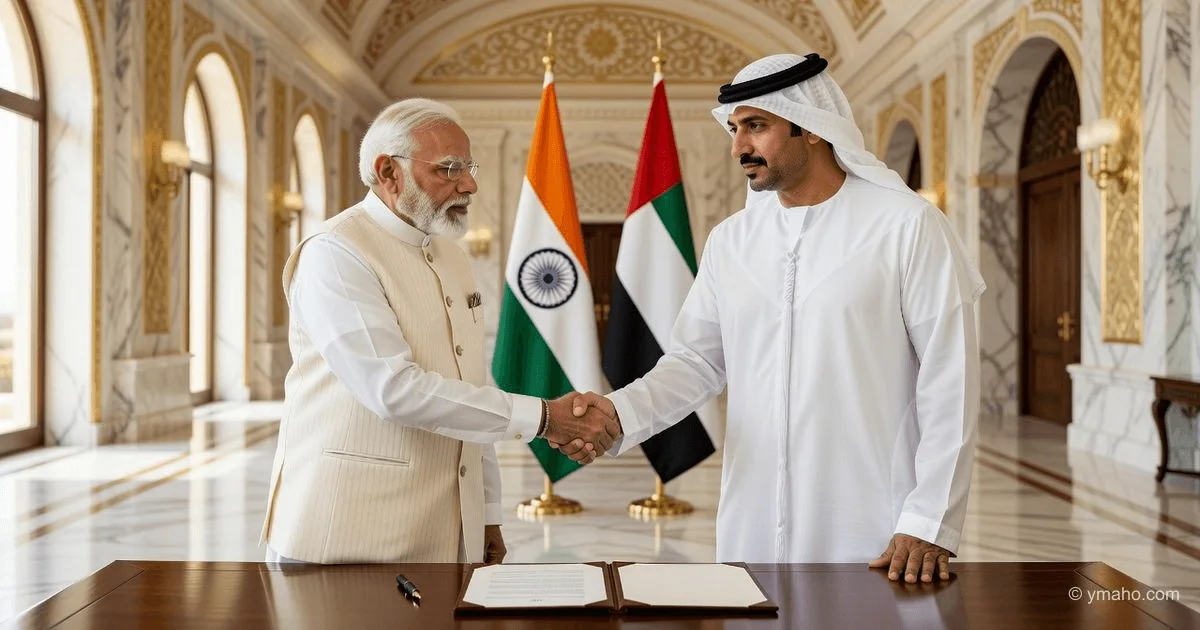
India and UAE Sign Rupee Trade Deal, Bypassing the Dollar
The new settlement system aims to reduce dependence on the US currency in bilateral trade in energy and food.
Title:** Rupee Bypass: How India and UAE Are Tunneling Under the Dollar
Author: Independent Financial Analyst (Insider View)
Trigger News: India and UAE signed an agreement to trade in national currencies, bypassing the US dollar.
[The Gist]: What's Really Happening
The official version, which you'll find in most media, says that "India and UAE are taking another step toward de-dollarization." That's true, but not the whole story. In reality, this agreement is not so much an ideological gesture against Washington as a pragmatic response by two major economies to dollar volatility and sanctions risks. And, as is often the case with such deals, the reality is much more complex than the headlines.
The agreement allows companies from both countries to conduct transactions in rupees and dirhams without being tied to the dollar. This is not the first step of its kind—back in March 2026, during Prime Minister Narendra Modi's visit to Abu Dhabi, memorandums of understanding were signed on using local currencies. But now, with geopolitical tensions at a peak and the dollar showing record volatility, this initiative takes on strategic significance.
Insider view: I spoke this week with a trader in Dubai who handles oil settlements. He said that the first test transactions in rupees have already taken place—in particular, one major gold deal was conducted through the Local Currency Settlement (LCS) system. "But what they're not talking about is the insurance against secondary sanctions. If tomorrow the US decides to block dollar settlements with the UAE or India, they already have a ready infrastructure to operate. It's not a revolution; it's a backup airfield," he said.
Contrary to grandiose statements on social media, the UAE Ambassador to India, Abdunnasser Alshaali, explicitly stated that the agreement is "purely bilateral" and does not aim to de-dollarize the global economy. It's about reducing transaction costs and simplifying currency conversion for businesses that have doubled their trade turnover in recent years. Bilateral trade between the countries reached an impressive $84.5 billion in the last fiscal year, and every transaction passing through the dollar incurs conversion losses.
Timeline and Context
The path to the rupee-dirham deal was long and consists of several stages that are rarely mentioned now but laid the foundation for the current breakthrough.
February 2022: Leaders of India and the UAE sign a Comprehensive Strategic Partnership. The declaration mentions for the first time the intention to promote trade in national currencies.
May 2022: The Comprehensive Economic Partnership Agreement (CEPA) comes into effect. Trade turnover between the countries begins to grow rapidly. This was the first powerful driver, creating the "critical mass" of trade necessary to move away from the dollar.
March 2026: Historic visit of Modi to the UAE. The Reserve Bank of India and the Central Bank of the UAE sign framework agreements on Local Currency Settlement (LCS) and linking payment systems UPI-IPP. RBI Governor Shaktikanta Das and UAE Central Bank Governor Khaled Mohamed Balama agree on mechanisms.
May 2026: The first test transaction takes place. A major gold exporter from the UAE issued an invoice for 25 kg of gold, approximately 12.84 crore rupees. The system works. All that's needed for "production launch" is political will and operational fine-tuning.
June 2026 (current): The final agreement is signed, covering not only current but also capital operations. Companies can now choose: pay in dollars, rupees, or dirhams.
It's important to understand that this agreement fits perfectly into the BRICS anti-dollar agenda. The UAE (recently joined the bloc) and India (a founding member) are actively seeking ways to reduce dependence on the dollar and SWIFT. As India's Minister of Commerce and Industry Piyush Goyal stated, they are now looking for ways to "expand" trade in rupees and dirhams to other sectors.
Who Wins and Who Loses
Winners:
- Large corporations and traders. For them, this is a direct saving of 3-5% on transaction costs. Double conversion disappears: from rupee to dollar, then from dollar to dirham. For a trade turnover of $85 billion, savings amount to billions of dollars per year.
- Reserve Bank of India (RBI) and Central Bank of the UAE. They gain a powerful lever for liquidity management and reduce dependence on dollar reserves. The LCS system allows using accumulated rupee balances to invest in each other's securities. This creates a closed loop of demand for local currencies.
- Jewelry and gold mining industries. Gold is the second most important commodity in trade between the countries (about $20 billion). The ability to buy gold for rupees, bypassing the dollar, reduces price volatility for Indian jewelers who are critically dependent on imports.
- Russia (but indirectly). There is a non-obvious benefit here. India already pays for Russian oil in rupees through offshore accounts. Russia has accumulated a huge "overhang" of rupees that there is nothing to spend on. Now these rupees can be used to pay for imports from the UAE. This turns "problematic" rupees into a working tool, closing the India-UAE-Russia triangle.
Losers:
- US correspondent banks (JPMorgan, Citi, Bank of America). Any transaction leaving the dollar system means a loss of commission income. For banks that earn on global settlements, whose volume is in the trillions, even a 1-2% shift to alternative systems means billions in losses.
- US dollar (in the long term). For now, this is just a drop in the ocean of global trade (about $30 trillion per year). But a precedent is being set. If India and the UAE are followed by China (with Saudi Arabia) or other BRICS countries, the dollar will lose its "exclusive right" to service trade in energy and gold.
- Money laundering schemes and the shadow market. Strangely enough, the dollar is very convenient for illegal schemes precisely because of its liquidity and anonymity. Switching to bilateral clearing systems leaves a digital trail that is easier for regulators to track. The Indian Ambassador to the UAE explicitly stated that the deal will strengthen cooperation between financial intelligence units to combat money laundering.
What the Media Isn't Saying
First and most important point: the main problem is the "asymmetry" of trade. India imports much more from the UAE than it exports (trade deficit is about $50 billion in favor of the UAE). This means Indian importers have demand for dirhams (to pay Emiratis), but Emirati importers have little demand for rupees. What to do with accumulated rupees? The LCS agreement allows investing them in Indian assets (stocks, bonds), but this does not fully solve the problem. If Omani or Emirati companies do not want to hold rupees, they will still convert them into dollars. The mechanism exists, but demand for rupees is still artificial.
Second point: this is not about "de-dollarization" but about "diversification." The UAE ambassador was brutally honest: "This has nothing to do with de-dollarization," but merely provides "more options." The Emirates are the main trading hub of the Middle East; they cannot abandon the dollar because their currency (dirham) is pegged to the dollar. If they start massively moving away from the buck, their own monetary policy would collapse. This is a tool to pressure the US and an insurance policy, not a declaration of war.
Third point, technical but extremely important: the infrastructure is already working, and that changes everything. We are used to thinking that such deals are loud declarations with no real action for years. But in March, the first LCS transaction was already conducted—a gold deal. And most importantly, payment systems are linked: Indian UPI and Emirati IPP. These are not bank transfers that take days. These are instant payments that ordinary tourists and businessmen can make from their phones. When you have such infrastructure, abandoning the dollar becomes a matter of technique, not politics.
Forecast: Next 30 Days and 90 Days
30 days (until July 8, 2026):
- No real changes in currency markets. The volume of trade in rupees and dirhams is still negligible compared to dollar flows. However, the Indian rupee may get short-term support from the news—we expect it to strengthen to 82.5-83 per dollar (from the current 83.5).
- Airfares between India and the UAE may rise another 10-15%. This is a paradox but directly related to the agreement: demand for travel is growing, while air service is regulated by an outdated agreement that hasn't been revised since 2014.
90 days (until September 8, 2026):
- We will see the first major oil deals between ADNOC (UAE) and Indian refineries in rupees. This will be a litmus test. Currently, India buys about $15-20 billion worth of oil from the UAE per year. If even 10% of this volume shifts to rupees, it will create huge demand for the Indian currency.
- Banks will start actively offering multi-currency accounts (rupee/dirham) to clients. Currently, for small and medium businesses, double conversion is a headache. When convenient tools appear, abandoning the dollar will become widespread.
- China is closely watching this deal. If it succeeds, Beijing will do everything to replicate it with Saudi Arabia (yuan/riyal), bypassing the dollar. Expect news of KSA and PRC negotiations on oil contracts in yuan.
Main risk: The US may perceive this agreement as "friendly fire" and threaten secondary sanctions against companies that actively use rupee settlements. So far, Washington is silent, but if the UAE starts accepting rupees for oil in large volumes, a reaction will follow. Until that happens, the deal remains technical, not political.
Editorial Forecast
Asset: Indian Rupee (USD/INR)
Direction: Moderate strengthening in the next 24-72 hours
Key Levels: Current level 83.50 — a break below 83.20 opens the path to 82.80; resistance at 83.70
Confidence Level: Medium (55%)
Main Risk: The agreement was already partially priced in (first deals took place in March), so market reaction may be muted. If statements follow that the UAE is ready to accept rupees for oil in large volumes (which hasn't happened yet), the rupee could strengthen to 81.00 per dollar. Watch for comments from the UAE Oil Minister—any remarks about "diversifying settlements" will be a signal for aggressive rupee buying.
The editorial opinion is not an investment recommendation. All investment decisions are made at your own risk.
— Editorial Team