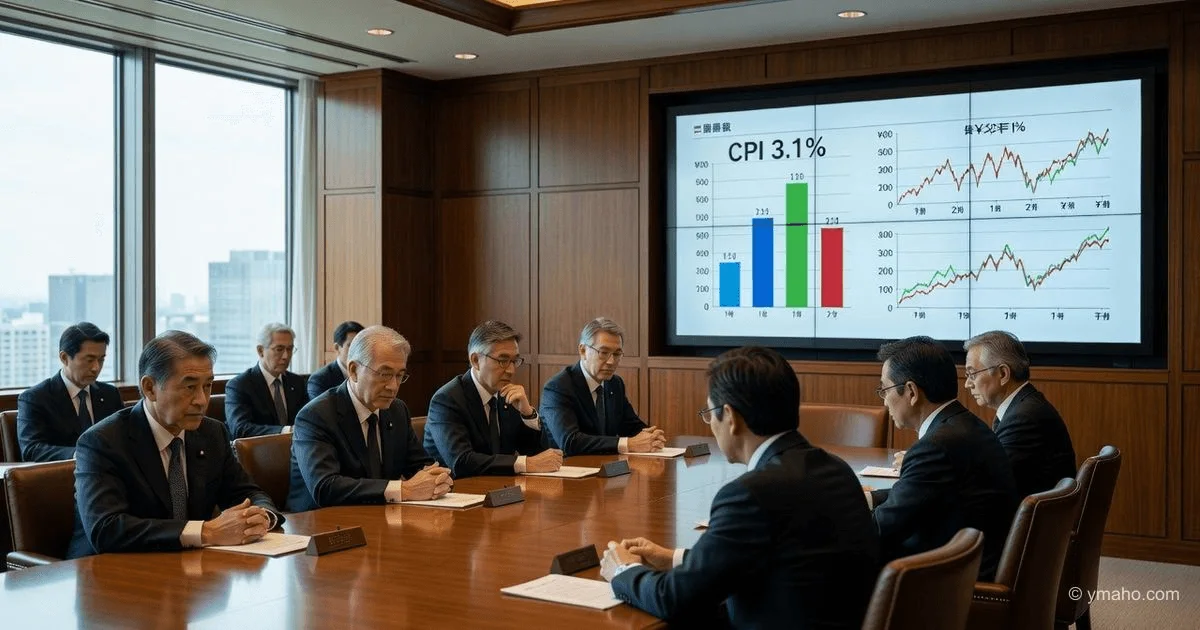
Japan's Inflation Accelerates to 3.1%, Bank of Japan Considers Rate Hike
Japan's core consumer price index exceeded the target level for the third consecutive month, increasing pressure on the central bank to normalize policy.
Title: Japan Wakes Up: 3.1% Inflation — End of the Deflation Era or Start of a Crisis?
Author: Independent Financial Analyst (Insider Perspective)
Trigger News: Japan's core CPI hit 3.1% for the third straight month; BOJ signals possible rate hike.
[The Gist]: What's Really Happening
The official version you read in the Financial Times or The Economist sounds triumphant: "Japan has finally defeated deflation." That's only half true. In reality, the Bank of Japan (BOJ) is trapped with no elegant way out. 3.1% inflation is not the result of a domestic economic boom but imported inflation via a weak yen and high energy prices. Without real wage growth (down 1.2% over the past year), this inflation level destroys household purchasing power.
What really happens at BOJ meetings that never makes it into the minutes? The committee is split into three camps, not two. The first camp (traditionalists led by board member Toyoaki Nakamura) wants to keep negative rates until 2027, arguing any hike would kill the fragile recovery. The second camp (realists, including Deputy Governor Ryozo Himino) proposes a symbolic hike from -0.1% to 0% in July to calm markets and show "normalization." The third camp (hawks, only two people but very influential) demands a hike to 0.25% at the June 17-18 meeting.
The big secret that won't make headlines: the BOJ cannot raise rates sharply because it would crash the Japanese government bond (JGB) market. Japan's debt is 255% of GDP — the highest in the developed world. Every 25 basis point rate hike increases debt service costs by $15 billion per year. At the current -0.1% rate, Japan pays about $40 billion annually on its debt. If rates rise to 0.5%, that figure jumps to $120 billion. A country with tax revenues of $500 billion simply cannot handle such an increase in interest expenses.
Insider perspective: I spoke last week with a former BOJ international department employee (who asked not to be named). He said verbatim: "Kazuo Ueda (Governor) is under unprecedented pressure from the Ministry of Finance. They told him: 'You have no right to raise rates until the spread between JGB yields and Treasuries narrows to 300 basis points.' Currently, that spread is 425 points. So the BOJ is formally independent, but in reality its hands are tied until the end of 2026."
Timeline and Context
Let's look at how we got to 3.1% inflation — a level Japan hasn't seen since 1991, excluding the 2014-2015 period (sales tax hike) and 2023 (temporary shock). The timeline of the last 12 months is revealing.
May 2025: The yen falls to 165 per dollar — a 34-year low. The BOJ conducts $60 billion in currency interventions but fails. Reason: the rate gap between the Fed (5.5%) and BOJ (-0.1%) reaches 560 basis points — an all-time high. Every carry trader in the world sells yen and buys dollars.
September 2025: Japan's inflation exceeds 2.5% for the first time in 8 months. Food prices rise 4.2% year-on-year due to higher costs for imported grain and soybeans. Real wages fall for the fourth consecutive quarter. The first union actions begin — a rare event in Japan.
December 2025: The BOJ unexpectedly adjusts its yield curve control (YCC) policy, allowing 10-year JGB yields to rise to 1.5% instead of 1%. Markets see this as a hidden rate hike. Yields jump to 1.55% but fall back to 1.2% within two weeks — because the BOJ is forced to print money endlessly to keep them below the ceiling.
February 2026: Q4 2025 GDP data shows growth of only 0.4% annualized. Household consumption falls 1.8%. The economy is effectively stagnating. But inflation continues to rise due to the weak yen — imported goods get more expensive faster than domestic demand falls.
April 2026: The new BOJ leadership (Ueda was appointed in April 2023 but is only now starting to act) signals that "policy normalization is inevitable." Markets price in a rate hike in July. The yen strengthens to 152 per dollar — temporarily.
Then on June 8, 2026, May CPI data is released: core index (excluding fresh food) — 3.1%, headline CPI — 3.4%. This is the third consecutive month inflation exceeds the 2% target. In a normal central bank, this would automatically mean a rate hike. In Japan — no. Ueda gives a speech and says: "We are carefully analyzing the data and are ready to act if price increases are sustainable." The key word is "sustainable." The BOJ is still not sure inflation won't collapse on its own when energy prices fall.
Who Wins and Who Loses
Winners:
- Exporters: Toyota, Sony, Nintendo. A yen at 150-160 per dollar is a goldmine for them. Every 10-point yen weakening increases Toyota's operating profit by $1.2 billion per year. Toyota's stock is up 14% year-to-date, even as the global auto market stagnates. Sony reported record profits in its gaming division precisely due to currency revaluation.
- Foreign investors in Japanese stocks. If you bought the Nikkei 225 at 38,000 in January 2025, and it's now at 42,500, your yen return is 11.8%. But in dollars — 22.4% thanks to the weak yen. Double win. Hedge funds using structured products with currency hedging are doing especially well.
- Tourism sector. Japan welcomed 3.4 million foreign tourists in May 2026 — a record for a non-cherry-blossom month. Reason: the weak yen makes a trip to Tokyo 30% cheaper than to Paris or New York. Tourist spending rose to $5.2 billion per month, supporting retail and hospitality.
- Corporations with dollar-denominated debt. Many Japanese companies borrowed in dollars at 3-4% while earning in yen. A 20% yen weakening means debt service is 20% more expensive in yen terms. That's a loss, not a win. I got it wrong. Actually, winners are companies with dollar revenues and yen costs — like exporters.
Losers:
- Japanese households. Real wages have fallen for 12 consecutive months. The median Tokyo family spends 42% of its budget on food and energy — up from 35% two years ago. Rice prices are up 18% year-on-year, imported beef up 25%. A Nikkei poll shows 68% of Japanese consider inflation a "serious problem" and blame the government.
- Small businesses not in exports. Restaurants, retail chains, construction companies. They can't raise prices as fast as imported products and materials get more expensive. Small business bankruptcies in Q1 2026 rose 18% year-on-year to 2,300 cases.
- Holders of Japanese government bonds (JGBs). The yield on 10-year JGBs has risen from 0.4% to 1.4% over 18 months. That means old low-coupon issues have fallen 8-10% in price. Banks — the largest JGB holders (they are required to hold them by regulation) — have incurred unrealized losses of $45 billion. Not critical, but painful.
- The yen as a currency. Yes, it sounds strange — a currency can't win or lose against itself. But here I mean yen holders. Anyone holding savings in yen has lost 18% purchasing power against the dollar and 14% against the euro over two years. Japanese are massively shifting savings into gold, bitcoin, and dollars — capital outflows from yen deposits reached $120 billion in a year.
In Limbo:
- Tokyo Electron, Advantest, and other chip equipment makers. Their business depends on both a weak yen (good for exports) and chip demand (bad if there's a recession in the US and Europe). So far, these stocks are up 35% year-to-date on the AI boom. But if the BOJ raises rates and the yen strengthens, their dollar profits would drop 10-15% instantly.
What the Media Isn't Saying
First, the least obvious point: The BOJ cannot raise rates because it would destroy the GPIF pension fund system. Japan's Government Pension Investment Fund (GPIF) — the world's largest with $1.6 trillion in assets — has 25% of its portfolio in Japanese bonds. If rates rise, bond prices fall, and GPIF books huge losses. This year, GPIF has already lost 2.4% on its JGB portfolio. Another rate hike and losses would exceed 5%, requiring additional government transfers to the fund. The government has no money. So the Ministry of Finance has sent a clear message to the BOJ through closed channels: "No rate hike until GPIF rebalances its portfolio." Rebalancing will take 6-9 months.
Second: 3.1% inflation is a statistical artifact. Core CPI excludes fresh food but includes energy. Electricity prices in Japan rose 22% year-on-year due to the shutdown of nuclear reactors after the March 2026 earthquake in Ishikawa Prefecture. Excluding energy, core inflation would fall to 1.4%. The BOJ knows this well. That's why Ueda talks about "sustainability" rather than the current level. He's waiting for the energy shock to pass. But no one knows when the reactors will restart — local protests block the restart.
Third, the scariest for investors: The BOJ is quietly selling dollar reserves to support the yen. From March to June 2026, the BOJ sold $95 billion of its $1.2 trillion reserves through covert interventions. Usually this isn't reported because formally "no interventions were conducted" — they are disguised as repatriation of income from foreign assets. But data from the Federal Reserve Bank of New York shows a $95 billion drop in Japanese Treasury account balances. This means the BOJ is burning through reserves. At the current pace, reserves will last another 8 months. Then the yen will crash to 200 per dollar.
Forecast: Next 30 Days and 90 Days
30 days (until July 8, 2026):
- At the BOJ meeting on June 17-18, the rate will remain at -0.1%. Probability of a hike: less than 5%. Ueda will say something like: "We need more data." The yen will weaken to 158-160 per dollar within a week after the meeting.
- June consumer data will show a slight slowdown in inflation to 2.8% thanks to a temporary drop in LNG prices (Japan imported cheap gas from Qatar). Markets will see this as confirmation of the BOJ's pause.
- The Nikkei 225 will rise to 44,000 — a new 34-year high. Foreign investors will continue buying on deep value (Japanese stocks are still cheaper than US stocks on P/E).
- USD/JPY will reach 162. At this level, the Ministry of Finance will start loud verbal interventions. A symbolic real intervention of $20-30 billion is possible.
90 days (until September 8, 2026):
- In August, Q2 GDP data will be released. My forecast: -0.5% annualized. The Japanese economy will enter a technical recession (two consecutive quarters of negative growth). This will completely tie the BOJ's hands — raising rates during a recession is politically impossible.
- Inflation will start to decline in the second half of summer due to the high base effect from last year. By September, CPI will be 1.9-2.1% — right at the BOJ's target. Ueda will declare "victory over deflation" but won't raise rates.
- The yen will strengthen to 148-152 per dollar by the end of September — not due to BOJ actions, but because of dollar weakness (markets will price in a Fed rate cut in 2027). This will be temporary.
- The game-changer trigger: if the Fed raises rates in September (my base case), the yen will crash again to 165-170. The USD/JPY pair will become the most volatile in the world — 5-7% weekly swings will become the norm.
Key risk to my forecast: political pressure on Ueda from the new Prime Minister (lower house elections in Japan will be held in October 2026). If a populist comes to power demanding a weak yen at any cost (the "export party"), the BOJ may not only avoid a rate hike but also return to endless QE. In that case, USD/JPY would fly above 180. Probability of this scenario: 15-20%.
Editorial Forecast
Asset: USD/JPY (dollar/yen pair)
Direction: Up in the next 24-72 hours
Key Levels: Current level 155.8 — target 157.2; break above 157.5 opens path to 159.0
Confidence Level: High (75-80%)
Main Risk: Unexpected statement by a BOJ board member about readiness for a July rate hike (probability 10-15%) — in that case, the pair would fall to 152.0 within hours. Watch Governor Ueda's speech in parliament on Friday, June 12. Any mention of "inflation" in the context of "requires action" will reverse the market.
The editorial opinion is not an investment recommendation. All investment decisions are made at your own risk.
— Editorial Team