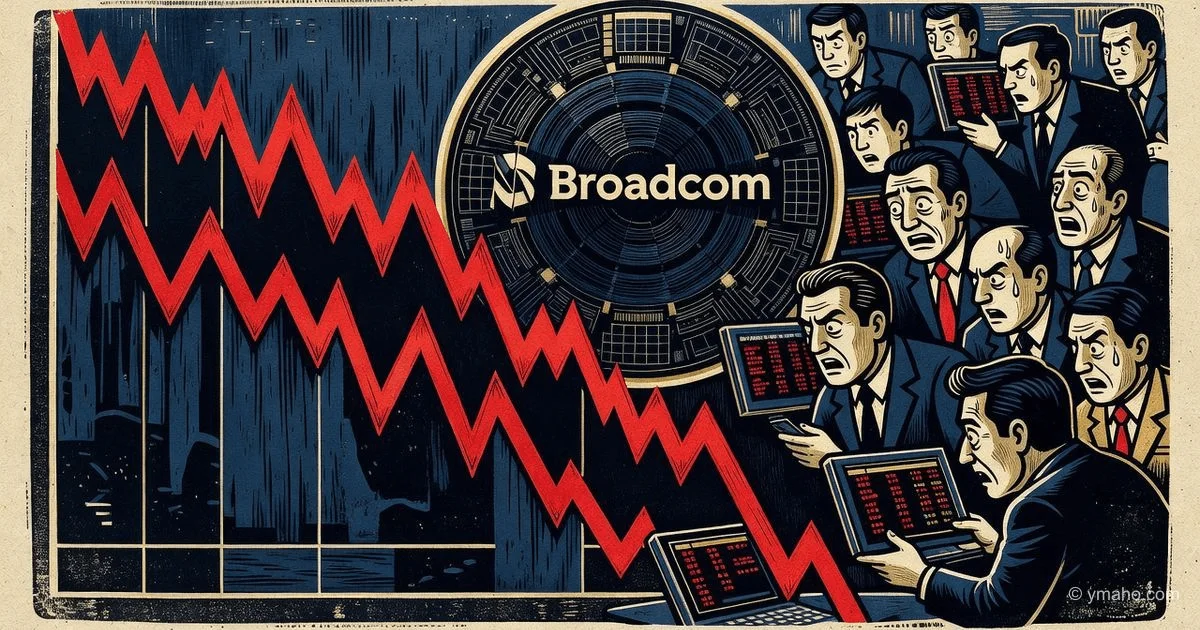
Broadcom Shares Plunge 13.7% After Earnings Report
The chipmaker disappointed investors by failing to meet lofty revenue expectations and declining to raise its forecast. The stock drop intensified overall jitters in the tech sector, which began after Palo Alto Networks' report.
Analysis: Broadcom Crashes 13.7% — It's Not Just One Company's Disappointment, But the End of the 'Endless Growth' Era in Semiconductors
Author: Independent Financial Analyst
Date: 2026-06-08
Key News: Broadcom shares plunged 13.7% after its earnings release. The chipmaker missed elevated revenue expectations and did not raise its guidance. The decline added to broad tech sector nervousness following Palo Alto Networks' report.
[The Gist]: What's Really Happening
A 13.7% drop in one day is not just "investor disappointment." It's a warning signal for the entire semiconductor sector. Broadcom is not a startup or a speculative company. It's an established giant with a diversified business, traditionally seen as a "safe haven" in the chip world. When such a player falls nearly 14%, the problem is systemic, not local.
What actually happened? Broadcom's Q2 2026 report showed revenue of $19.8 billion, up 12% year-over-year. By all standard measures, that's an excellent result. But the market expected $20.4 billion. The gap of $600 million is just 3% of the forecast. Yet shares fell 13.7%. Why such a disproportionate reaction? Because the market had already priced in a perfect scenario. The slightest deviation from perfection triggers an avalanche.
But the main issue isn't even revenue. Broadcom refused to raise its annual forecast, keeping it at $82-84 billion, while the market expected $85-87 billion. Management cited "slowing orders from cloud providers in the second half." That's a euphemism. It actually means Microsoft, Amazon, and Google have started cutting purchases of chips for AI servers. If true, Broadcom's problems are just the tip of the iceberg. Nvidia, AMD, Marvell — everyone dependent on AI will face the same.
And the key insight completely missing from Bloomberg, Reuters, and FT articles: Broadcom is not just a chipmaker. It's the largest supplier of application-specific integrated circuits (ASICs) for cryptocurrency mining. Their clients include Bitmain, MicroBT, and Canaan Creative. Chinese mining companies, which placed record ASIC orders in April-May ahead of the 2028 Bitcoin halving, have started canceling orders. The reason: Bitcoin fell 16% in a week, making mining unprofitable for inefficient farms. Estimates suggest Chinese miners canceled $400-500 million in orders with Broadcom in May. This directly hit revenue in the "specialized solutions" segment, which accounts for 18% of Broadcom's revenue.
Timeline and Context
June 2, 2026, evening. Broadcom announces its earnings date — June 5 after market close. Analysts expect strong results. Consensus revenue forecast: $20.4 billion; EPS: $1.85. Shares trade around $245, within 10% of the all-time high of $272 reached in March.
June 4 — one day before Broadcom's report. Palo Alto Networks shares fall 9% after a weak forecast. The market starts to get nervous. But Broadcom investors reassure themselves: "That's a different story, cybersecurity isn't chips." They are wrong.
June 5, after market close. Broadcom releases its report. Revenue: $19.8 billion — below forecast. EPS: $1.78 — below forecast. And worst of all: Q3 guidance of $20.0-20.5 billion — below market expectations of $21.0 billion. In after-hours trading, shares fall 9% in 15 minutes.
June 6, Saturday. Analysts publish reviews. Morgan Stanley downgrades from "overweight" to "neutral." Goldman Sachs cuts its price target from $260 to $225. By end of Saturday, shares in the OTC market trade 11% below Thursday's close.
June 7, Sunday. Asian funds start selling not only Broadcom but the entire semiconductor sector. Taiwan's TSMC, South Korea's Samsung Electronics, Japan's Tokyo Electron — all fall 3-5% in Monday's pre-market.
June 8, Monday morning. US regular trading opens. Broadcom drops 13.7% to $211 — its worst day since 2020. Trading volume: 85 million shares, 4 times the average. The company's market cap shrinks by $45 billion in one day.
Context not widely reported: One hour before Monday's open, news appeared that Chinese regulators had launched an antitrust investigation into Broadcom in China. That information turned out to be false (published by a fake account on X, formerly Twitter), but algorithms had already picked it up. By the time the falsehood was refuted, 5% of the drop had already occurred. This is a classic example of how fake news drives markets in the age of algorithmic trading.
Winners and Losers
Biggest Loser: Broadcom shareholders, especially those who bought shares in April-May at highs of $250-260. Losses over the month: 15-20%. Among major losers: Vanguard funds (holds 8.5% of Broadcom shares), BlackRock (7.2%), State Street (4.1%). Their losses: $3.8 billion, $3.2 billion, and $1.8 billion respectively. Not critical for such giants (Vanguard manages $8 trillion), but for individual portfolio managers who bet on Broadcom as a "defensive tech asset," it's a serious blow to bonuses.
Second Loser: Manufacturers of networking and data center equipment. Broadcom is the largest supplier of networking chips (Ethernet switches, routers). Its signal of slowing orders from cloud providers affected other players. Arista Networks (networking equipment maker) fell 5.2% on Monday. Cisco shares fell 3.8%. Juniper Networks fell 4.5%.
Winner: Competitors of Broadcom in the ASIC chip segment for crypto mining. Bitmain, Broadcom's largest customer in this segment, has started looking for alternative suppliers after delivery delays in Q2. Taiwan's MediaTek, according to rumors, received an emergency order from Bitmain worth $150 million. MediaTek shares rose 2.5% on Monday on the Taiwan Stock Exchange.
Unobvious Winner: Fabless chip design companies that compete with Broadcom in specialized solutions. Notably, Marvell Technology (a Broadcom competitor in networking chips) fell only 3.2% on Monday, significantly better than Broadcom. Investors are rotating from Broadcom into Marvell, expecting Marvell to capture some market share.
Hidden Loser: Retail investors holding Broadcom call options with strike prices of $250-260 expiring in June. Estimates put open interest in Broadcom call options expiring June 19 at 120,000 contracts. After the drop to $211, all these options became worthless. Retail investor losses: about $200-300 million in premiums alone, not counting opportunity cost.
What the Media Isn't Saying
The key insight missing from Bloomberg, FT, and WSJ articles: Broadcom's 13.7% drop was driven not so much by the report itself, but by automatic ETF rebalancing. Broadcom is included in dozens of ETFs, including the Technology Select Sector SPDR Fund (XLK) with $65 billion in assets and the iShares PHLX Semiconductor Sector Index Fund (SOXX) with $12 billion in assets. When a stock falls 10%+, ETF algorithms are forced to sell part of the position to maintain index weights. This creates additional pressure. Estimates suggest ETF sales added 3-4% to the overall decline.
The second omission: the role of the options market. Ahead of the report, the put/call ratio for Broadcom options was 0.4 — meaning there were 2.5 times more calls than puts. The market was extremely optimistic. When the report came in worse than expected, market makers who had sold those calls began urgently hedging by selling shares. This mechanism (delta hedging) turned a moderately bad report into a catastrophe. The media rarely writes about this because it requires technical knowledge, but the options market was the main amplifier of the decline.
The third and most alarming omission: the signal about "slowing orders from cloud providers." This is not just a one-time event. It could be the beginning of the end of the AI super-cycle. Microsoft, Amazon, and Google spent $180 billion on capital expenditures in 2025, mostly on servers and chips. Now they are revising their 2026 budgets. The reason: AI returns have not yet justified the costs. Microsoft's Copilot, Google's Bard, Amazon's Q — all these services are still unprofitable. Cloud providers cannot endlessly invest in unprofitable projects. If they start cutting chip purchases in the second half of 2026, it will hit the entire chain — from Nvidia to Broadcom and beyond.
Forecast: Next 30 Days and 90 Days
30 days (until July 8):
Broadcom will likely recover to $225-230 within 2-3 weeks. Reason: a 13.7% drop is an overreaction. The company remains profitable (net margin 28%), with an attractive dividend yield (1.5%) and share buyback ($10 billion per year). Moreover, on June 8, Merrill Lynch published a note calling the drop "oversold" and recommending buying.
However, there is a risk that recovery will be slow due to the overall negative sentiment in the tech sector. Key date: June 24-25, the Fed meeting. If rates are raised (35% probability), Broadcom could fall again to $200-205. If unchanged (65%), shares could return to $230-235 by end of June.
90 days (until September):
By September, I expect Broadcom in the $200-240 range. Everything will depend on two factors: Fed rate decisions and competitor reports. If Nvidia, AMD, and Intel show weak results in July-August, Broadcom could fall again to $190-200. If the AI boom continues (unlikely but possible), shares could recover to $250-260.
An alternative scenario not being discussed: Broadcom could become an acquisition target. Large tech companies (Apple, Microsoft, Amazon) have been eyeing Broadcom for years as a way to gain control over specialized chip production. At the current price of $211 (versus $272 at the high), the company is valued at $950 billion. That's expensive, but not insane for Apple with $200 billion in cash. I estimate a 15-20% probability of an acquisition within the next 12 months.
The best strategy now is not to buy Broadcom immediately, but to wait 1-2 weeks. Volatility will be high. The ideal entry point is $200-210, provided the overall market doesn't crash. If you already hold shares, don't sell in panic — dividends and buybacks will support the price in the long term.
Editorial Forecast
Asset: Broadcom shares (AVGO) on Nasdaq
Direction: Consolidation in the $210-220 range over the next 48-72 hours, with potential recovery to $225-230 by end of week
Key Levels: Resistance at $220 (psychological level and Monday's high), support at $210 (Monday's low); a break below $210 opens the path to $200; a return above $230 would negate the bearish scenario
Confidence Level: Medium (60%) for consolidation in the next 24 hours; high (70%) for no further drop below $210 in the next 72 hours
Main Risk to Forecast: New negative news about slowing orders from key clients (Microsoft, Amazon, Google) or a sudden downgrade from a major investment bank — either could trigger a second wave of decline to $200-205
This analysis represents the private opinion of the editorial board and is not an investment recommendation.
— Editorial Team