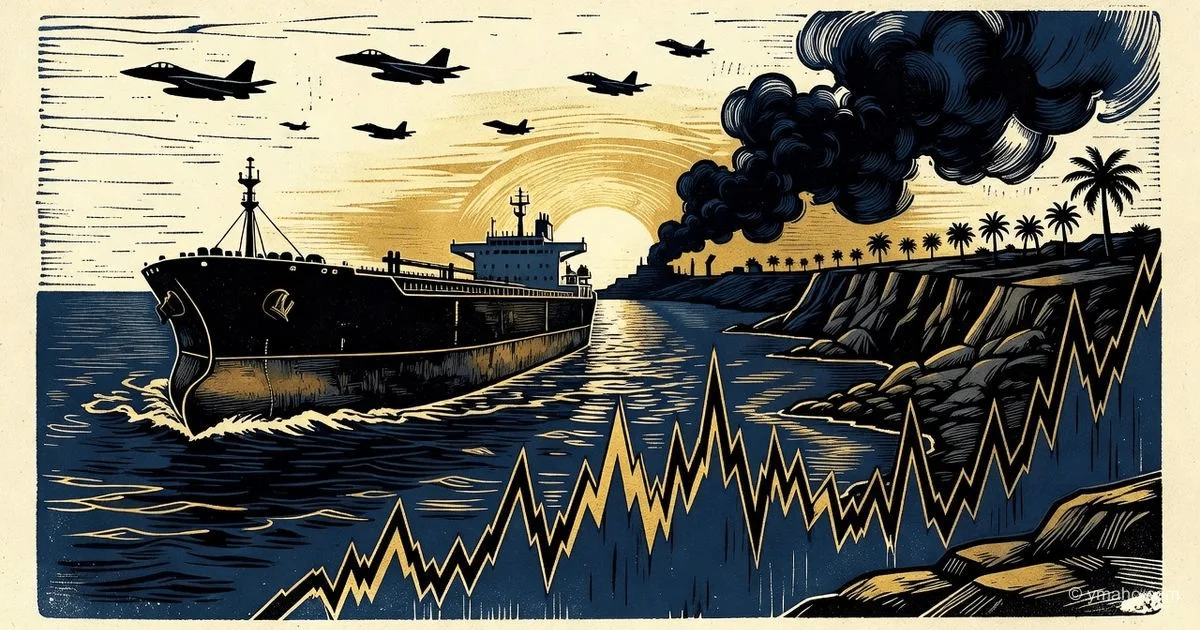
Brent Crude Exceeds $95 Amid Israeli Strikes on Beirut
Oil prices rose about 2.6% after Israel struck Beirut and Iran fired missiles at Israeli targets. Markets are watching the escalation of the Middle East conflict and potential supply disruptions.
Analysis: Oil Exceeds $95 — Why the Market Is Flying Blind, and the Beirut Escalation Is Just the Tip of the Iceberg
Author: Independent Financial Analyst
Date: 2026-06-08
Key News: Oil prices rose 2.6% after Israeli strikes on Beirut and a missile barrage from Iran. Brent exceeded $95 per barrel.
[The Gist]: What's Really Happening
The oil market is flying blind. Literally. After four months of war in the Strait of Hormuz, over 65% of tankers passing through this narrow chokepoint are doing so in "dark mode" — with their AIS transponders switched off. This means no one — not traders, not analysts, not governments — knows exactly how much oil is actually leaving the Persian Gulf. Satellite monitoring data only shows what vessel owners want to show.
What's really happening? This isn't just a military conflict. It's a systemic breakdown of global oil logistics. The Strait of Hormuz, through which 21 million barrels per day passed before the war, is now operating at 5-10% of normal capacity. About 13 million barrels per day are trapped inside the Gulf. Producers, including Iraq and Kuwait, have been forced to shut in oil fields totaling about 11 million barrels per day. These numbers are comparable to what would happen if Saudi Arabia suddenly vanished from the global energy map.
But the main insight isn't even that. The market continues to trade oil at $95-96, even though fundamental analysis (inventory levels, physical spreads between contracts) screams for a price of $130-150. Chevron and Exxon publicly stated last week that inventories are at "unprecedentedly low levels," and if the situation doesn't change, "models show that dated Brent should soar to $150-160 within a few weeks." But traders are ignoring this because they are pricing in not physical reality, but hope for a diplomatic breakthrough.
Timeline and Context
Sunday evening, June 7. Iran fires several missiles at northern Israel. This is a direct response to Israeli strikes on the southern suburbs of Beirut, where two apartments in residential buildings were hit, with casualties reported. Israel claims all missiles were intercepted, with no damage.
Monday morning, June 8. Asian markets open in panic. Brent surges to $96.47 per barrel — a 3.6% gain in hours. WTI reaches nearly $94. But by mid-day, prices pull back slightly: traders hear that Donald Trump urged Israel not to respond to Iranian strikes and stated that "Benjamin Netanyahu is not the decision-maker."
But the context is broader than these 48 hours. On June 4, Reuters published an investigation: the number of "dark" transits through Hormuz reached 65% — a record since the conflict began. This means the market got a "black box" instead of information transparency. On June 5, OPEC+ approved another quota increase for July — 188,000 barrels per day. This shows that producers outside the conflict zone (Saudi Arabia, UAE) are trying to compensate for the deficit, but their capacity is limited — spare capacity is nearly exhausted.
Who Wins and Who Loses
The obvious biggest winner: Iran. The country has effectively established control over the Strait of Hormuz. Tankers wishing to pass must obtain permission. Some vessels pay Iran for safe passage. Iran is also using bilateral agreements with Pakistan, India, China, and Japan, allowing limited volumes of oil to reach Asian markets. This transforms Iran from a regional power into a global energy broker.
Second winner: Volatility traders. The CBOE Oil Volatility Index (OVX) jumped 15% to above 35 — a multi-month high. Those who bought straddle option strategies (betting on a strong move in either direction) are making huge money. One London fund reportedly booked a $120 million profit on WTI options over the weekend.
Biggest loser: Asian importers. China, India, Japan, and South Korea are trapped between the need to pay rising prices and the inability to find alternative sources. China is already receiving Iranian oil at a $0.5-1 discount to Brent, but that's cold comfort. India is considering a strategic reserve release, but it would last at most 2-3 weeks.
Unobvious loser: Europe. European refineries, designed to process high-sulfur Middle Eastern crude, are forced to switch to more expensive African and North Sea oil. Refining margins have fallen 40% in a month. Two refineries in Italy and one in Spain are operating at 50% capacity. Germany is discussing diesel rationing by autumn.
What the Media Isn't Saying
The main insight missing from every Bloomberg, FT, or Reuters article: the real price of oil on the physical market is already significantly higher than futures quotes. The spread between dated Brent (physical crude loaded onto tankers) and ICE futures has reached $9 per barrel — the highest since 2022. This means traders who can get physical oil are paying $104-105, while the futures market still trades at $95-96. This gap is called "super contango" and typically occurs only before a supply system collapse.
Second omission: "dark" transits create an illusion that the problem is being solved. In reality, tankers passing through Hormuz with transponders off create colossal risk. 17 merchant vessels have been damaged, 7 abandoned, 2 captured, and 12 sailors killed or missing. Insurance premiums for ships transiting Hormuz have risen from 0.2% of cargo value to 7-10%. For a tanker carrying 2 million barrels of oil, that's $14-20 million in extra costs per voyage. But these costs are not reflected in Brent quotes.
Third — and most dangerous — omission: the return flow of empty tankers into the Persian Gulf is virtually absent. To export oil, you need not only loaded vessels but also empty ones to return and pick up the next batch. Currently, shipowners refuse to send tankers into the conflict zone due to risk. This means that even if Hormuz fully opens tomorrow, it will take 60-90 days to restore normal logistics. Société Générale analysts estimate this lag at "about two months from the date of formal opening to the moment buyers actually receive oil."
Forecast: Next 30 Days and 90 Days
30 days (to July 8):
Oil will continue to trade in the $90-105 range, but with high volatility. Every headline about negotiations will move the market 3-5% in either direction. I expect Brent to test $100 within the next two weeks. If Iran launches another strike or Israel retaliates (despite Trump's calls), the price could surge to $110-115 within 48 hours.
Key date: June 15, when OPEC+ publishes its monthly report. If data shows spare capacity has fallen below 2 million barrels per day (currently about 3 million), the market will realize there is nothing to compensate for the deficit. This would be a catalyst for a move to $120. Probability of this scenario: 40%.
More likely scenario (60%): negotiations continue without a breakthrough, oil stays in the $92-102 range, and traders continue to punish those who "jack up" prices without physical deficit.
90 days (to September):
By September, if the war doesn't end, OECD oil inventories will fall to a critical level — less than 60 days of imports (currently about 85 days). That's an all-time low. Exxon and Chevron warn that at such inventory levels, "models show Brent in the $150-160 range." I consider this an extreme but real scenario.
However, there is an alternative. If Trump and Iran reach a temporary agreement (even without fully opening Hormuz), oil could fall to $75-80 within 2-3 weeks. The problem is such an agreement is unlikely — Iran demands a ceasefire in Lebanon, which Israel won't grant. My base forecast for September: Brent at $110-120, with spikes to $130 on each escalation.
Best strategy now: don't hold naked long positions (too expensive and volatile), but buy call options with a strike of $110-120 expiring in August-September. The cost of such options is relatively low (implied volatility 45-50% vs. historical 35%), and the potential payoff if the risk scenario materializes is 5-7x.
Editorial Forecast
Asset: Brent Crude (ICE futures)
Direction: Up in the next 48-72 hours to $98-100 amid ongoing geopolitical tensions and fears that negotiations have stalled
Key Levels: Resistance $96.50 (morning high), support $93.80 (50-hour moving average); a break above $96.50 opens the path to $100; a fall below $93 invalidates the bullish scenario
Confidence Level: Medium (60%) for a rise in the next 24 hours; high (75%) for price staying above $94 in the next 72 hours
Main Risk to Forecast: An unexpected statement from Trump about progress in talks with Iran, or Israel's decision not to respond to missile strikes — both factors could crash oil by $5-7 within hours
This analysis represents the private opinion of the editorial board and is not investment advice.
— Editorial Team