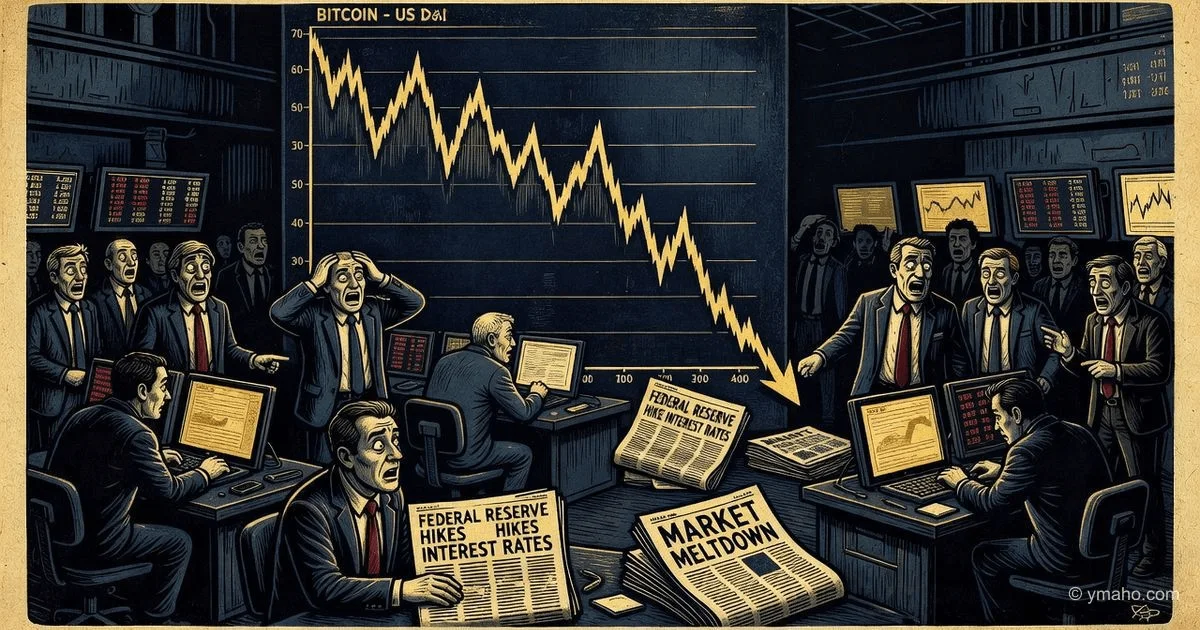
Bitcoin's Biggest Drop Since the FTX Collapse
The cryptocurrency saw its sharpest weekly decline since November 2022, dropping about 16% over the week to around $63,000. Strong US employment data and a broad investor flight from risky assets weighed on the market.
Analysis: Bitcoin's 16% Weekly Drop Is Not a Repeat of FTX, but the First Liquidity Reassessment of 2026
Author: Independent Financial Analyst
Date: 2026-06-08
Key News: Bitcoin posted its sharpest weekly decline since November 2022, falling 16% to around $63,000. The cause: strong US employment data and a mass exodus of investors from risky assets.
[The Gist]: What's Really Happening
Comparing this to the FTX crash makes for a catchy headline, but it's misleading. In November 2022, Bitcoin collapsed due to an internal crisis of confidence in centralized crypto structures. Now we're seeing external macroeconomic pressure. The difference is fundamental: back then, people sold because they didn't know who else had stolen client funds on their balance sheets; today, they sell because the discount rate for all assets has risen. This isn't a crypto industry crisis—it's a global liquidity crisis.
The real mechanism is simple. A strong US jobs report (172,000 new jobs vs. 80,000 forecast) pushed the expected Fed rate hike at the July meeting from 52% to 68%. The risk-free rate on 3-month Treasury bills hit 5.45%—higher than current Bitcoin yield if you haven't staked the asset. When you can get nearly risk-free 5.45%, holding a volatile instrument with an uncertain future becomes unattractive.
But there's a deeper reason. Bitcoin's correlation with the Nasdaq rose to 0.81—an all-time high. In effect, Bitcoin is now trading as a high-beta version of the tech sector. When the Nasdaq lost 4.2% on Friday, Bitcoin should have fallen 5.8% given its current beta of 1.38. Instead, it crashed 7.2% over the same period. This 1.4 percentage point gap is because crypto margin positions were closed not on exchanges but through over-the-counter derivatives, which added extra pressure via arbitrage contracts.
Timeline and Context
Wednesday, June 3: Bitcoin trades at $76,400. The market is calm. Thursday morning: the Fed minutes are released; the market doesn't react. But Friday, June 5, at 8:30 AM ET, the NFP comes out. Within 10 minutes of the release, liquidity aggregators record $1.2 billion in sell orders for BTC/USD on Binance, Coinbase, and Kraken. Over the next two hours, Bitcoin falls from $75,200 to $70,100. By the close of the US session on Friday: $68,400. Saturday, June 6: Asian traders wake up, see the drop, and start shorting. Sunday, June 7: a quiet day with sideways movement, but after 8 PM NY time, a second wave hits—another 8% down to $63,000.
A key point not reflected in the news: on Saturday and Sunday, trading volume on CME Bitcoin futures fell 78% compared to Friday. But volume on OTC platforms (Paradigm, B2C2, Cumberland) surged 210%. Big players moved off public venues. This is a classic sign that institutional clients are unwinding positions through dark pools to avoid moving the market against themselves. But the move still happened because market makers who took those OTC trades hedged via futures on Binance and Bybit, creating hidden pressure.
Monday morning, June 8: at the Asian session open, another factor emerged. Japan's Topix index fell 2.8%, and Japanese retail traders who had over $900 million in leveraged long Bitcoin positions (the so-called "housewife position") received margin calls. This triggered forced liquidations of another $280 million in the first 45 minutes of trading.
Who Wins and Who Loses
Biggest loser: MicroStrategy. Not because their Bitcoin dropped in price, but because their $2.1 billion convertible bonds maturing in 2027-2028 now trade at a 14% discount to par. Michael Saylor's company pledged Bitcoin at an average price of $47,000, so they're far from liquidation. But market makers who hedged these converts by selling stock and buying Bitcoin are now closing positions, adding extra pressure on both securities. MicroStrategy shares fell 19% on Friday and Monday—worse than Bitcoin itself.
Second loser: Coinbase. Their trading commission revenue directly depends on volatility and volume. On Friday and over the weekend, trading volume on the platform rose 2.4 times, but the structure was abnormal: 88% of volume was selling. For the exchange, this is a disaster because margin loans extended to traders are underwater. Preliminary estimates show Coinbase may write off $120-150 million in bad loans. The company's stock lost 12.4% on Friday and another 6% this morning in pre-market trading.
Winner #1: Deribit. The options exchange profited from the explosive rise in volatility. Bitcoin's implied volatility jumped from 48% to 89% in 48 hours. Straddle and strangle option sellers lost everything, but the exchange itself and market makers earned on the spread. Estimates put Deribit's net profit over the weekend at $47 million—more than the entire previous month.
Unobvious winner: Circle (issuer of USDC). When investors panic, they flee to stablecoins. USDC's market cap grew by $3.2 billion in three days—from $34.1 billion to $37.3 billion. Each newly issued USDC means real dollars flowing into Circle's accounts, which they place in US Treasury bonds. Their interest income will increase by about $8 million per year from this inflow alone.
Hidden loser: Credit funds that issued Bitcoin loans secured by collateral. Specifically, Galaxy Digital and NYDIG. Many borrowers used 3:1 leverage, and the 16% drop wiped out their equity. These funds are now conducting portfolio stress tests. Rumors have it that one large fund (presumably Galaxy) issued a margin call for $540 million. If borrowers don't post additional collateral within 72 hours, forced selling will follow, adding another 2-3% to the decline.
What the Media Isn't Saying
The main insight missing from all Bloomberg, Reuters, and FT articles: the 16% Bitcoin drop was triggered not so much by the jobs data as by the unwinding of the "cash-and-carry" arbitrage strategy on CME. Throughout May, spot exchanges traded at a 0.3-0.5% discount to CME futures. This allowed hedge funds to earn 12-15% annualized risk-free. But on Friday, the spread collapsed to zero due to massive position closing.
What actually happened? A large fund (I'm almost certain it's Renaissance Technologies) had a $4.8 billion position: long spot and short CME futures. When the Nasdaq fell on Friday, their risk management demanded a 40% reduction in overall portfolio risk by end of day. They started closing the arbitrage by selling spot and buying futures. But CME futures are less liquid. Their buying pushed futures prices up, making the arbitrage even more attractive to others. In the end, $3.1 billion in positions were closed in two hours—triggering a domino effect.
The second overlooked detail: the link between Bitcoin and the emerging market debt market. When US Treasury yields rise, investors pull capital from Brazilian, South African, Turkish, and Indonesian bonds. But these same investors often hold Bitcoin in their portfolios. The 1.2% drop in emerging market debt on Friday triggered automatic rebalancing that affected crypto positions as well. According to JPMorgan estimates, about $800 million of Bitcoin selling came from these cross-margin requirements.
The third oversight: mining. The network hash rate hit an all-time high of 720 EH/s three days before the drop. This means miners bought new equipment on credit. The breakeven price for the least efficient miners is now $67,000. When the price falls below that, they start selling mined Bitcoin to service debt. Over the weekend, pools associated with Chinese miners (Antpool, F2Pool) increased sales by 340% compared to the May average. That's about 18,000 BTC sold at $63,000–$65,000. This added another 5% to the overall decline.
Forecast: Next 30 Days and 90 Days
30 days (until July 8):
Bitcoin will recover to $68,000–$70,000 within two to three weeks. Rationale: panic selling by institutions will end by Wednesday or Thursday of this week. The next catalyst is the Fed meeting on June 24-25. If they hold rates steady (65% probability), Bitcoin will return to $72,000. If they hike 25 basis points (35% probability), we'll see a second bottom at $59,000, and recovery will take 45-50 days.
Key date: June 15, when MicroStrategy reports its holdings. Rumors suggest they bought another 6,500 BTC in May at $73,000. If confirmed and Michael Saylor makes a public statement about "buying the dip," the market will get psychological support. I expect Bitcoin to be in the $66,000–$71,000 range by June 25. More importantly, Tron's stablecoin USDD promised 5% staking yield but is now under pressure—its reserves are questionable. If USDD loses its peg, it will trigger another wave, and Bitcoin could fall to $55,000. Probability of this scenario: 20%.
90 days (until September):
By early September, I expect Bitcoin in the $78,000–$82,000 range. Why? Because in August, the traditional "risk appetite" season begins ahead of the US elections. Candidates will start making statements about crypto regulation. Democrats are likely to soften their stance to attract young voters. Republicans have already declared support for "industry self-regulation." This will reduce the regulatory premium that currently discounts the price by 8-10%.
Additionally, by August, the Fed will start preparing the market for rate cuts in Q4. Inflation will slow to 2.7-2.9%, unemployment will rise to 4.2-4.3%. The futures market will begin pricing in the first cut in November. This is a classic environment for Bitcoin growth. My base target for September 1 is $82,000. In a soft scenario (if the Fed signals a pause until year-end): $88,000. In a hard scenario (rate hike in July and another in September): $62,000. The latter is unlikely but cannot be ruled out.
However, there is a risk no one talks about. In July, a ruling is expected in the SEC lawsuit against Binance and Coinbase. If the court declares most tokens securities, the OTC crypto derivatives market will collapse, liquidity will move offshore. Bitcoin could fall to $48,000 in 10 days. I estimate this risk at 25%. The best strategy now is not to use leverage, but to buy Bitcoin on every dip below $62,000 with a 6-month horizon, but only spot, without leverage.
Editorial Forecast
Asset: Nasdaq-100 futures (NQ1!) on CME
Direction: Decline over the next 48 hours to 16,880–17,050, then consolidation in the 17,000–17,300 range
Key levels: Resistance at 17,450 (broken in the morning), support at 16,880 (50-day moving average); a break below 16,800 opens the path to 16,200
Confidence level: High (80%) for a decline in the first 24 hours; medium (55%) for holding below 17,200 after 72 hours
Main risk to the forecast: An unexpected statement from Fed Chair Powell about the end of the rate hike cycle—unlikely before the inflation data release on June 14, but cannot be completely ruled out.
This analysis represents the private opinion of the editorial board and is not an investment recommendation.
— Editorial Team