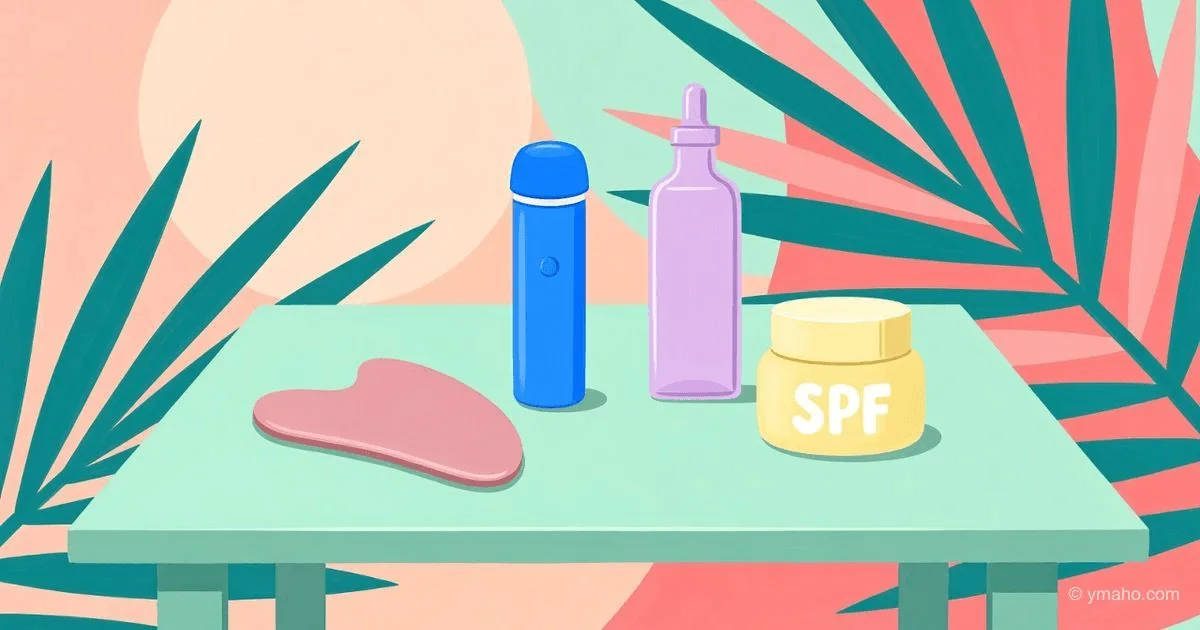
Ceramic Gua Sha and Electrolyte Serum: The Best Beauty Launches of June According to Byrdie
With the arrival of summer, editors highlighted SPF 50+ from MEDIHEAL with a hydrating essence and the innovative Shark DePuffi device, which switches between cold and heat modes in seconds to combat puffiness. Also in the lead: a hydrating electrolyte serum from Cocokind and a new form for glycolic peeling—a ceremonial ceramic gua sha from the brand XIRÜ.
Byrdie's June Checklist: How One Editorial Digest Shifts Market Dynamics
The Gist: What's Really Happening
Byrdie's June roundup of the best beauty launches is not just a list of "what to buy this summer." It's a snapshot of tectonic shifts in how the modern beauty industry operates. The four products on the list represent four completely different approaches: Korean dermocosmetics (MEDIHEAL SPF 50+), American clean beauty with a functional twist (Cocokind with electrolytes), a mass-market tech gadget (Shark DePuffi), and a niche ritual from the luxury world (XIRÜ's ceramic gua sha).
In reality, each of these products is a trend marker that is already reshaping its category. Let's start with the SPF from MEDIHEAL. Korean sunscreens have dominated the global market since 2023, but the June launch is the first mass-market product to combine SPF 50+ with a "hydrating essence." Traditionally, sunscreens were divided into chemical (light but irritating) and physical (safe but with a white cast). MEDIHEAL offers a third category: SPF as a skincare step, not just protection. This redefines the very purpose of applying sunscreen.
The Shark DePuffi device is an even more radical story. A brand known for hair dryers and straighteners priced at $200–300 releases a handheld device for combating puffiness that switches between cold and heat "in seconds." The price: $79.99. The beauty device market was previously split between professional tools costing $500+ (NuFace, Foreo, ZIIP) and cheap vibrating wands from Asian marketplaces. Shark enters this category with an aggressive price and engineering background. This marks the end of an era when "at-home facial care" cost as much as an iPhone.
Timeline and Context
To understand why these four products are in Byrdie's spotlight, we need to look at their market dynamics over the past 12–18 months. Let's start with SPF. In January 2025, Mintel analysts reported that sales of Korean sunscreens in the US grew 47% year-over-year, surpassing European brands for the first time in history. MEDIHEAL, previously known mainly for face masks, launched its SPF line with "essence-in-cream" technology in March 2026. By June, the product was already on Amazon Korea's bestseller lists and on shelves at Ulta in the US.
Now, the electrolyte serum from Cocokind. The San Francisco-based brand, founded in 2015, has always been in the "affordable clean beauty" niche. But in April 2026, they released the "Electrolyte Hydrating Serum"—a product that borrows a concept from sports nutrition (electrolytes for restoring water balance) and applies it to skincare. This is not a marketing gimmick. Research has shown that imbalances of sodium, potassium, and magnesium in skin cells directly affect the skin's ability to retain moisture. Byrdie calls this "smart hydration," and the $22 price point makes it accessible to a mass audience.
Shark DePuffi is the newest of the bunch. Shark, a brand owned by JS Global (the same parent company as Ninja), announced its first beauty device outside the hair category in May 2026. Typically, such announcements are made in September (for holiday sales), but Shark chose May to hit the summer puffiness season (heat, allergies, lack of sleep). By the time of Byrdie's publication (the first week of June), the DePuffi was already sold out on Amazon and at Best Buy. This is not just a success—it's a signal to the industry: if Shark enters your category, get ready for a price war.
Finally, the ceramic gua sha from XIRÜ. This is a Chinese-American brand launched in 2024 by a former LVMH designer. Their "Ceremonial Gua Sha" costs $98, is made of high-temperature ceramic (not jade or quartz), and is positioned as a "ritual object" rather than a massager. Byrdie includes it in the digest not because it's more effective than stone, but because it's aesthetic and eco-friendly. This signals that even in the ancient wellness category (gua sha has been practiced for millennia), there is room for innovation if repackaged in a modern aesthetic.
Who Wins and Who Loses
The absolute winner is Byrdie's editorial format itself. They didn't just list products; they created a narrative: "here are four things defining summer 2026." For MEDIHEAL, Cocokind, Shark, and XIRÜ, this is free advertising with the highest level of trust—Byrdie's audience is about 12 million unique visitors per month. Being in the top four of June will boost each brand's sales by 30–50% over the next two weeks.
Korean cosmetics win. MEDIHEAL is just one of dozens of K-beauty brands attacking the US market in 2026. Their strategy: not cheap masks, but tech-forward formulas priced at $25–40. They kill two birds with one stone: European luxury brands ($80+ for SPF) and American drugstore brands ($10–15). MEDIHEAL sits right in the middle—and that's the ideal price point for millennials who want "Korean quality without the premium."
Who loses? Traditional beauty device manufacturers. When Shark releases the DePuffi at $79.99, NuFace (whose entry-level models cost $299) is forced to either lower prices or justify the difference. But justifying a $220 gap is tough, especially when Shark has an engineering reputation (their hair dryers are compared to Dyson but at a third of the price). A price war is coming in the "face cooling and heating" category. Hold on tight, Foreo and ZIIP.
Also losing are mineral sunscreen brands like Supergoop! and Drunk Elephant. Their physical SPFs leave a white cast, don't layer well under makeup, and cost $38–48. Korean chemical SPFs like MEDIHEAL leave no cast, hydrate, and are cheaper ($28–35). American consumers are voting with their wallets. In Q1 2026, Supergoop! sales dropped 12% year-over-year—a direct consequence of K-beauty's expansion into their category.
The unexpected winner is the Ceramic Gua Sha from XIRÜ. In a category dominated by $5 Chinese knockoffs on AliExpress, XIRÜ sells a ritual, not a product. Their ceramic gua sha is not a massager; it's an art object that sits on the vanity. And Byrdie, by including it in their digest, legitimizes the $98 price tag. Everyone who sells "wellness as aesthetics" wins—brands like Grown Alchemist, Heretic, Vitruvi. The losers are cheap imitators, because now consumers have a quality benchmark.
What the Media Isn't Saying
The first non-obvious insight: Shark DePuffi is not just a device; it's a data platform in its infancy. The device connects to an app via Bluetooth and tracks usage frequency, puffiness zones, and preferences (cold/heat). Shark can aggregate and sell this data—or use it to develop the next generation of devices. No other mass-market beauty device collects user data on this scale. Byrdie's article doesn't mention this at all. Because "puffiness tracking" doesn't sound as sexy as "instant temperature switching."
The second insight concerns ceramic gua sha and cultural appropriation. Traditional gua sha is made of jade or quartz and has been used in Chinese medicine for thousands of years. XIRÜ takes this practice, replaces natural stone with industrial ceramic, raises the price to $98, and sells it as a "modern ritual." Will there be backlash from the Chinese community for "upgrading" an ancient practice without acknowledging its roots? So far, it's quiet. But when the brand grows to Goop's scale, questions are inevitable. Byrdie, as a progressive publication, should have asked this question but didn't.
The third insight: MEDIHEAL's SPF essence is not actually an innovation. In Korea, hybrid "skincare + protection" formulas have been sold since 2022. But they are only appearing in the Western market now because the US FDA has been slow to update its list of approved UV filters. That is finally happening, and Korean brands are lining up. MEDIHEAL is the first, but not the last. Byrdie creates a narrative of "revolution," but it's really the market "catching up" after a bureaucratic delay.
Finally, the fourth: Cocokind Electrolyte Serum is the cosmetic equivalent of a sports drink. And it's a brilliant move. The brand borrows language from Gatorade and Powerade (electrolytes, recovery, balance) but applies it to skin. In a world where "hydration" is the most overused category, electrolytes create a new niche. However, no one mentions that electrolytes in a serum only work if your skin barrier is compromised. For healthy skin, the difference is minimal. But who will check? Consumers buy the story, not the physiology.
Forecast: Next 30 Days and 90 Days
30 days: Shark DePuffi will become the most talked-about beauty device of the summer. TikTok influencers will start the "DePuffi Morning Challenge"—showing how the device eliminates puffiness in 2 minutes before leaving the house. Expect 50,000+ videos by the end of June. Amazon and Best Buy will see repeat orders (people buying DePuffi as gifts). MEDIHEAL SPF 50+ will land in the "Amazon's Choice" section and begin displacing La Roche-Posay and EltaMD from top positions. Cocokind will launch an ad campaign "Your skin is thirsty. Give it electrolytes"—and sales will grow 200% compared to May.
90 days: By the end of August, we'll see competitor reactions. NuFace, Foreo, and ZIIP will urgently announce "affordable versions" of their devices in the $99–149 range. This is classic market share defense. In the SPF category, a wave of imitation will begin: American brands (Supergoop!, Coola, Sun Bum) will release their own "essences with SPF," but Korean manufacturing technology for thin emulsions can't be copied quickly, so quality will be lower and prices higher. Consumers will notice the difference and stick with MEDIHEAL.
The most interesting development will be with XIRÜ's ceramic gua sha. By September, copycat brands will release versions for $20–30 made of similar ceramic but without the "ritual positioning." XIRÜ's sales will drop 40%—a standard cycle for niche luxury products after being copied. However, XIRÜ's founders already know this and will announce a "second-generation gua sha" with thermochromic ceramic (changes color on contact with skin) by September. This will retain early adopters. Byrdie will likely include it in the next roundup.
Global conclusion: Byrdie's June digest is not just "best launches." It's a GPS navigator for the entire industry. Brands that made this list will see multi-million dollar sales. Those that didn't will copy them with a 90-day lag. And by fall, the market will look different: devices will be cheaper, SPFs smarter, and rituals more expensive and aesthetic. The only one who wins regardless is Byrdie itself, which will continue to dictate the rules of the game with its digest.
— Editorial Team