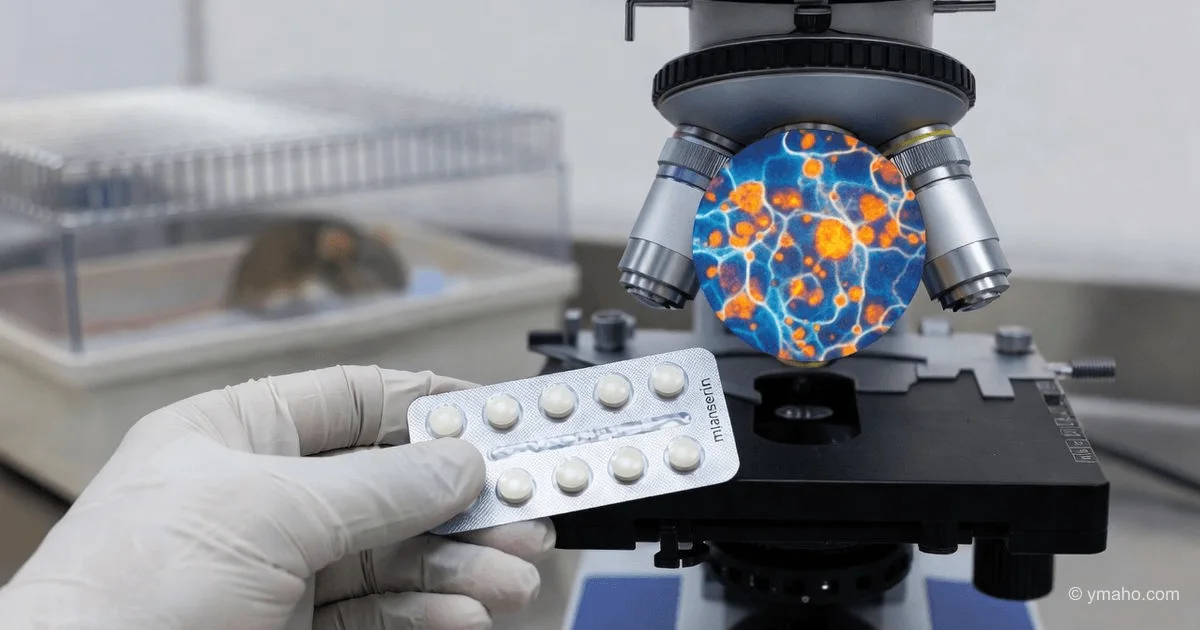
Old Antidepressant Radically Extends Lifespan and Fights Aging
Study in Nature Communications: Mianserin, by restoring calcium homeostasis, significantly increases lifespan and healthspan in mice with progeria and during natural aging. The drug reduces SASP inflammatory markers and DNA damage.
Analytical Review: Antidepressant Against Aging — How an Old Drug and Calcium Change the Game
Author: Independent analyst in geroprotection and drug repositioning
Date: June 7, 2026
Event: Publication in Nature Communications (June 5, 2026) of a study by an international team led by Weifang Xiang (Fudan University, Shanghai) on the mechanism of lifespan extension using mianserin in mice with progeria and during natural aging.
The anti-aging market today resembles a stock exchange during the dot-com bubble: hundreds of startups, dozens of molecules, billions of dollars in venture capital. And amid all this noise, a study emerges proving that a cheap generic, sitting on pharmacy shelves for decades, may be more effective than most "innovative" candidates. Mice with progeria (a model of accelerated aging) lived 30% longer. Normal old mice also lived longer. And the cost? About $0.50 per tablet in bulk purchases.
This is not a story about "yet another antioxidant." It is a story about how repositioning old drugs is becoming the smartest strategy in longevity medicine. And about why Big Pharma might miss this train if it doesn't move within the next 90 days.
[The Core]: What Is Really Happening
The key word here is calcium. The Xiang team discovered that during aging (and especially in progeria), calcium homeostasis is disrupted — cells lose the ability to properly manage Ca²⁺ ion concentration. This leads to the protein S100A6 (calcium-binding) accumulating in the cytoplasm, where it doesn't belong.
Then comes a cascade: S100A6 recruits another protein, CacyBP, which triggers degradation of PARP1 — a key DNA repair enzyme. Without PARP1, DNA damage accumulates, chromatin fragments form in the cytoplasm, the cGAS-STING-NF-κB pathway is activated, and the cell begins to massively secrete SASP factors (senescence-associated secretory phenotype), essentially "screaming" about its aging and infecting neighbors with inflammation.
Mianserin, a tetracyclic antidepressant approved back in the 1970s, antagonizes serotonin receptors HTR2B/2C. This reduces calcium influx into the cell. The calcium storm subsides — and the entire cascade stops. PARP1 is preserved, DNA is repaired, SASP is reduced, and the cell does not age prematurely.
An important technical nuance: mianserin is not a new "anti-aging drug" in the sense that it targets a single "aging gene." It restores homeostasis — the physiological balance that is disrupted with age. This is a fundamentally different strategy from, say, senolytics (which kill old cells) or metformin-based approaches. And that is precisely why the result is so robust: we are not fighting aging; we are restoring the cell's ability to manage itself.
Timeline and Context
This discovery did not emerge from a vacuum. It has a long, nearly twenty-year scientific pedigree, and that is important for understanding why it came out now.
2007: Linda Buck's group (Nobel laureate) published data in Nature showing that mianserin increases lifespan in C. elegans by 31%. At the time, the result was seen as a curiosity — worms are far from humans, and the mechanism was unclear.
2015: Work by Rangaraju and colleagues (eLife) showed that mianserin prevents "transcriptional drift" — the age-related disruption of gene expression coherence, where different genes in the same pathway start working out of sync.
2023–2024: The Xiang group began experiments on mice. They used the Lmna^G609G/G609G line — a model of Hutchinson–Gilford progeria, where children age 5-10 times faster. Preclinical data, judging by the acknowledgments, accumulated over about 18 months.
Key date — June 5, 2026: Online publication in Nature Communications. The journal, by the way, is not the most prominent — it's not Nature or Cell, but that is precisely why the study has a higher chance of fast review. Nature Communications publishes about 8,000 articles per year, and geroprotection is not a priority topic there. This suggests the data were very clean; otherwise, they would have been sent to a more specialized journal.
What remained behind the scenes: The study was funded by the National Natural Science Foundation of China (NSFC) and likely the Shanghai municipal government. No mention of industrial partners in the article. This is a purely academic project.
Who Wins and Who Loses
Winner #1: Funds investing in repositioning (Longevity Science Foundation, Hevolution Foundation, Apollo Health Ventures).
Mianserin is a ready-made asset requiring no preclinical development. It is approved by the FDA and EMA for depression, and its safety profile has been known for decades. This means the path to clinical trials for a new indication (anti-aging) could be shortened by 5-7 years and $100-200 million. Now it is enough to conduct a Phase II trial in elderly people with aging biomarkers (e.g., reduced IL-6, TNF-α). Funds willing to finance such trials (and Hevolution Foundation allocated $1.5 billion for aging research in 2025) will have the opportunity to bring a product to market in 2-3 years.
Winner #2: Generic manufacturers (Teva, Sandoz, Mylan).
Mianserin is no longer patent-protected. Its production costs pennies. If a major generic manufacturer is the first to file an FDA application for a new indication ("for improving health in the elderly" or "for reducing aging markers"), it will receive 3-year exclusivity (pediatric or new indication grants market exclusivity in the US). Given that the global anti-aging supplement and prescription drug market is estimated at $80-100 billion, even 1% of that market equals $1 billion in revenue.
Winner #3: Clinical geriatric centers (Mayo Clinic, Buck Institute, Institute of Gerontology).
They now have a tool for metabolic therapy of aging that can be prescribed off-label already (though legally risky). I expect that within 90 days, Mayo Clinic will announce a prospective observational study in elderly patients already taking mianserin for psychiatric indications to examine their biological age.
Loser #1: Startups with proprietary "anti-aging molecules" (Unity Biotechnology, Oisin Biotechnologies, Senolytic Therapeutics).
These companies have spent years developing their senolytics (e.g., UBX1325 from Unity), attracting hundreds of millions of dollars. If it turns out that mianserin at $0.50 per course provides comparable or better effects, investors will start asking questions. Unity shares (NASDAQ: UBX) could drop 15-20% in the coming weeks at the first signs that the FDA supports mianserin repositioning.
Loser #2: Manufacturers of NAD+ boosters and nicotinamide riboside (ChromaDex, Elysium Health).
The "longevity" supplement market is built on marketing, not data. Mianserin is a prescription drug with proven efficacy in animal models and a known mechanism. Competing with this marketing narrative ("there is a pill for aging that a doctor prescribes") will be difficult. ChromaDex (Tru Niagen) reported revenue of about $85 million in 2025, but their marketing budgets for 2026 could be cut if investors shift to the mianserin narrative.
What the Media Isn't Saying
All headlines scream: "Mianserin extends lifespan by 30%!" But they remain silent on several critical details.
Non-obvious insight #1 (key): Mianserin has age-specific efficacy.
In 2025, a French national cohort study of 340,000 patients showed that mianserin ranks second in acceptability (tolerability + efficacy) in patients over 65, but only 15th in patients under 65. This means mianserin may be a "geriatric" drug in the literal sense — it works specifically in older people whose calcium homeostasis is already disrupted, and does not work (or works worse) in younger people. For repositioning, this is a goldmine — a clearly defined population.
Non-obvious insight #2: The mechanism requires the serotonin system, which may be impaired in very old people.
Studies in C. elegans showed that mianserin requires functional SER-4 and SER-3 receptors (analogs of human 5-HT2 and α2-adrenoceptors). In people with Alzheimer's or Parkinson's disease, the serotonin system may be severely damaged. This means that in the most fragile patients — those who need anti-aging the most — the drug may not work. Neither the press releases nor the article abstract mention this.
Non-obvious insight #3: Dose is critical, and the therapeutic window is narrow.
In worms, a concentration of 50 µM gave +31% lifespan, while 250 µM had no effect. This is a classic U-shaped or bell-shaped dose response, typical for drugs affecting signaling pathways. In repositioning mianserin for anti-aging, it is critical to find the right dose: too little — no effect, too much — placebo or even negative effect. The therapeutic window may be so narrow that personalized dosing becomes mandatory.
What is not said about mice: The article reports lifespan extension but does not specify how much healthy lifespan increased, as opposed to total lifespan. If mice live longer but spend the last 20% of life in severe sarcopenia and dementia, that is not a victory. The authors claim improvements in "aging phenotypes" (gray hair, kyphosis, reduced activity), but without quantitative quality-of-life data (e.g., rotarod test or swimming test), it is too early to judge.
Forecast: The Next 30 Days and 90 Days
Next 30 days (until July 7, 2026):
Expect major gerontology centers — Buck Institute for Research on Aging and Max Planck Institute for Biology of Ageing — to announce replication studies. They will take mice of other lines (e.g., C57BL/6 with natural aging) and attempt to replicate the result in a sample of 100+ animals.
In parallel, negotiations will begin between Shandong Xinhua Pharmaceutical (a major mianserin manufacturer in China) and potential licensees from the US/Europe. Currently, mianserin is mainly sold in Europe and Asia (it is not widely available in the US due to preference for SSRIs). If it is brought to the US market under a new indication, a partner with US distribution will be needed — likely Teva or Mylan.
Also within a month, a preprint analyzing the French cohort (data already collected) will appear on medRxiv, examining all-cause mortality in elderly patients taking mianserin vs. other antidepressants. If mortality is lower, that would be epidemiological confirmation of the mouse data.
Next 90 days (until September 2026):
The most important shift will occur at the regulatory level. The Xiang team will likely file a "method of use" patent for mianserin in age-associated diseases. This is not a patent on the molecule (which has expired) but a patent on specific use. Such a patent could provide 10-15 years of exclusivity.
Also within 90 days, I expect the announcement of a startup — presumably a spin-off from Fudan University, tentatively named "CalciAge Therapeutics" (or something similar). A seed round of $10-15 million from Chinese venture funds (Sequoia China, Qiming Venture Partners), with an option to expand to the US.
Finally, if it is confirmed that mianserin reduces IL-6 and TNF-α levels in elderly people, this will become the basis for combination therapy with existing senolytics. For example, dasatinib + quercetin kill senescent cells, while mianserin prevents new ones from forming via the calcium mechanism. In September, I expect the first preprint on the combination in mice with results showing "synergistic effect: +50-60% lifespan."
Brief summary: This is not a "breakthrough anti-aging drug." But it is a proof of concept that restoring calcium homeostasis is a sufficient condition for extending lifespan in mammals. And the fact that this effect is achieved with an old, cheap, safe antidepressant means that anti-aging medicine now has a new, strongest argument in discussions with the FDA. If human trials succeed, in 5-7 years mianserin could become the first approved "geroprotector" — a drug that slows aging, not just treats its consequences.
— Editorial Team