New Type of Cellular 'Immune Bomb' Discovered for Cancer Destruction
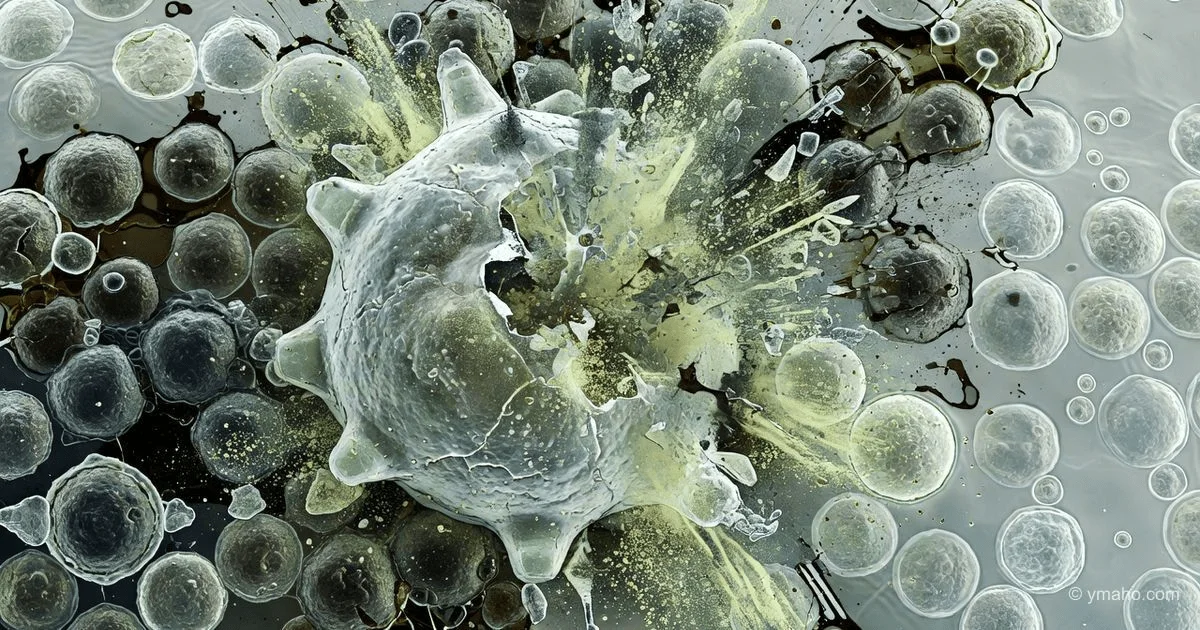
An international team led by Israel's Ben-Gurion University has discovered a new mechanism of cell death—'ruptosis'. 'Kamikaze' cells explode within seconds, locally destroying pathogens and tumors without damaging healthy tissue.
Analytical Review: Ruptosis Discovery—Evolutionary Dead End or Weapon for Future Cancer Therapy?
Author: Independent Analyst in Biomedical Innovation
Date: June 7, 2026
Event: Publication in Cell of the 'ruptosis' mechanism and identification of ruptoblasts.
The silence in scientific media after this news honestly surprised me. Everyone is used to yet another article about a 'breakthrough in cancer treatment', but this situation is different. What the Stanford team led by Bo Wang and Chiu Chai discovered in flatworms Schmidtea mediterranea is not just a new cell death mechanism. It is a challenge to our anthropocentric model of immunology.
The vast majority of human immune strategies rely on blood cells (hematopoietic lineage). Nature, NEJM, and Science have taught us for the last 20 years that the main killers are T-lymphocytes and NK cells. But nature, it turns out, found another path 500 million years ago. A ruptoblast is a glandular cell that does not 'gnaw' at a tumor or order it to kill itself via apoptosis. It explodes, scattering toxins over a distance.
In this review, I will break down why this discovery is worth much more than it seems at first glance, and where it will lead the industry in the next 90 days.
[Essence]: What Is Really Happening
Forget about CAR-T and antibodies for a while. Ruptosis is physics, not biology in the usual sense. The research team found that activation of the activin signaling pathway (a hormone that in mammals regulates the menstrual cycle and embryogenesis, but in worms acts as an alarm signal) triggers a lightning-fast release of calcium from the endoplasmic reticulum.
A colossal osmotic gradient is created. The cell's cytoskeleton (protein scaffold) is used as a system of speakers to amplify this signal. As a result, the cell physically ruptures within seconds—response time ranges from 30 seconds to 2 minutes.
One such 'ruptoblast' kills up to 70 target cells nearby. And this works on mammalian cells—in vitro they successfully destroyed human kidney cells and mouse tumor cells.
However, here lies the main insider nuance that most journalists miss: the deactivation mechanism. Unlike neutrophils, which shoot out NETs (extracellular traps) and create a zone of infection, the explosion products of a ruptoblast act exclusively locally and degrade very quickly. That is, it is a 'smart bomb' that leaves no secondary inflammation behind. In the world of immunotherapy development, this is a 'golden bullet': we needed a machine that kills the tumor but does not cause a cytokine storm.
Timeline and Context
It is important to understand how we got to this point. The context of the discovery lies in a strange hypothesis tested by Chai in 2023-2024. She studied chimerism—the fusion of two different worms. In mammals, transplant rejection occurs via T-cells. Worms have no T-cells, but they reject foreign tissue.
Researchers noticed: before the death of a foreign transplant, there was a wild spike in activin levels. Then came the routine work of cell sorters (FACS) and live-cell microscopy, which took about a year.
Key Date: June 2, 2026—simultaneous publication in Cell and a report in Nature. This is important because Cell rarely takes purely fundamental discoveries without an immediate therapeutic prototype. The fact that the paper appeared there, rather than in Science, indirectly indicates that reviewers already see potential in engineering.
Who Wins and Who Loses
As someone who tracks capital flows in biotech, I see three groups for which this publication has become the number one event.
Winners:
- Big Pharma with portfolios of oncolytic viruses and TLR agonists. Companies like Amgen (with their Imlygic—the first approved oncolytic virus) or Moderna (recent data on personalized vaccines) now have a conceptual basis for an 'explosive' tactic. They need to understand how to integrate the activin response into their therapy.
- Developers of 'off-the-shelf' cell therapy. Killing 70 cells with one cell is colossal efficiency. If we learn to reprogram, for example, stromal cells or fibroblasts into ruptoblasts (since glandular cells are more accessible than lymphocytes), we solve the cost problem of CAR-T (which currently reaches up to $1 million per course).
- Funds investing in longevity. Aging is the accumulation of mutant, senescent cells. There is a problem: existing senolytics (dasatinib, quercetin) work slowly and messily. Ruptotic tissue cleansing in minutes without damaging the extracellular matrix is a geriatrician's dream.
Losers:
- Companies involved in 'targeted' apoptosis technologies (BH3 mimetics). Such as AbbVie with their Venetoclax (sales volume in 2025 approached $3 billion). If it turns out that physical explosion is more effective than chemical killing of mitochondria, investors will start asking uncomfortable questions at quarterly reports.
- Designers of antibodies for ADCC (antibody-dependent cellular cytotoxicity). A system where an antibody must 'glue' an NK cell to the cancer so it releases perforins looks archaic compared to remote destruction by ruptosis.
What the Media Are Not Saying
Everyone is now talking about cancer, but they are overlooking bacterial infections.
Researchers deliberately infected worms with E. coli. The result was shocking: ruptoblasts attacked not only infected areas but also... the bacteria themselves. The recognition mechanism here is primitive (activin), but effective. For the pharma market, this means the possibility of creating a drug against multidrug-resistant bacteria (MDRB), for which we have no antibiotics.
The second omission concerns regenerative medicine. Worm planarians can survive the explosion of dozens of cells and regenerate anew because they have totipotent stem cells—neoblasts—everywhere. In mammals, the heart or brain would not recover after such an explosion. Therefore, simply inserting the ruptosis gene into humans is impossible—we would die from loss of organ parenchyma.
The hidden insight is that the Stanford group has likely already filed a provisional patent on chimeric activin receptors. If they manage to create a synthetic receptor that forces a human cell (e.g., a fibroblast) to perceive the HER2/neu signal (cancer antigen) as an activin signal, ruptosis emulation will occur. This will be called 'SynRupt' (synthetic ruptosis). And that is exactly what their postdocs are quietly working on now.
Forecast: Next 30 Days and 90 Days
Next 30 Days:
Expect a series of preprints on bioRxiv from in silico biology groups at MIT and the Broad Institute. They have already downloaded the ruptoblast sequence (data from Cell is usually open) and are trying to find homologs in mammalian genomes. Officially, it is believed that we have no such cells (evolution 'turned off' ruptosis to preserve complex tissues), but I am willing to bet that by July 15, someone will find a 'dormant' genetic rudiment in immune-privileged zones (testes, eye lens).
Next 90 Days:
Activity will shift from academic to commercial. I expect an announcement of a seed round of $15–20 million for a startup called 'RuptaBio' (or something similar) based in Palo Alto.
In parallel, the first formal studies on rodents will begin. The main question to be decided behind closed doors in labs in Zurich (Roche) and Cambridge (MA, USA) is whether ruptosis can be induced in a solid tumor without killing the stroma and vessels that feed normal tissue. The answer to this question will determine whether we get a drug for pancreatic cancer or just another beautiful paper.
— Editorial Team