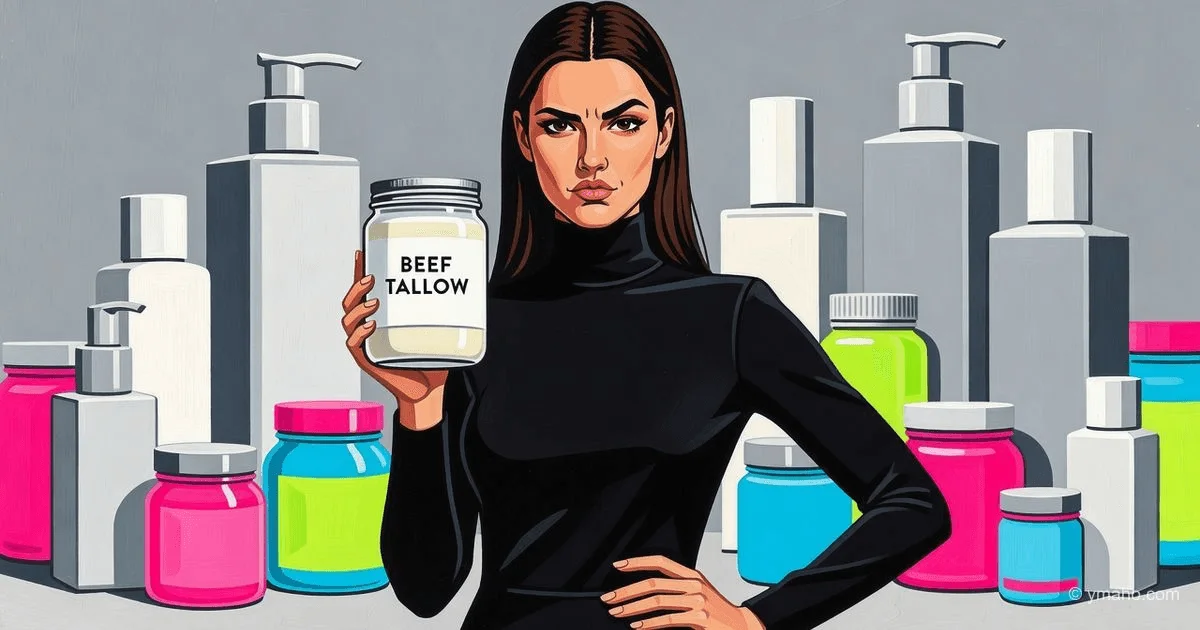
Emily Di Donato Criticizes the Beauty Industry in Byrdie Interview
The model and new Vichy ambassador urged not to chase viral ingredients, calling the rejection of treatments in favor of simplicity a "hot take." She stated she won't use beef tallow on her face and considers expensive facials unnecessary, betting on collagen and vitamin C to fight hyperpigmentation.
"Back to Basics" American Style: How Emily DiDonato Declares War on Beef Tallow and Resets the Rules of the Game
The Gist: What's Really Happening
At first glance, Emily DiDonato's interview with Byrdie is a standard story about how a model "found balance" and stopped chasing trends. But in reality, we are witnessing a rare moment when a public figure with an audience of 4.6 million openly calls nonsense what the industry is trying to sell as a "revolution." She doesn't just criticize beef tallow for the face—she questions the very logic of viral consumption in the beauty segment.
The key insight is that DiDonato is not a random influencer but a certified nutritionist and yoga instructor with 15 years of industry experience. She started her career at 17, went through the era of tanning beds and aggressive diets, and now represents the French dermocosmetic brand Vichy, which in 2026 is betting on an integrative approach to health: the connection between skin, hair, nutrition, and psycho-emotional state.
What most commentators miss: her criticism is not just a "model's opinion." It's a marker of a paradigm shift. When someone with her credentials says "I won't put beef tallow on my face," she effectively separates "folk" beauty culture (TikTok, DIY, pseudo-natural) from evidence-based dermatology. And she does this at a time when the market is flooded with brands selling slaughterhouse byproduct as an elixir of youth for $45–80 per jar.
Timeline and Context
To understand the weight of DiDonato's statements, we need to trace the chronology of the last six months. In January 2026, Vichy announced her as global brand ambassador, and this is not a random "pretty face" casting. Vichy President Vincent Chauvière directly says: "We needed someone who embodies a holistic approach. Emily is a certified nutrition coach and yoga instructor, she has 4.6 million followers, and she genuinely uses our products."
February-March 2026 become DiDonato's "collagen season." In an interview with Vogue Adria, she details her strategy: SPF 50+ daily, vitamin C, peptides, a protein-rich breakfast, collagen supplements, and a complete ban on tanning beds. She emphasizes that she's not trying to "turn back time" but to "optimize what I have now." This is a key difference from the traditional anti-aging narrative.
May 2026: the hashtag #beeftallow gathers 184,000 posts on TikTok. Brands like "The Good Trade" publish lists of "10 Best Tallow Brands of 2026." In response, dermatologists start raising alarms: there is not a single peer-reviewed study proving the effectiveness of beef tallow for the face, but there is a risk of clogged pores and bacterial infections from low-quality raw materials.
And then June 2026. The Byrdie interview, where DiDonato calls the tallow trend "not what normal skin needs" and expensive facials an excess. She bets on collagen and vitamin C to fight hyperpigmentation. And here's the main point: she doesn't just reject the trend—she offers an alternative that sells at the pharmacy for $30-50, not in an Instagram shop for $80. This is a blow to an entire segment of "natural" cosmetics built on fear of "chemicals."
Who Wins and Who Loses
Absolute winner — Vichy. The brand got not just an ambassador but someone who legitimizes their positioning in the public sphere. DiDonato doesn't just promote Liftactiv Collagen Specialist 16—she explains why collagen, vitamin C, and SPF work together, and beef tallow does not. For Vichy, which in 2026 is betting on "skin longevity," this is the perfect narrative: science versus scare tactics.
Also winning is the entire category of science-backed dermocosmetics — La Roche-Posay, CeraVe, SkinCeuticals. When a public figure with 4.6 million followers says "I choose what's proven," consumers get permission to ignore viral trends and return to trusted products. This is especially important for women aged 30-40 who are tired of 12-step routines and want simplicity.
Who's at risk? Brands built on tallow culture. Companies like "Fatco" or "Tallow Me Beauty," which sell a jar of fat for $45-80, relying on fear-mongering about "chemicals." When DiDonato says "I won't use this," her followers hear "it's not safe." And it's not just her—in April 2026, dermatologist Geeta Yadav from FACET Dermatology published an analysis calling tallow "greasy, heavy, and unpredictable in composition."
Also losing are influencers who monetize the tallow trend through affiliate links. A 2025 study showed that 82% of social media posts about beef tallow recommended its use, but dermatologists were the least likely to promote it. Risks were almost never mentioned, and scientific evidence was absent. Now that a Vichy ambassador with 4.6 million followers says "it's nonsense," trust in such bloggers collapses.
Hidden winner — pharmacy beauty retailers like Ulta and Boots. When consumers become disillusioned with viral trends, they go where they can get professional advice and buy products with proven efficacy. This is a classic "flight to quality" after a hype.
What the Media Isn't Saying
First non-obvious insight: DiDonato is not just a critic but a conduit for the new trend of "longevity without fanaticism." She doesn't call for abandoning cosmetics. She says "choose 2-3 working ingredients and use them every day." This is directly opposite to the strategy of mass-market brands that want you to buy 10 bottles. She offers minimalism, and this undermines the industry's business model built on overspending.
Second insight concerns the generational conflict in the beauty space. DiDonato is 34, a mother of two. Her audience is women 28-45 who have also become mothers and can't spend 40 minutes on skincare rituals. The tallow trend is mainly promoted by girls 18-25, who have different skin (oilier, acne-prone) and different budgets. For them, $45 for a jar of fat is an experiment. For a woman with a mortgage and two kids, it's foolishness. DiDonato articulates what her generation has long understood but was afraid to say.
Third insight — money and lobbying. No one says out loud that tallow brands are actively funded by ultra-right "MAHA" (Make America Healthy Again) movements that promote a return to "natural" as an ideology. This is not just cosmetics—it's a political statement. And when DiDonato says "I choose science," she effectively enters a cultural war where billions of dollars in the "clean" beauty market are at stake.
Finally, fourth: she risks her career. Big brands don't like their ambassadors criticizing anything publicly—it creates reputational risks. But Vichy, apparently, gave her carte blanche. And this is an incredibly smart move: in an era when consumers want authenticity, a brand that allows its ambassador to speak the truth wins trust. DiDonato says "I sleep with my husband, I have two kids, I don't drink collagen for breast firmness—I drink it to run with my kids." This isn't about youth. It's about strength and quality of life.
Forecast: Next 30 Days and 90 Days
30 days: DiDonato's statements will trigger a wave of "exposés" of the tallow trend in Western media. Magazines like Women's Health and Allure will publish pieces with headlines like "Why Beef Tallow Won't Bring Back Your Youth." Sales of tallow brands will drop 15-20% within a month—this is a standard market reaction to criticism from an authoritative voice. But the main blow will hit influencers: their affiliate agreements with tallow brands will start to be terminated because advertisers don't want to be associated with "pseudoscience." Vichy, in turn, will launch a series of educational videos with DiDonato on how collagen and vitamin C work. Their target is 10 million views on TikTok and YouTube.
90 days: By the end of summer, we will see the first lawsuits from consumers against tallow brands. Someone will get severe acne or dermatitis and prove that the brand didn't warn about risks (a classic "failure to warn" in the US). This will set a precedent, and platforms like TikTok will start labeling tallow content as "unverified information." Simultaneously, demand for "proof-based beauty"—cosmetics with clinical studies and publications in peer-reviewed journals—will grow. Brands that can show data will command a 30-40% price premium.
However, the most important shift will occur in consumer behavior. The tallow trend won't disappear entirely—it will retreat into a niche of "hardcore naturalists" who believe in pharma conspiracies. But the mass consumer will return to pharmacy brands. And here, Vichy, La Roche-Posay, and Avene have a historic chance: they can capture the 30-45 age group that finally got permission not to chase hype. DiDonato's "less is more" strategy will become mainstream. The irony is that an industry that for decades taught us to buy more will itself bury that principle—under slogans of "conscious consumption" and "scientific approach." But that's a whole other story.
— Editorial Team