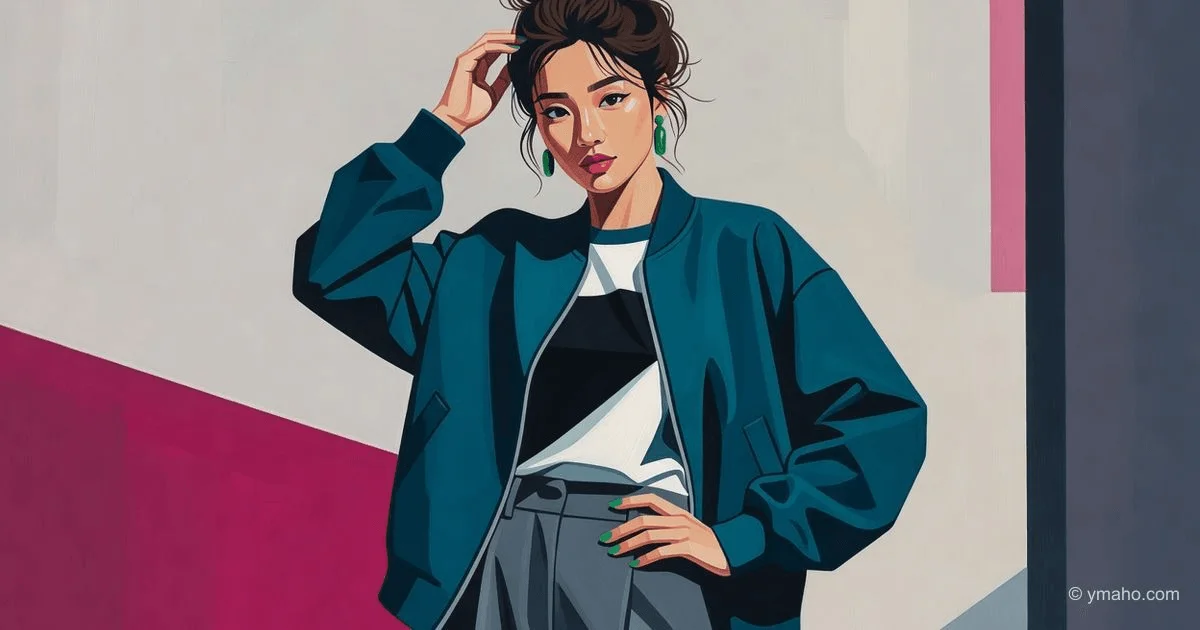
The Charismatic 'Dirty' Bun: Asian Idols Are Rewriting Hairstyling Standards
In contrast to perfectly sleek styling, Korean and Japanese lifestyle publications are seeing a surge in the aesthetic of 'deliberately messy volume' at the roots. Girls are applying texturizing sprays and dry shampoos even to clean hair to achieve a 'second-day' effect, giving their hairstyles a more relaxed and confident look.
The Charismatic 'Dirty' Bun: How Asian Idols Are Killing Perfect Hair
The Essence: What's Really Happening
At first glance, the trend of 'deliberately messy volume' at the roots is just another iteration of the effortless chic aesthetic. But in reality, we are witnessing a fundamental break from the standard of 'absolutely smooth, mirror-like shiny hair' that has been cultivated in Asia for decades. If before, Korean and Japanese girls spent hours straightening, styling, and fixing every strand, today idols and influencers consciously create a 'second-day' effect — textured volume at the roots and a slight carelessness along the length.
Key insight: This trend is not about laziness or saving time. It's about a shift in visual code. Smooth, 'slicked-down' hair in Asian culture has long been associated with discipline, control, and social conformity — from school regulations to corporate dress codes. 'Dirty' volume, on the other hand, reads as 'I decide how I look, and I don't care about your expectations.' It's a micro-rebellion packaged in a texturizing spray.
What does this mean for the industry? The market for dry shampoos and texturizing sprays in Asia, which until recently was niche (Asian hair tends to be less prone to oily roots than European hair), is skyrocketing. Brands that first adapt formulas to the heavier structure of Asian hair (and without leaving white residue on dark roots) will capture a multi-million dollar market share.
Timeline and Context
The trajectory of this trend can be traced through the evolution of Asian pop culture. 2020-2023: The era of 'clean aesthetics' — perfectly loose hair without a single stray strand, 'sun-kissed' shades. 2024: The first idols from groups like NewJeans and IVE start appearing in public with 'voluminous crowns' and slight disarray — fans are initially confused, then start copying.
March 2026: Japanese trade publications identify the 'charismatic messy bun' as a separate category in salons. Meanwhile, analysts note: searches for 'volume at roots' in Korean and Japanese search engines have increased by 40-50% over the past 6 months. Texturizing spray, previously sold only in specialty stores for stylists, appears on the shelves of Olive Young and @cosme.
June 2026 — the moment of consolidation. The trend is no longer described as an 'idol experiment' but as a stable consumer behavior. Girls consciously apply dry shampoo to clean hair — this was previously considered absurd because dry shampoo was designed to extend time between washes. Now it's a tool for creating volume and texture. Pioneer brands (e.g., Korean b:feel and Japanese &honey) launch 'volume' lines labeled 'for deliberately messy styling.'
Who Wins and Who Loses
Absolute winner — the category of texturizing hair products in Asia. Dry shampoos, salt sprays, volume powders. If before this was a 'Western' product that didn't adapt well to Asian hair (left white residue, dried it out), now local brands are releasing formulas with no visible particles and volume that lasts 8-10 hours. The market, which was modest just a year ago, is showing double-digit growth.
Winners are manufacturers of lightweight fixing products (veil sprays, zero-grease waxes). Idols demonstrate hairstyles that hold without hairspray — 'living,' moving hair, but with volume retention. This is technically challenging: polymers are needed that fix at the roots but don't stick the length together. Brands like Mise-en-Scène and Ma Cherie have already launched such products, and they are flying off the shelves.
Winners are salon stylists specializing in Asian texture cutting. The trend requires proper haircuts: volume at the roots doesn't come from nowhere; it needs to be 'built in' through layering and texturizing. 'Korean layered cut' styles are becoming the most requested in Japanese and Korean salons. The cost of such a cut ranges from JPY 8,000 to 15,000 (about $55-100) in Tokyo, with bookings weeks in advance.
Who is at risk? Manufacturers of 'classic' high-hold styling products (hairsprays, gels, mousses). Their products create 'perfect smoothness' but kill volume and movement. In the era of the 'deliberately messy bun,' lacquered styling reads as 'old-fashioned' and 'provincial.' Brands that don't restructure their portfolios will be left with products no one wants.
Losers are salons that continue to push 'Japanese straightening' (thermal reconditioning). This procedure costs $200-500 and makes hair perfectly smooth for 3-6 months. But smooth hair is the antithesis of the current trend. If you don't have natural volume and you've chemically killed it, you can't achieve the 'dirty bun.' Clients are starting to refuse straightening, and salons are losing one of their main revenue sources.
Unexpected winner — manufacturers of professional hair dryers with ionic technology. Paradox: to create 'messy' volume, you need the right tool. A cheap dryer dries and tangles hair. A good dryer with a concentrator allows you to 'lift' the roots without overheating the scalp. Sales of the Dyson Supersonic in Asia grew by 15% in the first half of 2026 — and that's no coincidence. Women are willing to pay $500 for a tool that gives them 'controlled messiness.'
What the Media Aren't Saying
First non-obvious insight: Asian hair is objectively harder to style with volume. According to a study by L'Oréal published in the European Journal of Dermatology, Asian hair (Chinese, Japanese, Korean) has the highest growth rate (average 424 micrometers per day vs. 384 for European and 308 for African hair), but the lowest density (167 hairs per square centimeter vs. 214 for Europeans). This means each hair is heavy and grows fast, but there are fewer of them. Natural volume is lacking. The 'messy' trend is not about 'letting go.' It's about 'engineering chaos' with products and tools. The irony is that creating the 'dirty' bun takes more time and money than smooth styling.
Second insight concerns cross-cultural borrowing. The trend came from the Western 'undone hair' aesthetic (looks of Jane Birkin and French girls) but adapted to Asian realities. In the West, 'messiness' often meant 'less groomed.' In Asia, it means 'groomed but without visible effort' — a huge difference. Idols don't appear in public with truly dirty hair. They use products that create the illusion of a second day. This is 'expensive messiness' — just like an oversized blazer for $1,000. The media don't talk about this because it breaks the magic.
Third insight — the dirty bun as camouflage for post-keratin hair. Keratin straightening and hair botox were super popular in Asia in 2022-2024. But these procedures have a side effect: hair becomes so smooth and heavy that it's impossible to style into a voluminous hairstyle. The trend for the 'messy bun' allowed thousands of women who regret their keratin to create the appearance of movement. Texturizing spray provides the 'grip' that slippery hair lacks. The industry is silent about this because selling one product (spray) doesn't compensate for the loss of the keratin market (course $200-400). But consumers have already voted with their wallets.
Finally, the fourth: this trend is the enemy of shampoos. If you apply dry shampoo to clean hair, you don't need to wash your hair every day. On the contrary, the trend encourages washing every 2-3 days, because volume holds better on the second day. This is a direct threat to the shampoo market, which in Asia is worth billions of dollars. Shampoo manufacturers that don't have texturizing sprays in their portfolio are losing. Those that do win twice: the consumer buys both shampoo (rarely) and spray (often). This is a redistribution of spending within the hair care category, and it's already happening.
Forecast: Next 30 Days and 90 Days
30 days: In June 2026, Korean and Japanese mass-market brands (Etude House, Canmake, Cezanne) will launch budget texturizing sprays in the $8-15 price range. Currently, market leaders are professional brands ($25-40), and democratization of the category will increase the market 2-3 times in a month. TikTok and Instagram will be flooded with tutorials on 'how to get dirty volume without dry shampoo' (folk methods: salt, baby powder, even flour). Professional stylists will start criticizing: 'salt dries the scalp,' 'powder clogs pores.' But the trend won't die from this — it will only become sharper.
90 days: By August, the first analysts will record a decline in sales of classic conditioners. Reason: texturizing sprays require 'clean' hair without silicones. Consumers are switching to silicone-free shampoos and abandoning conditioners in favor of lightweight leave-in products. This is a tectonic shift in the 'conditioning' category that will affect even global players like Pantene and Tsubaki. By the end of summer, the trend will spread to China — influencers from Shanghai and Beijing will start mass-posting photos with 'voluminous crowns.' The Asian hair care market, which a year ago was divided between 'smoothness' and 'curls,' will gain a third axis — 'controlled messiness.' And this will change the formula for success for brands for years to come.
Global conclusion: The charismatic 'dirty' bun is not about hair. It's about the right to be imperfect. In a culture where the ideal of smoothness and shine was absolute, the emergence of 'volume and texture' is permission to relax. And the fact that this permission must be bought with money only underscores its value. The most expensive product on the market today is the one that allows you to look as if you made no effort. Because true luxury is the illusion of freedom from standards. And Asian idols, with their millions of fans, have just rewritten the code of that illusion.
— Editorial Team