Limited Edition Summer Fridays Mini Balms: Sea Salt Caramel and Peach Granita Flavors
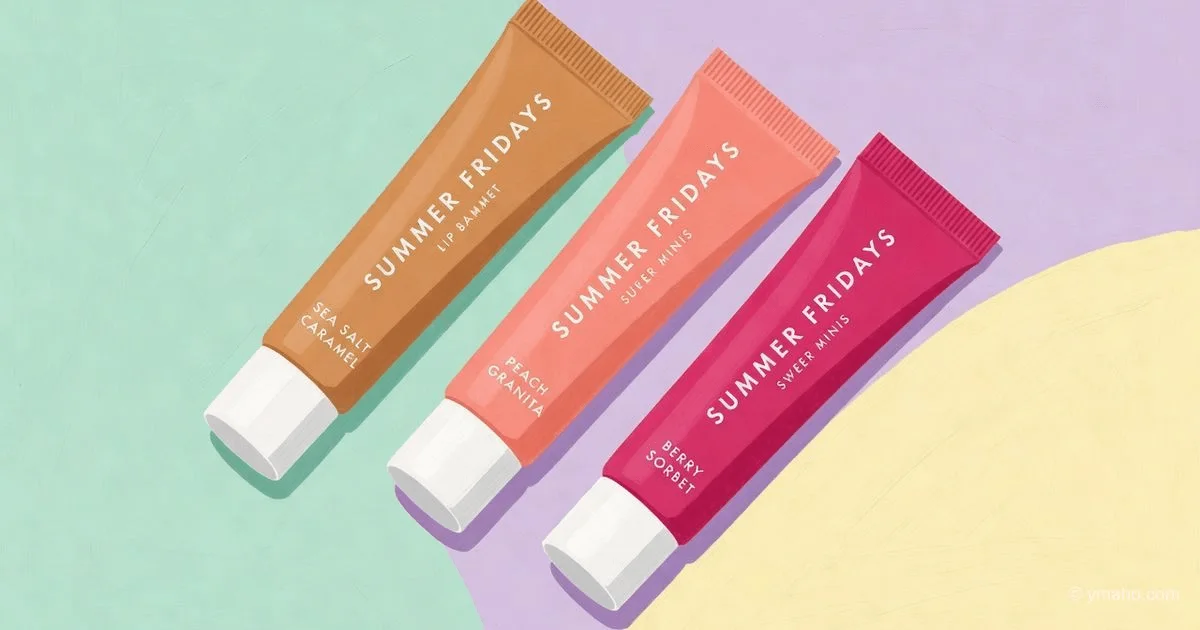
The beloved brand of viral lip balms has released a summer mini collection, "Sweet Summer Minis," which instantly went viral on social media. In addition to Sea Salt Caramel and Peach Granita, the set includes the shade Berry Sorbet, and YSE Beauty has jumped on the clear pink gloss trend with the launch of Like a Gloss in the shade Model Behavior.
Limited Edition Summer Fridays Mini Balms: How a Little Box with Three Glosses Is Restarting the Beauty Economy
The Gist: What's Really Happening
At first glance, Summer Fridays simply released a summer lip balm mini set, "The Sweet Summer Minis" — three shades: Sea Salt Caramel, Peach Granita, and Berry Sorbet, packaged in a box sold at Sephora for $30-35. But in reality, this event is a snapshot of how the modern beauty industry works in 2026. A brand whose lip balm sells "every two seconds" is transforming lip care from a functional necessity into a collectible experience.
The key here is the mini format. A limited-edition set is not just three balms. It's a trigger for collector behavior: the consumer isn't buying a product, but an "exclusive opportunity." When Summer Fridays says "limited edition," it activates the ancient mechanism of fear of missing out (FOMO). And it works: as soon as unboxing videos hit TikTok, the sets started disappearing from Sephora shelves.
What's more important: the brand chooses dessert-fruit flavors — salted caramel, peach granita, berry sorbet. This isn't just "nice scent." It's indulgence, affordable pleasure in an era of inflation and anxiety. When you buy a caramel-flavored balm, you get the emotional equivalent of a dessert without the calories. And that's a much more powerful sales driver than "24-hour hydration."
Timeline and Context
To understand the magnitude of this move, you need to see how Summer Fridays built its empire. March 2018: two influencers (Marianna Hewitt and Lauren Ireland) launch one product — Jet Lag Mask — with zero ad budget on Sephora's website. Within two weeks, the mask becomes number one in the skincare category, surpassing La Mer and SK-II. In 2018, this was unthinkable: influencers didn't create brands; they advertised others'.
September 2025: Summer Fridays' annual retail sales reach $244 million, with a 10.5% share in Sephora's skincare category. That's more than Tatcha, Drunk Elephant, and Glow Recipe. In July 2024, private equity firm TSG Consumer Partners buys a majority stake, valuing the company at over $700 million. The influencers who started with one mask now run a business with a quarter-billion-dollar turnover.
March 2026: Summer Fridays reports revenue of $4.24 million in just one month. Site conversion rate is 4.0-4.5% with an average order value of $75-100. For comparison, in beauty retail, a 2% conversion rate is considered good. Summer Fridays has double that. And that's excluding sales through Sephora, which account for the lion's share.
May 2026: Trend Hunter notes the announcement of The Sweet Summer Minis — a set of three limited-edition balms. By early June, the sets are sold out at most Sephora locations. Simultaneously, YSE Beauty (a brand founded by actress Molly Sims) releases Like a Gloss in the shade Model Behavior — a clear pink gloss that rides the same wave of "edible aesthetics."
The irony is that flavors like Pink Guava, Vanilla Beige, and Cherry have been mainstream since 2024. But Summer Fridays makes an unexpected move: they release salted caramel and peach granita. These are more complex, "adult" flavors that don't scream for attention. And it works because their audience — women aged 25-35 — have outgrown Bubble Yum and want nostalgia without infantilism.
Who Wins and Who Loses
Absolute winner — Summer Fridays itself. They turned a $30 set into a cultural event. Every Instagram post with an unboxing is free advertising that the brand doesn't buy but receives. Their lip balm sells every two seconds worldwide. This isn't just a product — it's social currency. When you have a Summer Fridays Lip Butter Balm in your bag, you show that you're "in the know." And that's worth more than any ad contract.
Sephora wins. The retailer gets exclusive distribution (the set is available at Sephora and sephora.ca). The traffic Summer Fridays generates — millions of sessions per month, as shown in March 2026 data — converts into sales not only of balms but of everything else. While a customer goes for the limited set, they toss a toner, serum, and SPF into their cart. Sephora understands this and gives Summer Fridays the best shelf space — because the brand pays it back tenfold.
Who's at risk? The entire mid-price "lip care" category — Laneige, Glossier, Rhode. Laneige sells a balm in a jar for $18, but they haven't created FOMO. Rhode relies on Hailey Bieber, but Summer Fridays has two founders who were influencers themselves and know the mechanics from the inside. Glossier, once the king of minimalism, has lost its edge. Summer Fridays is currently the fastest train in the category, and it's hard to catch up.
Mass-market brands like Chapstick (monthly revenue $54,982) and Maybelline Baby Lips lose. They sell functionality — "hydrates for 8 hours." But millennials and Gen Z don't buy function; they buy identity. Baby Lips won't give you the status of "a girl who knows her way around beautiful things." Summer Fridays does. And the $15-20 price difference is completely irrelevant to this audience.
Unexpected winner — the secondary market. When the limited set sells out, resales start on eBay and Poshmark at 2-3 times retail. Sellers who bought 5-10 sets each make $50-100 net per set. Summer Fridays doesn't get a cent from this, but gets the main thing: proof of scarcity. "If it's being resold at triple the price, then I was right to buy it." The reputation loop closes.
What the Media Isn't Saying
First non-obvious insight: Summer Fridays built an empire on "social currency" without a single dollar of ad investment. When Marianna Hewitt and Lauren Ireland launched Jet Lag Mask in 2018, they had 1.2 million followers combined. They didn't pay anyone for reviews. They just said "here's our mask" — and their audience did the rest. Today, this model is scaled: every balm buyer becomes a micro-ambassador, posting a "shelfie" with that recognizable tube. Summer Fridays isn't selling cosmetics — it's selling community belonging.
Second insight concerns the effective use of the mini format. Most brands release mini versions for "try before you buy the full size." Summer Fridays does the opposite: they sell full-size versions (15g for $24) and release the mini set as an exclusive. The minis (presumably 5-7g each) don't replace the full size — they complement the collection. The consumer already has Vanilla Beige and Pink Guava in the large format, but buys the set for Sea Salt Caramel, which isn't available otherwise. This is a brilliant product strategy: not cannibalizing the core assortment, but supplementing it.
Third insight — the salted caramel and peach granita flavors are a disguise for sheer pigment. In reality, these balms give a very faint, almost transparent tint. "Your lips but better" is the corporate mantra. The consumer thinks she's buying the "Berry Sorbet" shade, but her lips just become slightly pinker than before. This is the perfect product: it doesn't require a mirror, doesn't stain teeth, and doesn't contradict the "no-makeup makeup" trend. Summer Fridays sells the illusion of color — and that's exactly what the 2026 woman wants.
Finally, the fourth: a summer release in May is a calendar anomaly that will become the new norm. Usually, beauty brands launch limited collections at the start of the season — in March for spring, in June for summer. Summer Fridays launches in late May and creates scarcity by June. This means the sales peak will hit mid-summer, when people are already on vacation and looking for a "souvenir for themselves." They calculate consumer psychology months in advance. This isn't marketing — it's an operational strategy on Amazon's level.
Forecast: Next 30 Days and 90 Days
30 days: The Sweet Summer Minis will be completely sold out across Sephora's global network. On secondary markets (eBay, Depop, Poshmark), the set price will reach $70-80, 2.5 times retail. Summer Fridays will not release an additional batch — that would ruin exclusivity. Instead, the brand will start teasing a fall collection (likely with pumpkin and apple flavors) to shift attention. YSE Beauty by Molly Sims, seeing the success, will launch its own mini gloss set by the end of June.
90 days: By the end of summer, analysts will tally results: Summer Fridays will increase its share in Sephora's lip care category from the current ~15% to 20-22%. Competitors will respond with a wave of limited sets — Laneige will release "Summer Sips" (lemonade, cocktail, mojito), Glossier will release "Beach Bag" (salty lip plumping spray). But none will replicate Summer Fridays' success because they copy the product but can't copy the "social capital" embedded in the brand. The summer set will become the most resold beauty product of the season, finally cementing Summer Fridays' status as "the brand that creates lines."
Global takeaway: Summer Fridays isn't just selling lip balms. They're selling a ticket to a world where you have time for self-care, where you can afford little joys, and where you're seen as a person with taste. Limited sets are not a marketing tool but a myth-making tool. And while competitors think about hydrating formulas, Summer Fridays thinks about desires. That's the difference between a brand that makes products and a brand that creates culture.
— Editorial Team