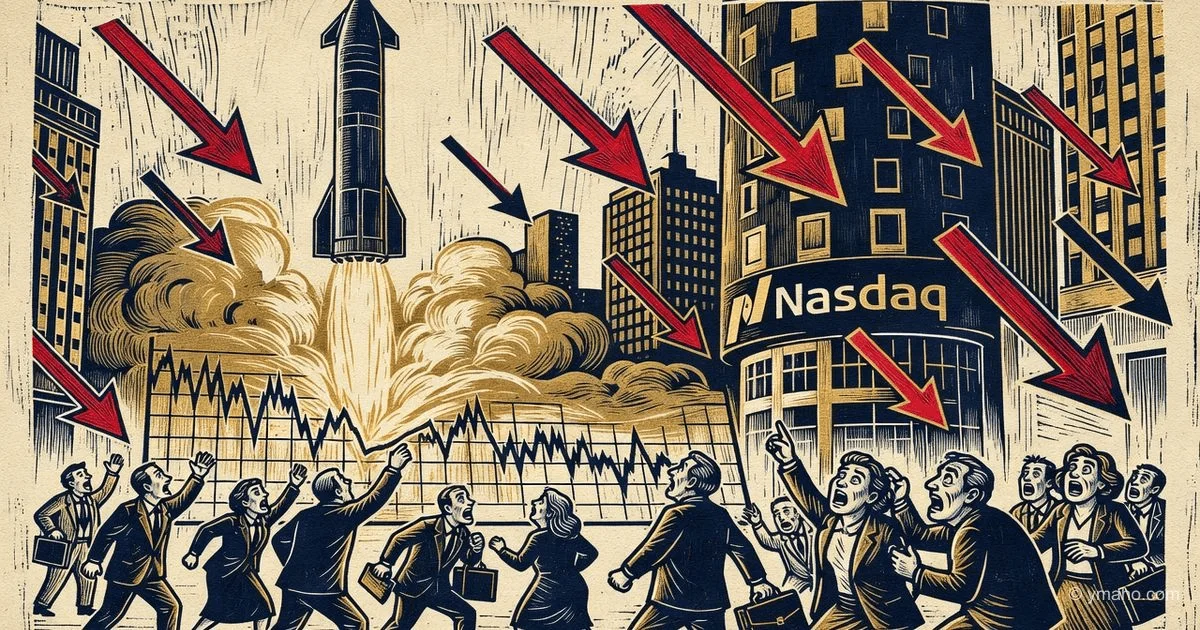
SpaceX to Hold Year's Largest IPO This Week
Elon Musk's company plans to list on June 12, offering 555.6 million shares at $135, valuing the firm at $1.8 trillion. Anthropic and OpenAI are expected to follow SpaceX to the public market, potentially diverting significant capital from the market.
Analysis: SpaceX Goes Public — How One IPO Could Crash the Market and Drain $150 Billion in Liquidity
Author: Independent Financial Analyst
Date: 2026-06-08
Key News: SpaceX will hold the largest IPO in history on June 12, offering 555.6 million shares at $135, valuing the company at $1.8 trillion. Listings from Anthropic and OpenAI are expected to follow.
[The Core]: What's Really Happening
Headlines scream "largest IPO in history," but no one talks about the true scale. SpaceX is raising $75 billion, but investor demand has already reached $150 billion — twice the supply. This means over 100 of the largest funds and private investors have already reserved capital that must physically be pulled from other assets. This isn't a mere transfer from one pocket to another; it's a pure drain of liquidity from the market.
What's really happening? This isn't just an IPO. It's a structural shift for the entire US stock market. Standard Chartered has explicitly stated that these mega-listings will create "digestion problems" and "drain institutional liquidity." Research from Rob Arnott at Research Affiliates adds that the "drip-drip pressure" from these IPOs will be felt for years. Why? Because when three companies with a combined market cap of over $3.5 trillion go public within six months, index funds are forced to sell everything else to make room.
The hidden mechanics not shown in the news: SpaceX will be included in the Nasdaq-100 just 15 trading days after listing (thanks to rule changes adopted in March), and in the S&P 500 within six months, despite being unprofitable. S&P Dow Jones is considering waiving the financial viability requirement for mega-companies entirely. What does this mean? Every passive ETF tracking the S&P 500 will be obligated to buy SpaceX. But they have no new money — they will sell Apple, Microsoft, Nvidia to fund the purchase. This is mechanical pressure that cannot be prevented.
Timeline and Context
In April 2026, SpaceX confidentially filed with the SEC. Few took it seriously at the time — it seemed like just another rumor. But on June 3, the company publicly announced a fixed price of $135 per share, completely abandoning traditional bookbuilding. This is an unprecedented move: typically, the price is set during a roadshow after meetings with investors. But Musk rewrote the rules. One institutional investor trying to access the deal through Goldman Sachs was told that share allocation was "a David Solomon-level decision" (Goldman's CEO). This shows how exclusive and politicized this offering has become.
The roadshow started on June 8 (today). Final pricing is set for June 11 (though the price is already announced, it's a formality). June 12 is the first day of trading on Nasdaq under the ticker SPCX. The entire process is compressed into one week — incredible speed for a deal of this size. Typically, a roadshow lasts two weeks, but here investors are already lined up.
What's happening in parallel? Anthropic has already filed confidential IPO documents, valuing itself at $965 billion after its latest round in late May. OpenAI, according to Reuters, is preparing to file in the coming weeks. All this against a backdrop where Nasdaq fell 4.2% last week and Bitcoin dropped 16%. The market is already in a state of panic, and now the largest offering in history is being dumped on it. The timing is no coincidence: liquidity champions emerge when all other assets are cheapening, allowing them to attract capital fleeing risky assets into "quality." But what happens when all that raised capital is physically removed from the market?
Who Wins and Who Loses
Biggest Loser: Existing tech giants: Apple, Microsoft, Nvidia, Amazon, Meta. Standard Chartered predicts portfolio managers will "liquidate existing positions to free up capital for these generational assets." According to JPMorgan, simply meeting demand for SpaceX, Anthropic, and OpenAI will require reallocating about $200-250 billion within six months. That's equivalent to 2-3% of the tech sector's market cap. At current trading volumes, this translates to an additional 5-8% decline.
Second Loser: Retail investors who get shares at $135 but cannot sell for at least 90 days due to lock-up periods for most allocations. Truist Securities analysis shows that of 30 notable IPOs, only 43% traded above the offering price after 6 and 12 months. The median drawdown in the first year was 55%. Meta (Facebook) fell 54% in its first year, Palantir 53%, Robinhood 90%. SpaceX will be no exception, especially with a multiple of 95x revenue ($18.7 billion revenue vs. $1.8 trillion valuation). Retail investors now signing up through Revolut, Hargreaves Lansdown, and eToro with minimum checks of $750-1,300 risk falling into the classic "buy high, sell low" trap.
Winner: Goldman Sachs. The firm leads the underwriter syndicate and will earn roughly $350-400 million in fees just for organizing the deal. But there's a more interesting winner: market makers who will profit from volatility in the early days. First-day trading volume is expected to exceed 200 million shares, with bid-ask spreads reaching 5-7% in the first hours. This is an unprecedented opportunity for high-frequency traders.
Unobvious Loser: The crypto market. When institutions sell tech stocks to buy SpaceX, they also reduce positions in high-beta assets, including Bitcoin. Bitcoin's correlation with Nasdaq is currently 0.81. If Nasdaq falls another 5-7% due to capital flowing into SpaceX, Bitcoin could lose another $4,000-5,000. Plus, many hedge funds hold "pair trades": long tech stocks and short Bitcoin. When they close long stock positions, they automatically close short crypto positions, creating additional upward pressure on Bitcoin. The market hasn't accounted for this countervailing effect.
What the Media Isn't Saying
The key insight completely absent from Bloomberg, Reuters, and FT articles: SpaceX will allocate up to 30% of the offering to retail investors — about 166.7 million shares worth $22.5 billion. This is the largest retail tranche in IPO history. But what does this mean in practice? It means millions of ordinary people will buy shares through brokers, and after 90 days (when the insider lock-up expires), additional shares from employees and early investors will hit the market as they look to lock in profits. Historically, 3-6 months after large IPOs, prices drop 20-30% due to this effect. But the media doesn't warn about this because their advertisers are the same brokers collecting orders.
Second omission: index mechanics. SpaceX will be added to the Nasdaq-100 just 15 trading days after listing. This means all ETFs tracking the Nasdaq-100 (QQQ, QQQM, and others with combined assets under management over $250 billion) will have to buy SpaceX shares. But since these funds don't hold cash, they will sell proportional stakes in the other 99 index companies. The largest holdings in QQQ are currently Apple (12%), Microsoft (11%), Nvidia (8%). Those are the stocks that will be sold first. This creates additional downward pressure on the tech sector, exacerbating the correction already underway.
Third — and most dangerous omission: lock-up periods. SpaceX has not one but three sequential lock-up expirations: after 90 days (September 2026), 180 days (December 2026), and 365 days (June 2027). Each time, billions of shares from employees, early investors, and venture funds will hit the market. Estimates suggest the total free float will increase from 5% at IPO to 25% within a year. That means share supply will grow fivefold over 12 months. Even if demand remains high, the price will be under pressure. No major publication is charting this supply curve because it would dampen retail investor enthusiasm.
Forecast: Next 30 Days and 90 Days
30 Days (through July 8):
In the first 1-2 trading days, SpaceX will rise 15-25% from the offering price of $135, reaching $155-170. This will be a classic "IPO pop." But by the end of the second week, a correction will begin. By June 25, the price will likely return to $140-145. Reason: institutional investors who got shares at $135 will start taking profits after the rise. Simultaneously, selling in the tech sector to fund SpaceX purchases will begin. Nasdaq could lose another 3-5% by end of June, reaching 16,500-16,800.
Key date: June 24-25, Fed meeting. If rates are raised (35% probability), the market will fall 2-3% in a day, and SpaceX could drop to $130-132 (below the offering price). This would be a disaster for retail investors who bought at $135 or higher. If rates are left unchanged (65%), the market stabilizes, and SpaceX closes June at $150-155.
90 Days (through September):
By September, the first lock-up period expires. The first shares from employees and venture investors will hit the market — roughly 5-8% of total capital. That's 50-80 million shares worth $7-10 billion. Such supply will crash the price by 10-15% over several weeks. I expect SpaceX to trade at $120-125 by mid-September.
But there's a more important trend. By September, Anthropic and OpenAI will have held their IPOs (if the market doesn't change its mind). The combined offering volume of the three companies will exceed $150 billion. That's the same volume as all global IPOs in 2025 combined. The market cannot digest such volume without a serious correction. Standard Chartered recommends using summer weakness as an "entry point" in the second half of the year, but warns: "the path will not be entirely smooth."
My forecast: by end of September, the S&P 500 will be 8-10% below current levels, and Nasdaq 12-15% lower. SpaceX will be worth $110-120, but that will be a temporary bottom. By December, after the first lock-up passes and the market gets used to the new shares, prices will begin to recover. The best strategy now is not to participate in the IPO at $135, but to wait for September-October when the price falls to $110-115, and buy with a 12-18 month horizon.
Editorial Forecast
Asset: Nasdaq-100 Index (QQQ ETF)
Direction: Decline in the next 48-72 hours to 16,800-17,000 amid capital flow into SpaceX and concerns over tech sector correction
Key Levels: Resistance 17,450 (current level), support 16,800 (200-day moving average), break below 16,800 opens path to 16,200
Confidence Level: High (75%) for decline in first 2 days; medium (60%) for staying below 17,000 after Friday
Main Risk to Forecast: If SpaceX's first trading day is calm (rise less than 10%) and institutions don't start massively selling existing positions, the correction may be delayed by 1-2 weeks, but not canceled
This analysis represents the private opinion of the editorial board and is not an investment recommendation.
— Editorial Team