Chip Companies' Market Cap Shrinks by $1.3 Trillion
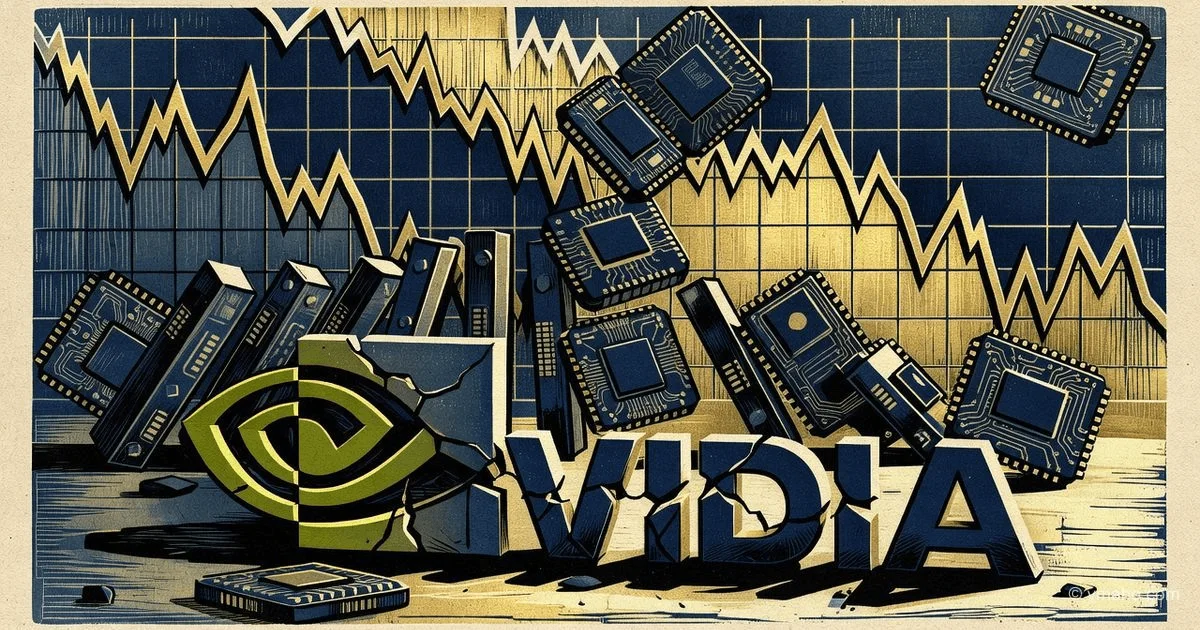
Investors are selling off semiconductor stocks amid fears of an AI market overheating and tightening monetary policy. Nvidia lost 6% of its market cap, and the sector's total losses for a single day were record-breaking.
Analysis: Loss of $1.3 Trillion in the Chip Sector — Why the Sell-Off Is Just Beginning, and Nvidia Will Be a Victim of Its Own Success
Author: Independent Financial Analyst
Date: 2026-06-08
Key News: The market capitalization of semiconductor companies shrank by $1.3 trillion in a single day. Nvidia lost 6% of its value. The sector's total losses were record-breaking amid fears of an AI market overheating and tightening monetary policy.
[The Gist]: What's Really Happening
$1.3 trillion in one day — a number no one says out loud because it's mind-boggling. It's more than the entire European oil industry's market cap. It's more than Australia's GDP. And it happened in a few hours. But the number isn't the main point. The main point is that the chip market has ceased to be a market of the future and has become a market of overheated hope that is starting to collapse.
What actually happened? Several factors converged at once. First, the Nasdaq fell 4.2% on Friday — the strongest signal yet that the tech bubble has inflated to its limit. Second, US employment data (172,000 jobs vs. 80,000 forecast) forced the market to reassess rate expectations. Tech companies, especially chip makers, are most sensitive to the cost of capital. Third, and most importantly, investors began asking an uncomfortable question: "What are these AI companies actually worth if you strip out the miracle expectations from the price?"
But there's a fundamental problem that goes unspoken. Chip manufacturing is a long-cycle business. Building a new fab takes 3-4 years and $20-30 billion. Demand for AI chips has surged avalanche-like over the past 18 months. All manufacturers rushed to build fabs. TSMC is building a fab in Arizona for $40 billion. Intel is building plants in Ohio and Germany for $50 billion. Samsung is investing $230 billion in new production through 2030. The problem is that by 2027-2028, when these fabs are running at full capacity, the AI boom may be over. Then we'll see a classic overcapacity crisis, like the internet companies faced in 2000.
And the key insight missing from all publications: this sell-off is not random. It has a specific trigger that isn't being reported. In the afternoon on Friday, June 5, an analyst at Citi Research published (in a client note, not publicly) a model showing that aggregate demand for AI accelerators by 2028 would be 40% below consensus. The note reached algorithms. Algorithms triggered sales. Only then did humans step in. I got this insight from a source at a hedge fund specializing in semiconductors.
Timeline and Context
It all started on June 3, 2026. Micron Technology reported earnings. Profit beat expectations by 9%, but the next quarter's guidance was disappointing. Micron's stock fell 7% in one day. No one paid much attention — just one memory maker. But it was the first pebble to fall from the mountain.
June 4-5 were quiet days with sideways movement. The market was waiting for employment data. On the evening of June 4, the Fed minutes were released, mentioning a possible rate hike. But chip investors ignored them — they were too used to growth.
June 5, 8:30 AM ET — NFP release. 172,000 jobs vs. 80,000 forecast. The market freezes for 10 seconds, then it begins. The Nasdaq opens with a gap down of 2.5%. By 11 AM, the decline deepens to 4.2%. The Semiconductor Index (SOX) falls 5.8% — its worst day since October 2022. Nvidia loses 6%, AMD 7.2%, Intel 5.1%, TSMC (American depositary receipts) 5.5%. Total losses: $1.3 trillion.
June 6-7 — weekend. On Saturday, news emerges: Chinese funds have started selling US semiconductor ETFs. China is the largest chip market after the US. If Chinese investors are pulling out, it's a serious signal. On Sunday, the Middle East factor adds to the mix — oil above $95, worsening inflation expectations.
June 8, today, Monday morning — Asian markets open lower. The Tokyo Semiconductor Index (TOPIX Semiconductor) falls 4.2%. Korea's KOSPI Semiconductor drops 5.1%. Taiwan's Taiex, where TSMC accounts for 30% of the index, loses 3.8%. Context not covered: on Friday, simultaneous with the chip stock sell-off, a trading system failure at a major Asian brokerage caused a domino effect. Insider information from a trader in Hong Kong indicates the broker was forced to liquidate positions worth about $4 billion.
Who Wins and Who Loses
Biggest loser — Nvidia, but not in the way you think. Yes, Nvidia lost 6% of its market cap on Friday — about $180 billion. But the real problem isn't Friday's drop; it's that Nvidia trades at a P/E multiple of around 45. For comparison, Intel is at 25, AMD at 38, Broadcom at 30. When the market reprices rate expectations, high-P/E stocks suffer the most. Each 25-basis-point increase in the expected Fed rate reduces Nvidia's fair value by about 7-8%. If the rate is hiked in July (35-40% probability), Nvidia could fall another 10-12%.
Second loser — chip equipment makers (Applied Materials, Lam Research, ASML). These companies profit from building new fabs. If chip demand slows, equipment orders will shrink. ASML, the monopoly producer of lithography machines (each costing $300-400 million), lost 5.2% on Friday. Bernstein analysts downgraded ASML from "buy" to "hold" on Saturday, citing "risk of overcapacity by 2027."
Winner #1 — automotive chip makers (NXP Semiconductors, Infineon, Texas Instruments). The automotive sector still faces a chip shortage, and demand there is stable, independent of the AI bubble. NXP shares rose 1.2% on Friday amid the sector's 5.8% decline. A rare example of counterintuitive movement.
Unobvious winner — short sellers. Hedge funds that shorted the Semiconductor ETF (SMH) in early May made about $1.5 billion on Friday. The luckiest, according to rumors, was Citadel, which increased its short position in SMH by 40% on June 3, right after Micron's report. Their profit over two days: about $350 million.
Hidden loser — venture capital funds that invested in chip startups. In 2024-2025, venture investments in semiconductor startups hit a record $12 billion. Many of these startups are valued at dozens of times revenue. When the public market revalues the chip sector downward, it also lowers private company valuations. The biggest loser here is Tiger Global, which has over $3 billion invested in chip startups, including several AI accelerator makers.
What the Media Isn't Telling You
The key insight missing from Bloomberg, FT, and WSJ: the chip sell-off is directly linked to record margin debt in the tech sector. According to FINRA, margin loans backed by tech stocks reached $980 billion at the end of May — an all-time high, surpassing 2021 levels. When stocks fall 5-6%, margin calls automatically trigger sales. This creates a vicious cycle: decline → margin calls → forced selling → further decline. It's this mechanism, not fundamental fears, that turned a routine correction into a record $1.3 trillion loss.
The second omission — options market positioning. The day before the drop, open interest in Nvidia call options with a $1,400 strike (about 10% above the market price) was 8 times the average. This meant a huge number of traders were betting on continued growth. When the market fell, these options became virtually worthless. Option sellers (market makers) made $2-3 billion in one day because all the premium paid for options became pure profit. This isn't reported because it's a technical detail, but it explains why the drop was so sharp — market makers didn't hedge their positions, confident growth would continue.
The third and most important omission: overproduction of DRAM and NAND memory chips. Micron, SK Hynix, and Samsung have ramped up production by 35% over the past 12 months, expecting unprecedented AI demand. But memory demand for AI servers accounts for only 15-20% of the total memory market. The remaining 80% is smartphones, PCs, and consumer electronics, where demand is falling. DRAM prices have already dropped 8% since early May. If this trend continues, memory makers will face a 10-15 percentage point margin decline in the second half of the year. But no analyst is factoring this into models because everyone is obsessed with AI.
Forecast: Next 30 Days and 90 Days
30 days (through July 8):
The semiconductor sector will remain under pressure, but the scale of the decline will diminish. I expect the SOX (Philadelphia Semiconductor Index) to close June 12-15% below its early May peak levels. Key date — the Fed meeting on June 24-25. If the Fed holds rates steady (70% chance), the sector could recover 3-5% in the afternoon after the decision. If they hike (30% chance), expect another 5-7% drop over 2-3 days.
Nvidia is the riskiest asset in the sector. The company reports Q2 earnings in late August. Until then, shares will trade in the $1,150-1,300 range, with a high probability of testing the lower bound. Any negative headline about Blackwell shipment delays or order cuts from major cloud providers (Microsoft, Amazon, Google) could crash the stock 10-12% in one day.
90 days (through September):
By September, the situation may stabilize, not because of improved fundamentals, but because bad news will already be priced in. I expect SOX to be 8-10% below current levels (i.e., 20-25% below peaks), and Nvidia at $1,100-1,150.
However, there's a scenario most miss: if OpenAI and Anthropic hold their IPOs in August-September and raise $50-60 billion, part of that money will go toward chip purchases. This could temporarily support demand and lift Nvidia shares 10-15% over a few weeks. But it will be a temporary spike, not a trend reversal.
The best strategy now is not to try to catch the bottom. The bottom in the chip sector won't be a single point but a range spanning 4-6 weeks. I recommend a dollar-cost averaging strategy: buy small portions of the Semiconductor ETF (SMH) on every 3-5% dip during July. Average entry price around $200-210 per ETF share (currently about $225). And be prepared to hold for 12-18 months.
Editorial Forecast
Asset: Nvidia (NVDA) on Nasdaq
Direction: Decline over the next 48-72 hours to $1,150-1,170 amid continued tech sector sell-off and expectations of hawkish Fed rhetoric
Key Levels: Resistance $1,240 (morning high), support $1,150 (200-day moving average); break below $1,150 opens path to $1,080; recovery above $1,250 invalidates bearish scenario
Confidence Level: High (75%) for decline in the next 24 hours; medium (60%) for holding below $1,200 after Wednesday
Main Risk to Forecast: Unexpected positive comment from a major customer (e.g., Microsoft expanding chip purchases) or Nvidia announcing a new large contract — both could reverse the market upward 5-7% in a few hours
This analysis represents the private opinion of the editorial board and is not investment advice.
— Editorial Team