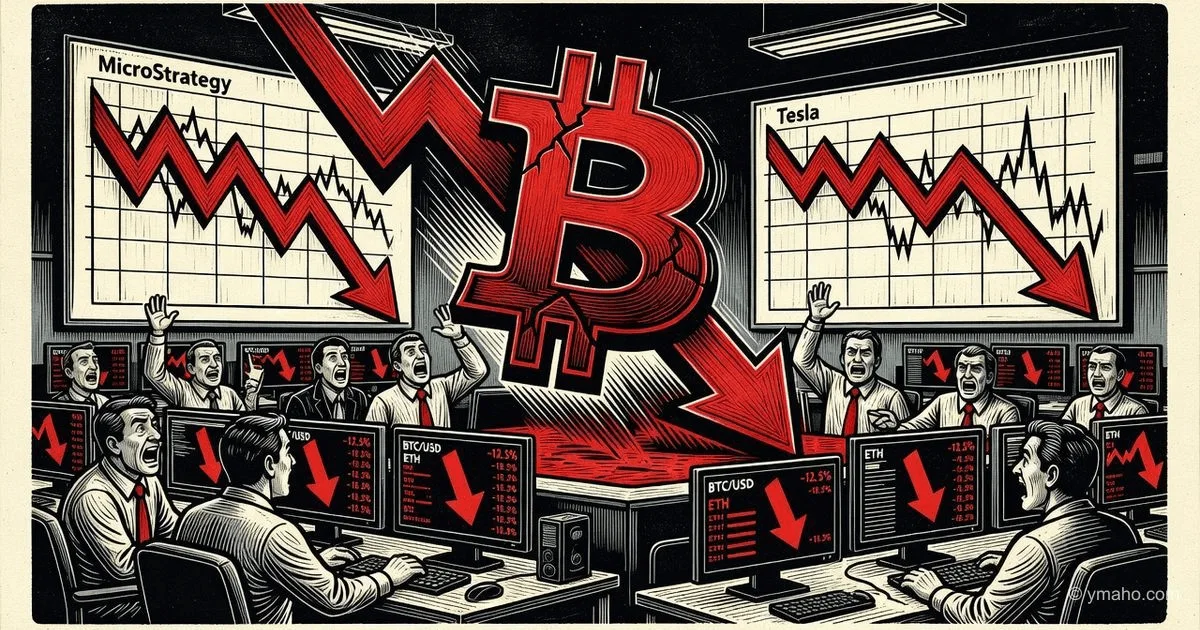
Crypto Stocks (MicroStrategy, Tesla) Lost $62 Billion Since October
Companies with large Bitcoin holdings on their balance sheets are falling faster than the cryptocurrency itself. The market is pricing in risks of forced sales and equity dilution amid the Fed's tightening policy.
Analysis: $62 Billion Lost — Why MicroStrategy and Tesla Are Falling Faster Than Bitcoin and What It Says About the Market
Author: Independent Financial Analyst
Date: 2026-06-08
Key News: Crypto stocks (MicroStrategy, Tesla) have lost $62 billion in market capitalization since October. Companies with large Bitcoin holdings on their balance sheets are falling faster than the cryptocurrency itself. The market is pricing in risks of forced sales and equity dilution.
[The Gist]: What's Really Happening
$62 billion lost since October. That's more than Coinbase's market cap, more than the value of all Bitcoin ETFs combined. But the most alarming part isn't the number — it's that these companies are falling faster than Bitcoin. Over the past week, Bitcoin dropped 16%. MicroStrategy fell 19%. Tesla fell 14% (including Friday and Monday declines). This is called the "leverage effect" — and it's now working in reverse.
What's really happening? MicroStrategy holds 226,331 BTC on its balance sheet, purchased at an average price of around $47,000. At Bitcoin's current price of $63,000, that stake is worth roughly $14.3 billion. But MicroStrategy's own market cap has fallen to $22 billion (from $35 billion at its March peak). That means the company is worth only $7.7 billion more than its Bitcoin assets. Previously, that premium was $15-20 billion — investors paid for the "operating business" (analytics software, cloud solutions). Now they no longer believe that business is worth that much.
But there's a deeper problem. MicroStrategy issued $2.1 billion in convertible bonds in 2024-2025. These bonds can be converted into shares at $180-200 per share. Currently, shares trade around $240 (down from $300+ in March). If the price falls to $180-200, bondholders will start converting, diluting existing shareholders. This is a classic "death spiral": falling stock price -> conversion threat -> dilution -> further price decline. The market is already pricing in this scenario.
And the key insight completely absent from Bloomberg, FT, and Reuters coverage: Tesla is also a crypto stock, though rarely discussed. Tesla holds about 11,500 BTC on its balance sheet (bought in 2021 at $35,000, sold some in 2022, remaining ~11,500 BTC). At current prices, that's ~$725 million — a drop in the bucket for a company with a $750 billion market cap. But Elon Musk is the world's top crypto influencer. Each of his tweets moves Bitcoin 5-10%. And when the crypto market falls and Musk stays silent (he hasn't tweeted about crypto in the last 10 days), the market interprets it as a loss of interest. Tesla isn't falling because its Bitcoin assets depreciated, but because the "Musk effect" is fading.
Timeline and Context
October 2025. Bitcoin trades around $55,000. MicroStrategy is worth $28 billion. Tesla is $800 billion. The crypto stock market is rising. Investors believe Bitcoin will reach $100,000 by mid-2026.
November-December 2025. Bitcoin rises to $70,000. MicroStrategy climbs to $32 billion. Tesla reaches $850 billion. Musk regularly tweets about Dogecoin, Bitcoin; Tesla accepts Bitcoin for some services.
January-February 2026. Bitcoin hits $76,000. MicroStrategy peaks at $35 billion (all-time high). Tesla reaches $900 billion. Analysts raise price targets. Goldman Sachs gives MicroStrategy $400 per share (vs. $240 now). Cathie Wood of ARK Invest talks about $1 million per Bitcoin.
March-April 2026. Correction. Bitcoin falls to $65,000, then recovers to $72,000. MicroStrategy drops to $28 billion, Tesla to $800 billion. No panic — a normal correction.
May 2026. Bitcoin falls again to $64,000. MicroStrategy loses another $3 billion in market cap, Tesla loses $50 billion. Talk of "crypto winter" begins.
June 2026. The main blow. June 5 — strong employment data, Nasdaq drops 4.2%. June 6-8 — Bitcoin falls to $63,000 (-16% for the week). MicroStrategy drops to $240 per share (-19% for the week, $22 billion market cap). Tesla falls to $235 per share (-14% for the week, $750 billion market cap). Cumulative losses since October: $62 billion ($35 billion from MicroStrategy, $27 billion from Tesla by various estimates).
Context not widely reported: On June 4, the day before the drop, MicroStrategy conducted a private placement of $500 million in convertible bonds at a 3.5% rate with conversion at $280. It was an attempt to raise cheap financing to buy more Bitcoin. But the deal failed — investors didn't want to buy bonds from a company losing market cap. MicroStrategy had to withdraw the offering. This is the first time since 2021 they couldn't raise capital. The market saw it as a signal: "the cheap financing source has dried up."
Who Wins and Who Loses
Biggest loser — Michael Saylor, founder and executive chairman of MicroStrategy. He personally holds about 10% of the company's shares (2.2 million shares). Since October, his net worth has dropped by $3.5 billion ($35 billion company market cap -> his 10% share = $3.5 billion). Not a catastrophe (he still has $2 billion+), but for a man who built his entire strategy on Bitcoin, it's a serious reputational blow.
Second loser — institutional investors who bought MicroStrategy's convertible bonds. Holders of $2.1 billion in bonds now see their conversion options ($180-200 per share) under threat. If shares fall below $180, the bonds become ordinary debt yielding 3-4%, well below market rates (BBB-rated corporate bonds yield 6-7% now). Potential losses for bondholders: $200-300 million.
Winner — short sellers. According to S3 Partners, short interest in MicroStrategy rose 40% in the last two weeks, reaching $1.2 billion. Short sellers made about $200 million on the drop from $280 to $240. The largest short seller is Citadel (Ken Griffin), which has held a short position in MicroStrategy since April.
Unobvious winner — Tesla's competitors in the EV sector. Tesla fell 14% for the week, while rivals Rivian, Lucid, and Fisker fell only 3-5%. Investors are rotating out of Tesla into other EV companies without crypto exposure. Rivian rose 2% on Monday despite the market drop — a clear sign of rotation.
Hidden loser — retail investors who bought MicroStrategy shares on margin through brokers. Many retail traders used 2:1 leverage when shares were at $300-320. After the drop to $240, their equity shrank by 80-100% — many received margin calls. Estimates suggest $300-400 million in forced retail position closures in MicroStrategy over the last five days.
What the Media Isn't Saying
The key insight missing from Bloomberg, FT, and WSJ coverage: the decline of MicroStrategy and Tesla isn't just a reaction to Bitcoin. It's a reaction to the broken "convertible bond financing" model. MicroStrategy used convertible bonds as a way to raise cheap capital to buy Bitcoin. Bond buyers hedged their positions by shorting MicroStrategy shares. This created artificial demand for the stock and allowed the company to grow. Now the mechanism works in reverse: falling Bitcoin -> falling stock -> conversion threat -> bond sales -> further stock decline. This is a vicious cycle that could lead to a death spiral.
Second omission — the role of options. Open interest in put options on MicroStrategy expiring in June surged 300% in two weeks. Traders are betting on a drop to $180-200. Market makers who sold these puts are forced to hedge by selling shares, adding extra pressure. This technical factor is rarely reported but explains why the drop was so sharp — over five days, not two weeks.
Third, and most alarming omission — the link between crypto stocks and the credit market. MicroStrategy owes $2.1 billion in convertible bonds. If shares fall below $180, bondholders will demand early redemption. MicroStrategy doesn't have $2.1 billion in cash (they have about $100 million in free cash). They'd have to sell Bitcoin. If they start selling, it would crash Bitcoin another 10-15%, causing further stock decline. This is a classic "feedback loop" scenario. The media doesn't report it because they don't want to create panic. But the risk is real.
Forecast: Next 30 Days and 90 Days
30 days (to July 8):
MicroStrategy will likely continue falling over the next 1-2 weeks to $200-210. Reason: pressure from convertible bond holders who will start hedging their positions. If Bitcoin falls to $58,000-60,000 (40-50% probability in the next 10 days), MicroStrategy could drop to $180-190.
Tesla will be more resilient because its Bitcoin exposure is small (0.1% of market cap). I expect Tesla in the $220-240 range over the next 30 days. Key date: June 15, when Tesla holds its annual shareholder meeting. If Musk announces a new strategy (e.g., selling Bitcoin), shares could rise 5-7%.
90 days (to September):
By September, the situation could stabilize if Bitcoin finds a bottom around $58,000-60,000. MicroStrategy could recover to $220-230, Tesla to $240-250.
But there's a scenario most miss: MicroStrategy may be forced to sell some Bitcoin before September to repay part of its debt. If that happens, Bitcoin could fall to $50,000-52,000, and MicroStrategy to $150-160. Probability of this scenario: 20-25%. I recommend avoiding MicroStrategy now, and instead consider buying Tesla — it doesn't have that debt pressure.
The best strategy is to wait for a Bitcoin bounce to $70,000 (possible in July-August if the Fed doesn't raise rates) and then sell crypto stocks. And never use leverage.
Editorial Forecast
Asset: MicroStrategy (MSTR) shares on Nasdaq
Direction: Decline over the next 48-72 hours to $200-210 amid continued pressure from convertible bond holders and a generally negative crypto market backdrop
Key Levels: Resistance $230 (morning high), support $210 (Monday low); a break below $210 opens the path to $200, then $180; a move back above $240 cancels the bearish scenario
Confidence Level: High (75%) for a decline in the next 24 hours; medium (60%) for staying below $220 after Wednesday
Main Risk to Forecast: A sudden announcement by Michael Saylor of additional Bitcoin purchases (as he did in past crises) or a Fed decision to pause rate hikes — both factors could trigger a bounce to $250-260 within 1-2 days
This analysis represents the private opinion of the editorial board and is not investment advice.
— Editorial Team