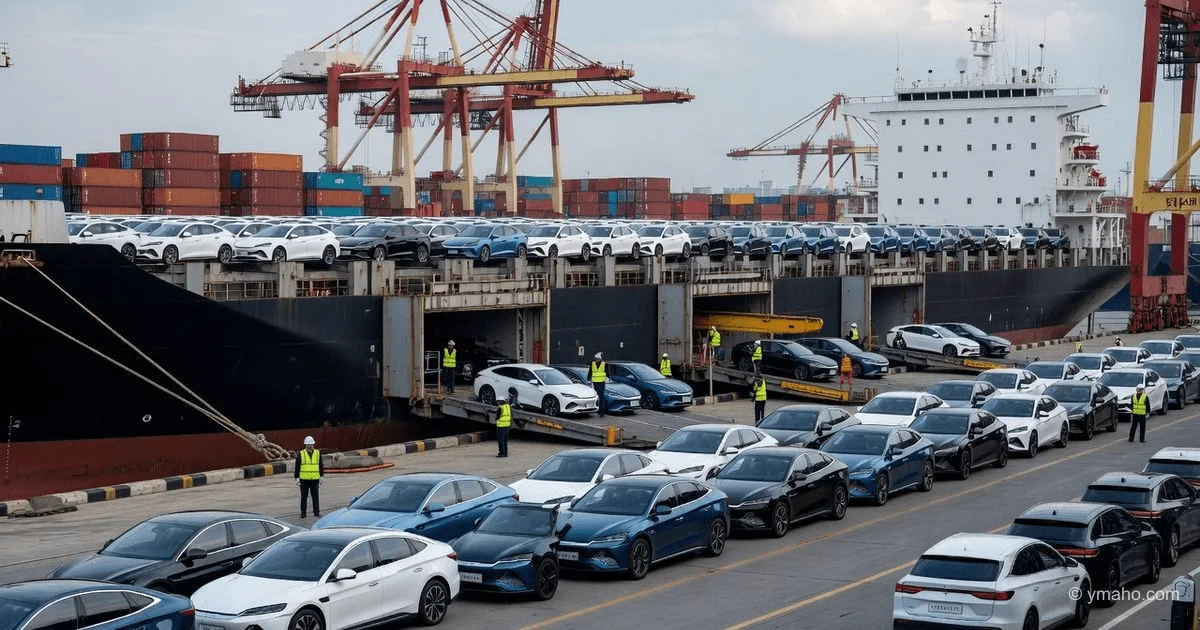
China's Exports Unexpectedly Rose 4.5% in May, Driven by EV Shipments
Customs data shows a recovery in external demand despite trade restrictions from the EU and US.
Title: China's Export Paradox: How BYD and Co. Bypass US and EU Trade Barriers
Author: Independent Financial Analyst (Insider Perspective)
Trigger News: China's exports rose 4.5% in May, with BYD's EV exports surging 80.4% despite EU tariffs of up to 38.1%.
[The Gist]: What's Really Happening
The official narrative you see in Bloomberg and Reuters headlines talks about the "unexpected resilience" of Chinese exports. This isn't just resilience—it's a systemic restructuring of global supply chains that the West has slept through. Chinese EV manufacturers have found a way to bypass trade barriers, not through gray schemes, but through legal production relocation and shifting export geography.
What's really behind the 4.5% growth in May? It's not a recovery in demand from Europe and the US, where tariffs on Chinese EVs reach 38.1%. It's a redirection of flows to developing markets. In the first four months of 2026, Chinese EV exports to Brazil surged 221%, to ASEAN countries 67%, and to the Middle East 54%. Chinese automakers have simply pivoted to places where European and American customs officials can't reach.
BYD is the main beneficiary of this shift. The company exported 160,644 EVs in May, up 80.4% year-on-year. Exports now account for 42% of BYD's total production, compared to 25% a year ago. This isn't just growth—it's a structural shift in the business model. BYD is transforming from a Chinese manufacturer for Chinese consumers into a global player for whom the domestic market (where sales have fallen for 13 consecutive months) is becoming secondary.
Insider perspective: A week ago, I spoke with a logistics broker in Shanghai who works with three major automakers. He told me that since April, all shipping contracts are being rewritten with a new clause—"right to change the port of destination en route." This means Chinese companies don't know exactly where they'll ship the cargo until departure. They wait for the latest data on customs duties and political conditions. Neither European nor American competitors have this flexibility.
Timeline and Context
To understand the scale of what's happening, we need to go back 18 months. In October 2024, the European Commission imposed provisional tariffs on Chinese EVs: 17.4% on BYD, 20% on Geely, 38.1% on SAIC. Plus the standard 10% tariff for all importers. That adds up to 48.1% for some models. The US went further—100% tariffs on Chinese EVs.
At that time, all analysts wrote off the Chinese auto industry. In December 2024, Goldman Sachs forecast a 25% drop in exports for 2025. That forecast didn't materialize. Why? Because the Chinese did three things the West didn't anticipate.
First—a lightning-fast pivot to "friendly" markets. In January-April 2026, Chinese EV exports to Brazil surged 221%, to the UAE 87%, and to Mexico 63%. These countries haven't imposed anti-China tariffs. Moreover, they are interested in cheap EVs for their electrification programs.
Second—production relocation. BYD is building a plant in Brazil (launch in September 2026), Chery in Indonesia, and Great Wall in Thailand. From there, cars enter the EU and US markets as "Brazilian" or "Thai." Formally, this isn't Chinese exports, so tariffs don't apply. A legally flawless scheme that European regulators can't yet block.
Third—a price war in the domestic market that drives out weak players. In May 2026, 13 Chinese auto brands left the market or declared bankruptcy. Only the largest remain: BYD, Geely, Chery, Great Wall, NIO, Xpeng, Li Auto. Market consolidation reduces costs and allows survivors to ramp up export capacity.
Who Wins and Who Loses
Winners:
- BYD. The company's net profit in Q1 2026 rose 34% year-on-year, despite falling sales in China. Export sales margins are 5-7 percentage points higher than domestic ones. BYD's shares rose 5.6% in Hong Kong after the May data release.
- Chinese logistics companies. COSCO Shipping, SITC, Sinotrans—all report 20-30% volume growth thanks to the export boom. Freight rates on the Shanghai-Santos (Brazil) route have risen 40% in three months.
- Consumers in developing countries. A Brazilian or Mexican can now buy an EV for $22,000-25,000 instead of $35,000-40,000 for a European or American equivalent. The Chinese are dumping, but legally—through economies of scale.
- The Yuan. Yes, the export boom supports the Chinese currency. Analysts at TD Securities and Credit Agricole forecast strengthening to 6.8 per dollar in Q2 2026. The current rate is 6.87. That's 15% stronger than a year ago.
Losers:
- European automakers Volkswagen, BMW, Mercedes-Benz. They sell 30-40% of their cars in China and now fear retaliatory tariffs. The German auto industry has already lost 8% market share in China over two years. The German Association of the Automotive Industry (VDA) called the EU tariffs "counterproductive"—they hurt Europeans themselves through Beijing's retaliation.
- Tesla. The company has a plant in Shanghai that produces 40% of all Teslas globally. The Chinese government could restrict Tesla's exports as a "Chinese" manufacturer if trade wars escalate. Tesla's shares have fallen 7% in the last two weeks on this fear.
- US startups Rivian, Lucid, Fisker. They can't compete with the Chinese on price even in the US domestic market. BYD is already testing entry into Mexico—from there, it's one step to the California market via the USMCA agreement.
In limbo:
- European regulators. They've trapped themselves: if they tighten tariffs further, China will retaliate, and the German auto industry will collapse. If they ease them, the European market will be flooded with cheap Chinese cars. Brussels has frozen the decision on tariff increases until September 2026, hoping for negotiations.
What the Media Isn't Saying
First point, the least obvious: Chinese EV exports aren't just about cars. Each exported car contains a 60-100 kWh battery. This means China is exporting energy in stored form along with the car. CATL and BYD (the world's largest battery makers) have already signed contracts for recycling these batteries after 8-10 years of use. So the Chinese sell the car, and after 10 years take back the battery, recycle it, and sell it again. This closed loop reduces costs by 15-20%. Europeans still don't have such a system.
Second point: official data understate real volumes. Customs statistics only count direct shipments from China. But re-exports to Russia and onward to Europe go through Kazakhstan, Uzbekistan, and Belarus. According to traders, the shadow market for Chinese EVs in Europe accounts for 15-20% of the official market. So the real export growth isn't 4.5%, but closer to 6-7%.
Third point, the scariest for European automakers: the Chinese win not only on price but also on technology. BYD already equips its export models with Level 2+ autopilot and Vehicle-to-Grid technology (reverse power feed to the grid). In Europe, such features cost an extra $5,000-8,000. For the Chinese, they come standard in a $25,000 car. European companies simply can't produce complex electronics that cheaply—they have different labor costs and environmental standards.
Forecast: Next 30 Days and 90 Days
30 days (until July 8, 2026):
- June export data will be released on July 8. My forecast: 5-6% growth year-on-year. EVs will again be the driver—exports up 35-40%, other goods up 2-3%.
- Chinese automaker stocks will be volatile. BYD could rise another 3-5% on news of new contracts with Brazil. Li Auto, on the other hand, could fall—the company had weak May results (sales down 18%).
- The yuan will strengthen to 6.82-6.85 per dollar. The export boom creates a steady inflow of foreign currency into China, supporting the exchange rate.
90 days (until September 8, 2026):
- The European Commission will make a final decision on tariffs. My forecast: they will be raised to an average of 25% instead of the current 17-38%. A compromise that lets Europeans say "we protected the market" and the Chinese say "we continue to supply."
- China will retaliate with mirror tariffs on European luxury cars (Mercedes S-Class, BMW 7 Series, Audi A8). This will hit the German auto industry, which is already losing market share in China.
- BYD will announce the construction of a plant in Hungary. This will be the first major Chinese auto factory inside the EU. After launch in 2028, the plant will produce 200,000 cars per year, entering the European market tariff-free.
- Main risk: escalation around Taiwan. If China begins military exercises near the island, Western investors will exit Chinese assets, and the yuan will crash to 7.2-7.3 per dollar. Probability of this scenario: 10-15% over 90 days.
Editorial Forecast
Asset: BYD (1211.HK) — shares on the Hong Kong Stock Exchange
Direction: Moderate growth over the next 24-72 hours
Key Levels: Current price $38.50 (HKD) — resistance at $39.80, support at $37.20
Confidence Level: Medium (60-65%)
Main Risk: US inflation data release (June 25) could trigger a correction across all Asian markets, including Hong Kong. If 10-year Treasury yields jump above 4.7%, investors will flee risky assets, and BYD could fall to $35.50 regardless of fundamentals. Watch Fed statements—any hawkish rhetoric will hit Chinese ADRs and Hong Kong stocks.
The editorial opinion is not an investment recommendation. All investment decisions are yours alone.
— Editorial Team