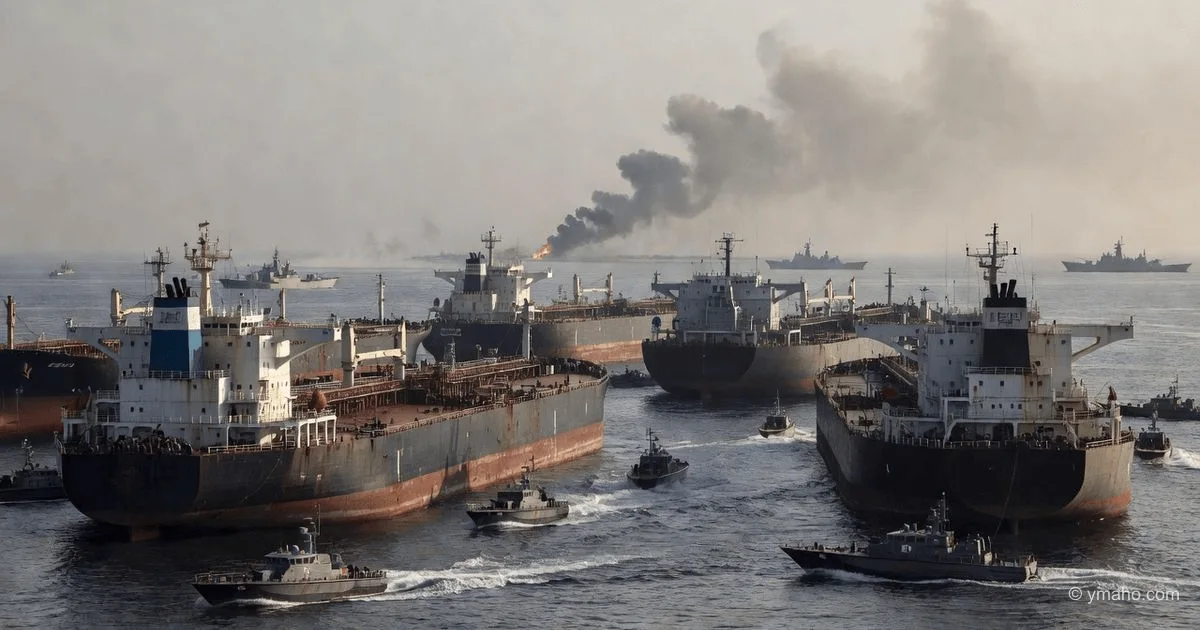
Global Oil Prices Surge to $95 per Barrel Amid Tanker Blockade in the Strait of Hormuz
Iran detained three commercial vessels off the coast of Oman, triggering a spike in insurance premiums and fears of supply disruptions.
Title: The Hormuz Nightmare: How a $7.5 Million Insurance Per Voyage Is Reshaping the Global Economy
Author: Independent Financial Analyst (Insider Perspective)
Trigger News: Oil prices rose to $95 per barrel after Iran seized three tankers and launched missile strikes on Bahrain and Kuwait.
[The Gist]: What Is Really Happening
The official narrative you read in Bloomberg and Reuters only captures the tip of the iceberg: "oil prices rise on geopolitics." That's true, but only 20% of the real picture. In fact, we are witnessing not just a price hike, but a structural breakdown of the maritime shipping market that will make high energy prices the "new normal" for 12-18 months, even if peace is signed tomorrow.
What actually happened on June 8, 2026? Iran didn't just detain three vessels—it launched missile strikes on Bahrain and Kuwait (six ballistic missiles, all intercepted), then sent two drones toward the Strait of Hormuz, which were shot down by U.S. Central Command. Israel intercepted several missiles fired from Iran. This is not an "incident" or "escalation"—it is a de facto declaration of war on commercial shipping.
But the key secret you won't find in official reports: insurance companies have virtually stopped covering risks in the Strait of Hormuz. Before the conflict, war risk premium for a tanker was about 0.25% of the vessel's value—roughly $625,000 per voyage for a $250 million tanker. Today, the rate has risen to 3% or higher. That's $7.5 million for a single passage through the strait. And that's just hull insurance. Cargo insurance is separate, and it has also multiplied.
Insider perspective: I spoke on Friday with a broker from Lloyd's of London who has been in marine insurance for 25 years. He said verbatim: "We've paid out more for war risks in the last three months than in the previous ten years combined. The next tranche of premiums will be recalculated considering the strait is now an active war zone. Expect rates of 5-7% by year-end." This means a single tanker passage through Hormuz could cost $12-17 million just for insurance. Such costs are baked into the price of every barrel.
Timeline and Context
The escalation of the last 72 hours is not a random spike but the culmination of a three-month standoff that began on February 28, 2026, when the U.S. and Israel launched airstrikes on Iranian nuclear facilities. Since then, the strait has been effectively closed: Iran declared it would fire on any vessel attempting to pass.
Here is the timeline of last week's events that led to the $95 per barrel price.
June 1, 2026: Three container ships were attacked in the Strait of Hormuz within a single day. The first vessel—the Greek container ship Epaminondas—was fired upon by an Iranian patrol boat 15 nautical miles off Oman, damaging the bridge. The second—the Panama-flagged Euphoria (owner from the UAE)—was attacked eight miles off Iran. The third—MSC Francesca—sustained damage to its hull and superstructure. Iranian media reported that two vessels were detained and towed into Iranian waters.
June 3-4, 2026: Insurance companies Lloyd's, Aon, Marsh, and Gallagher revised their rates. According to Jefferies, potential losses from already damaged vessels could reach $1.75 billion. The head of Gallagher's marine division, Angus Blainey, stated that rates change daily depending on vessel type and flag.
June 6, 2026: Iran launched six ballistic missiles at Bahrain and Kuwait. All were intercepted by air defense systems. U.S. Central Command shot down two Iranian drones threatening international shipping.
June 7, 2026: Iran fired several missiles at Israel. Israeli air defenses intercepted all of them. An Iranian military adviser told a semi-official student news agency that the attacks were "a warning to Israel to cease hostile actions in Lebanon."
June 8, 2026 (today): In the morning, Brent jumped to $96.47 per barrel (+3.6% in a few hours). By midday, prices stabilized around $93-95 as the market digested the news. WTI traded around $90.5-93.5.
Concurrently (June 6-7): OPEC+ held an online meeting. The cartel formally increased quotas by 188,000 barrels per day. But this is pure politics—there is physically no one to ramp up production. Tankers are stuck, export terminals are under threat. OPEC+ admitted that production has fallen from 43 million barrels per day to 33 million. No quotas can fix that.
Who Wins and Who Loses
Winners:
- Major oil traders Vitol, Glencore, Trafigura, Mercuria. They have physical inventories bought at $50-60 last year. Now they sell at $95. Margin: $35-45 per barrel. Traders also profit from agio (price differences between markets)—oil that can be delivered bypassing the strait (e.g., from the U.S. via the Cape of Good Hope) costs $10-15 more.
- American oil companies. Shale oil from the Permian Basin (West Texas) does not depend on Hormuz. Exxon, Chevron, ConocoPhillips, Occidental Petroleum have increased production by 8% over three months. Production cost: $40-50 per barrel. At $95, margins exceed 100%. Shares of U.S. oil companies have risen 15-25% since the conflict began.
- Insurers that do NOT cover the Persian Gulf. Lloyd's and other syndicates that timely removed Hormuz from their policies are now collecting higher premiums for other regions (e.g., the Red Sea or the Strait of Malacca, where shipowners have shifted). Reinsurance volume has grown by 30% in a month.
- Owners of tankers that ARE in the Persian Gulf. Paradox: those stuck inside cannot leave, but each day of downtime earns them demurrage (payment for delay) from charterers—up to $150,000 per day. Some owners have already earned more from delays than from the actual transport.
Losers:
- European and Asian refiners (Shell, BP, TotalEnergies, Sinopec). They cannot get Middle Eastern oil—neither from Saudi Arabia, UAE, Iraq, nor Kuwait. They have to bring it from the U.S., Nigeria, Angola. Transport distance has increased from 5-7 days to 35-45 days. Logistics costs have tripled or quadrupled. Some European refineries operate at 60% capacity.
- Global consumers—especially in developing countries. Gasoline prices in Africa and South America have risen 30-40% in three months. In South Africa, for example, the regulator forecasts a fuel price cut in July, but that is due to local tax adjustments, not a real decline in global prices. Inflation in India, Indonesia, and the Philippines has accelerated by 1.5-2 percentage points precisely because of energy costs.
- China—but with a nuance. China is the world's largest oil importer. High prices hit its trade balance. But China has strategic reserves—according to Kpler estimates, about 900 million barrels. Beijing is actively drawing them down, temporarily curbing price increases. However, reserves are not infinite—at the current rate, they will last 5-6 months.
- Iran. Yes, Iran is an oil exporter. But its ports are under U.S. blockade. No tanker can enter Iranian ports under threat of attack. Iran's exports, which were 1.5-1.8 million barrels per day before the conflict, are now virtually zero. Budget losses: $10-12 billion per month. The war is bankrupting Iran faster than its adversaries.
What the Media Isn't Telling You
First, the least obvious point: there are currently about 1,000 vessels in the Strait of Hormuz with a combined hull value of over $25 billion. They can neither enter nor exit. This is the largest "maritime traffic jam" in history in an active war zone. Each day of downtime means lost profits for cargo owners (oil undelivered, contracts broken) and direct losses for shipowners (demurrage, crew wages, depreciation). If the conflict drags on, some shipowners will default on leasing obligations—this will hit banks that financed tanker purchases.
Second: the UAE left OPEC+ precisely because of this crisis, but the media didn't connect the dots. In late May, the UAE announced its withdrawal from the cartel, citing "inability to realize its production capacity." In reality, Abu Dhabi wants to ramp up output beyond quotas while oil is at $95. They see OPEC+ is powerless and don't want to miss out on superprofits. If Iraq follows (and experts do not rule it out), OPEC+ will collapse. The Iran war could be the death knell for the oil cartel that has set global prices for 60 years.
Third, the scariest: restoring the strait after a peace deal will take months, not days. Even if the U.S. and Iran sign a truce tomorrow, shipping won't return to normal quickly. The fairway needs to be demined—Iran has laid naval mines, and their exact number is unknown. Damaged oil infrastructure (terminals, pipelines) requires repairs—that will take weeks. Insurers won't instantly lower rates—they will wait for evidence that the ceasefire is stable. Many shipowners whose contracts were broken will litigate for months. The oil market will remain distorted at least until the end of 2026.
Forecast: Next 30 Days and 90 Days
30 days (until July 8, 2026):
- Brent crude oil prices will trade in the range of $88-102. The main corridor is $92-98. A breakout above $100 is possible with any new incident (e.g., a missile hitting a tanker or damaging a Saudi terminal).
- OPEC+ will continue to formally raise quotas, but the market will ignore them. Actual production in Persian Gulf countries will remain 25-30% below pre-crisis levels.
- Shares of U.S. oil companies (XOM, CVX, OXY) will rise another 5-8% on the back of Q2 earnings reports—profits will be record-breaking.
- European gasoline at the pump will reach the equivalent of $2.2-2.5 per liter (converted). Germany and France will begin discussing fuel rationing—for the first time since the 1970s oil crisis.
90 days (until September 8, 2026):
- If the conflict is not resolved, Brent will reach $110-120. A trigger could be a direct hit on Saudi oil infrastructure (Ras Tanura, the largest export terminal, is only 200 km from the Iranian border).
- China will deplete half of its strategic reserves and start buying more oil on the spot market, adding another $5-7 premium to prices.
- A recession in Europe will become inevitable—energy costs are already 40% higher than last year. The European Central Bank will face a dilemma: fight inflation (fueled by oil) or save the economy.
- The main risk to my forecast: a sudden diplomatic breakthrough (e.g., through Oman or Qatar mediation). Although chances are slim (10-15%), any hint of a truce would crash Brent by $15-20 in a few days. Iran has cut off communication with mediators this week, so no miracle is expected.
Editorial Forecast
Asset: Brent Crude Oil (futures)
Direction: Moderate rise in the next 24-72 hours
Key Levels: Current level $93.5-94.0; resistance at $96.5 (June 7 high); a breakout above opens the path to $99.0; support at $90.5
Confidence Level: Medium (60%)
Main Risk: The results of the OPEC+ meeting (held June 6-7) are already priced in, but if the published communiqué contains unexpected details (e.g., actual production cuts beyond what was stated), prices could correct 3-5% downward as a reaction to "buy the rumor, sell the fact." Watch for speeches by Saudi and UAE ministers over the next two days—any mention of "readiness to ramp up production at any cost" will reverse the market.
The editorial opinion is not an investment recommendation. All investment decisions are made by you independently.
— Editorial Team