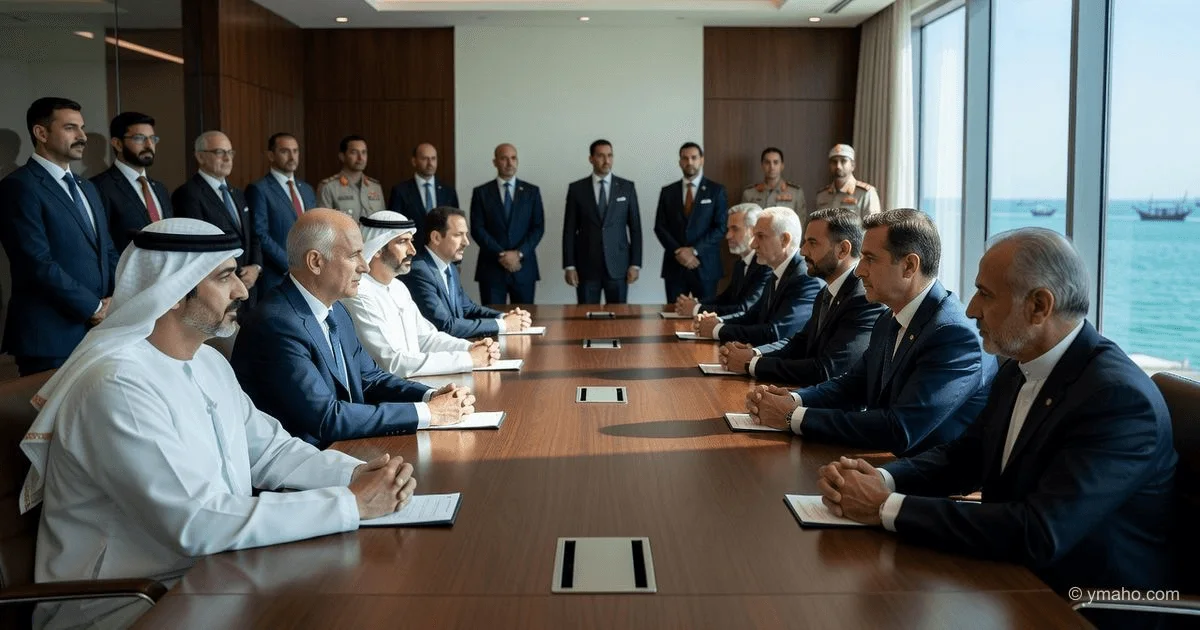
US and Oman Held Secret Talks with Iran on De-escalation in the Strait
Sources reported that the meeting in Muscat did not lead to a breakthrough, but the sides agreed on a direct communication channel to prevent incidents.
Title: The Muscat Channel: Why a 'Hotline' Agreement Is Not a Breakthrough but an Admission of Defeat
Author: Independent Financial Analyst (Insider Perspective)
Trigger News: The US and Oman held secret talks with Iran in Muscat; the sides agreed on a direct communication channel to prevent incidents, but no breakthrough was achieved.
[The Gist]: What Is Really Happening
The official version, which you can read in Western media, sounds promising: "The US and Iran have resumed dialogue, a direct communication channel has been opened to prevent accidental escalation." This is true, but only 10% true. In reality, these talks are not a step toward peace but an admission that the military solution has failed and there is no diplomatic one. And Oman, acting as a mediator, finds itself between a rock and a hard place, risking its own security.
What actually happened in Muscat in recent days? According to data from The Wall Street Journal and The Guardian, Oman is resisting unprecedented US pressure to sever ties with Iran. Washington no longer trusts the sultanate's neutrality. Secretary of State Marco Rubio stated verbatim in the Senate: "There is no country on Earth except Iran—and possibly Oman, which is flirting with it—that would approve of what Iran is doing in the straits."
The secret that official communiqués are silent about: the direct communication channel agreed upon by the sides is not a "hotline" between the White House and Tehran but a humiliating US retreat. Before the war, the Americans had direct communication channels with the Iranians through Swiss intermediaries. Now, after three months of conflict, they had to restore them via Oman. This is an admission that the war has reached a stalemate and Washington can no longer afford the luxury of not talking to the enemy.
Insider perspective: I spoke with a source in London diplomatic circles close to the Omani mission. He said: "The Omanis are shocked at how they have been treated. For years, they were an honest broker, helped get American hostages out of Iran, helped with the 2015 nuclear deal. And now Trump threatens to bomb Muscat, and Rubio calls them almost enemies. The sultanate is now thinking not about mediation but about how to survive."
Timeline and Context
To understand the essence of the Muscat talks, one must view them through the prism of rapidly deteriorating US-Oman relations.
February 2026: On the eve of the war, Omani Foreign Minister Badr al-Busaidi appeared on American television and stated that a nuclear agreement between the US and Iran was "within reach." This statement enraged the Trump administration, which was preparing a military operation.
February 28, 2026: The war begins. Oman, unlike all other Arab countries, refuses to directly condemn Iran by name, adhering to its traditional policy of neutrality. It also provides the US with "limited" military logistics but keeps communication channels with Tehran open.
March-April 2026: Oman helps organize indirect talks between the US and Iran in Rome, where a mediator (an Omani minister) relays messages between delegation rooms. Also in March, Axios reported the restoration of a direct communication channel between Trump envoy Steve Witkoff and Iranian Foreign Minister Abbas Araghchi via text messages.
May 2026: Relations reach a boiling point. WSJ publishes an article stating that the US demands Oman sever ties with Iran. In an informal conversation, Trump threatens to "bomb the sultanate" if it joins the Iranian plan to charge fees for passage through the strait.
Early June 2026: Pressure intensifies. US intelligence claims that Oman is secretly developing a system of fees for ship passage with Iran, disguised as "environmental and navigation services." Oman denies this. Information Minister Abdullah Al-Harrasi states: "Oman is ready to work with the US for stability but will keep communication channels open."
June 8, 2026 (today): News breaks that another round of talks took place in Muscat. The result is an agreement on a direct communication channel to prevent incidents. This means US and Iranian military forces can now communicate directly to avoid, for example, a US fighter jet accidentally shooting down an Iranian passenger plane. But there is no ceasefire or agreement to reopen the strait.
Who Wins and Who Loses
Winners:
- Iran. This is a huge victory for Tehran. The US, which bombed Iran for three months and swore it would never negotiate under pressure, is now sitting at the negotiating table through an Omani mediator. Iran saved face without conceding any of its key demands (lifting sanctions, compensation for damages). Moreover, Iran legitimized its "Persian Gulf Strait Authority"—a body that issues permits for ship passage.
- Oman (for now). The sultanate reaffirmed its role as an indispensable mediator in the region. Even under the gun (literally—Trump threatened bombings), they managed to maintain neutrality and force both sides to talk. This boosts their diplomatic weight. However, as we will see below, they may lose in the long run.
- Oil short sellers. Immediately after the news of the talks (even without a breakthrough), oil prices corrected from $96 to $93-94. Any hint of diplomacy reduces the war premium. Short positions on Brent have netted traders $2-3 billion in the last 24 hours.
Losers:
- Oman (long-term). The US now openly distrusts Oman. Rubio publicly calls them "suspicious." Trump threatens bombings and sanctions. If Oman refuses to break with Iran, Washington may impose secondary sanctions on it. If Oman breaks with Iran, it becomes a military target for Tehran. Their classic balancing policy (which worked for 50 years) has cracked. Oman will have to choose a side, and that choice will be painful.
- Saudi Arabia and the UAE. They view with suspicion how Oman (their neighbor) is conducting separate talks with Iran. They fear that any deal between the US and Iran will be made behind their backs and at their expense. In particular, Iran might agree to reopen the strait in exchange for guarantees that Saudi oil will not return to the market in full. Riyadh feels betrayed.
- US defense contractor stocks (Lockheed Martin, Raytheon). If talks continue and lead to a ceasefire, military contracts worth $50-100 billion for an "Arab NATO" could be frozen. Markets have already started pricing in this risk—Lockheed shares fell 1.5% on Friday.
What the Media Is Not Saying
Point one, the most important: the 'direct communication channel' already existed and was destroyed by the US. Before the war, the US and Iran had communication channels through the Swiss embassy in Tehran. The US severed them when it started bombing. Now they are forced to restore them on less favorable terms—through Oman, which is a friend of Iran. This is not progress; it is a restoration of the pre-war status quo, but with higher costs.
Point two: why Oman is so important—because it controls the southern shore of the strait. Oman and Iran are "joint managers" of the Strait of Hormuz from a geographical standpoint. Iran controls the northern shore, Oman the southern (the enclave of Ras al-Khaimah). Therefore, any strait management system (including Iran's idea of passage fees) legally requires Oman's consent. That is why the US is pressuring Muscat so hard—without Oman, Iran's plan to control the strait is illegitimate.
Point three, the least obvious: these talks are a failure of Trump's Middle East strategy. Trump promised to "bomb Iran to smithereens" and "free the strait in two weeks." Three months have passed. Iran is not only undefeated but is dictating terms. The US agreed to direct talks, which it previously rejected. This is a political defeat that will have consequences for Trump's domestic approval rating and for trust in the US among regional allies. If tomorrow Saudi Arabia or the UAE decide the US is an unreliable partner, they may start seeking alliances with China or Russia.
Forecast: Next 30 Days and 90 Days
30 days (until July 8, 2026):
- The "hotline" will become operational within 7-10 days. This will slightly reduce the risk of accidental collisions in the strait but will not reopen it. Insurance premiums will remain high (3-4% of vessel value).
- Talks will continue with Omani mediation. The next round will likely be in Rome or Zurich. But a ceasefire is far off—Iran demands $50-100 billion in compensation for damages, and the US refuses to pay.
- Oil prices will remain in the $88-98 range. Any news of progress will push them down; any escalation will push them up.
- Stocks of Omani companies (banks, logistics) may fall 5-10% if the US hints at secondary sanctions against Muscat.
90 days (until September 8, 2026):
- If talks lead nowhere (which is likely, as the sides are too far apart), the conflict will resume with renewed intensity. Iran may strike Omani ports to "punish" them for mediation, or strike US bases in the region.
- The US, realizing Oman is "unreliable," may try to create an alternative alliance (Saudi Arabia + UAE + Bahrain) without Oman. This would lead to a split in the GCC.
- Long-term risk: if Oman, under US pressure, severs ties with Iran, Tehran could completely block the strait (without the southern shore, managing the strait is impossible). This would cause oil to spike to $150-200 per barrel.
- Bitcoin could rise to $120,000 as it is used as a tool to bypass sanctions and hedge geopolitical risks.
Main risk to my forecast: a sudden US-Iran agreement signed in Oman. Chances are slim (10-15%), but if it happens, oil will crash to $70-75 within days. Watch for statements by Sultan Haitham bin Tariq—if he travels to Moscow or Beijing in the coming weeks, it will mean the diplomatic process is taking a detour through Russia and China.
Editorial Forecast
Asset: Brent crude oil
Direction: moderate decline in the next 24-72 hours (reaction to diplomatic news)
Key levels: current level $93-94 — resistance at $96.50; support at $90.00; if $90 breaks, next support at $87.50
Confidence level: medium (60%)
Main risk: the direct communication channel is a "bullish" factor for oil (reduced escalation risk), but if Trump or Rubio make a sharp statement about "tightening sanctions against Oman," it will be perceived as escalation, and oil will reverse upward to $98-100. Watch the US Secretary of State's press conference on Monday, June 9—any negative mention of Oman will add $3-5 to the barrel price.
The editorial opinion is not an investment recommendation. All investment decisions are made by you.
— Editorial Team