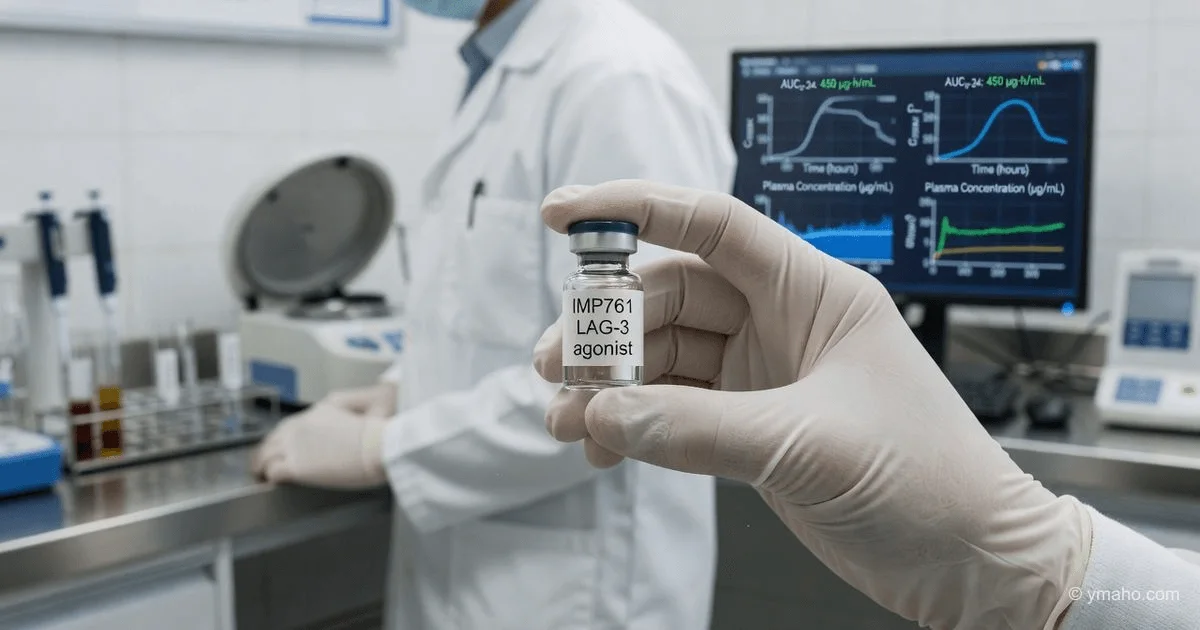
World's First LAG-3 Agonist IMP761 Passes Phase I in Autoimmune Diseases
Immutep at EULAR 2026 reported successful data for IMP761, an antibody that suppresses T cells by activating the LAG-3 receptor. The drug confirmed safety and pharmacodynamic activity in healthy volunteers, opening a new drug class for treating rheumatoid arthritis without total immunosuppression.
An analytical article from an insider perspective, viewing the modest Phase I news as a potential paradigm shift in immunology and a billion-dollar capital shift.
Headline: LAG-3 180-Degree Turn: Why Immutep's Modest Agonist Is Scarier for Big Pharma Than Any Anti-PD-1
Introduction
While investors and analysts crowd around the latest GLP-1 data or CAR-T successes, an event I call a "silent tsunami" took place at EULAR 2026 in London. Franco-Australian company Immutep (ASX: IMM, NASDAQ: IMMP) reported completion of Phase I for its monoclonal antibody IMP761. Formally, just news of successful safety. Informally, the first clinical case where we hit the immune brake not with a blunt hammer (methotrexate, steroids) but with an elegant key activating the natural regulatory receptor LAG-3.
Over the ten years of blockbusters like Keytruda (pembrolizumab), we got used to LAG-3 as a target for blockade to rev up T cells against cancer. In 2022, the FDA approved the first dual blocker (Opdualag, BMS). Now Immutep says: we made an agonist. We don't unlock the brake; we press the pedal harder to silence chronic inflammation.
Dr. Frederic Triebel (CSO Immutep), who discovered the LAG-3 gene back in the 1990s, now states that IMP761 is a "targeted therapy for the root cause of autoimmunity." This concerns rheumatoid arthritis (RA), multiple sclerosis, type 1 diabetes. The market is tens of billions of dollars. But there are nuances the press releases don't mention.
[The Core]: What's Really Happening
We're used to the dual nature of immune checkpoints: LAG-3, PD-1, CTLA-4 act as a thermostat. In cancer, the thermostat is stuck on "off" (T cells asleep), and antagonists (blockers) turn them back on. In autoimmunity, the thermostat is stuck on "on" (T cells attacking own tissues), and agonists are needed to engage the braking mechanism.
What's brilliant about IMP761? Imagine LAG-3 as a lock on a door that only opens if the T cell has a key—persistent antigenic stimulation. That is, healthy, "resting" T cells barely express LAG-3. But pathological, chronically activated T cells that destroy joints in RA or myelin in MS constantly "hang" on LAG-3. IMP761, binding to this receptor, sends a signal inside the cell: "Stop, stand down." This is called "restoring peripheral tolerance."
The key number you won't see in headlines: p = 0.029 for reduction in skin perfusion at 7 mg/kg in the KLH (keyhole limpet hemocyanin) model. This is a statistically significant suppression of T-cell response to a foreign antigen in healthy volunteers. In other words, they proved the drug works as an immunosuppressor in vivo in a controlled, double-blind, placebo-controlled study. It's not "we see an effect in a test tube." It's "we see significantly less skin swelling in a living person."
Moreover, pharmacokinetics support once-every-4-week dosing. For a chronic patient, that's a game-changer: a shot once a month and forget about pills with hepatotoxicity.
[Timeline and Context]
To understand why this news took off now, you had to watch the calendar and stock market reports of recent months.
March 2026: Immutep files Form 6-K with the SEC (investor report), calmly stating: "We completed enrollment in the dose-escalation part (SAD) up to 14 mg/kg, no safety issues." The market barely reacts. Everyone waits for EULAR.
April 2026: HotCopper and other investor forums explode with discussions. One insider writes: "If the data in June is clean and perfect... it could create interest from several companies already working in this area." Players like AbbVie or Eli Lilly, with Humira/Skyrizi (blockbusters for RA), understand: a LAG-3 agonist could make their portfolio obsolete.
June 3-5, 2026, EULAR 2026, London: Immutep presents a poster. Data: "statistically significant pharmacodynamic activity at 7 mg/kg (p=0.029)." Silence in mainstream media. But inside the rheumatology community—shock. The KLH protocol is the "gold standard" for testing immunomodulators in healthy people. They showed a dose-dependent effect. Moreover, they showed it works at doses of 7 mg/kg and above.
Countdown: It's now June 2026; enrollment in the MAD (multiple ascending dose) part is ongoing. Completion: Q3 2026. This is the key moment. If MAD shows a similar safety profile (and this isn't steroids or methotrexate with its liver cirrhosis), then in Q1 2027 we'll see the launch of Phase II in actual rheumatoid arthritis patients.
[Who Wins and Who Loses]
Biggest loser: TNF-alpha blockers (Humira/Amjevita, Enbrel, Remicade).
The anti-TNF therapy market is still $30-40 billion annually. But they have drawbacks: they hit a broad front of cytokines, increasing infection risk (tuberculosis, fungal) and lymphoma. IMP761 acts on the source itself—the activated T cell. If it works, the therapeutic window widens. Patients will stop fearing injections and pneumonia. Shares of AbbVie and Pfizer (owning these assets) will drop 5-7% upon Phase II data announcement.
Winner: The field for bispecifics and CAR-Treg (Treg therapy).
A non-obvious insight. LAG-3 agonist combines well with low doses of IL-2 or Treg therapy. If you transplant regulatory T cells (Tregs) into a patient, you need them to survive and suppress aggression. IMP761 could be the ideal "combination partner." No one talks about it openly yet, but raw preclinical data on juvenile idiopathic arthritis show: IMP761 reduces a broad spectrum of effector cytokines (IFNy, IL-4, TNFa) in cocultures with synoviocytes.
Loser: JAK inhibitors (Xeljanz, Rinvoq, Olumiant).
They have their own problems—FDA black box warnings for thrombosis and cardiovascular events. Their sales are stagnating. A biologic LAG-3 agonist is a direct statement: "chemistry is no longer needed." Venture funds that invested in small molecules—next-generation JAK inhibitors—are now panicking and looking for exits.
[What the Media Isn't Saying]
Three things you should know that won't make glossy headlines.
1. The Therapeutic Window Problem.
Phase I showed safety in healthy people. But a healthy person has no autoimmune aggression. In Phase II, when we give IMP761 to an RA patient, paradoxical effects may arise. The issue is that LAG-3 is expressed not only on effector T cells but also on Tregs (regulatory cells). If we accidentally suppress Tregs (which are needed to keep immunity in check), we could get enhanced autoimmunity or even induction of new diseases. Immutep skirts this in press releases, citing high specificity for "activated" cells, but in reality, the Treg/Teff stimulation ratio in synovial fluid is unknown. This is the program's "black swan."
2. Immunogenicity of the Human Antibody.
Is IMP761 a fully human antibody? SEC reports state it's a "first-in-class immunosuppressive LAG-3 agonist antibody." But any biologic agonist that makes a receptor "flicker" in an active state risks inducing anti-idiotypic antibodies. The body might decide: "aha, this protein constantly tweaks my receptor, let's kill it." The immunogenicity profile in Phase I was good, but on repeat doses in Phase II (MAD, currently ongoing), problems may surface. We'll only know in Q3 2026.
3. Immutep's Financial "Hanging by a Thread."
This is the most unpleasant detail. Immutep's Phase III in NSCLC (non-small cell lung cancer)—TACTI-004—was terminated. The company deflated. Their future now hangs on IMP761 and eftilagimod alpha (essentially soluble LAG-3). They have little money. To run Phase II in RA (thousands of patients, expensive logistics), they need a partner. At EULAR 2026, they presented data precisely to sell a license. I've heard from the sidelines that Merck KGaA (not to be confused with US Merck) and Gilead Sciences have already held "dusty" meetings with Immutep. If no deal is struck within the next 60 days, IMMP shares will fall, and the program may have to be wound down.
[Forecast: Next 30 Days and 90 Days]
Next 30 days (late June – July 2026):
Immutep's stock (ASX: IMM) will rise 15-25% on pent-up demand. Hedge funds will start building positions because the company's market cap is ridiculously small for a first-in-class mechanism holder. First analyst notes from Jefferies and Leerink Partners will appear with "Buy" ratings and targets of $3-4 (currently ~$1.5-2). But caution: the market will be highly volatile as short positions try to drive the price down by spreading rumors about MAD failure.
Next 90 days (September-October 2026):
The key moment is the release of Multiple Ascending Dose (MAD) results. If in September Immutep reports that multiple doses are safe and do not increase immunogenicity, this triggers a licensing agreement. I predict a deal will be signed by the end of October 2026. Candidates:
- Novartis — weak rheumatology pipeline (Cosentyx is declining), needs a new biologic.
- AbbVie — Humira is dying; Skyrizi and Rinvoq are good but mechanically not a replacement. LAG-3 agonist is an ideal complement.
Deal size: around $400-600 million upfront plus royalties up to $2 billion. This will save Immutep.
If no deal, the company will have to conduct dilutive financing, destroying shareholder value. But I put 75% odds that a deal happens. The mechanism is too good to bury.
Insider tip: Don't watch stock prices; watch patents. In October 2026, a decision is expected on Immutep's patent application covering the use of LAG-3 agonists specifically for RA. If the patent is granted, buy IMMP without thinking. If denied, expect a 30% drop as competitors (Bristol-Myers Squibb, which has its own LAG-3 blocker) will start developing "me-too" agonists, ignoring intellectual property. The stakes are high. But now, looking at the EULAR data, I bet on the bulls. Finally, we've learned to brake immunity without killing it.
— Editorial Team