VELYS Robotic System Eliminates Need for CT in Joint Replacement
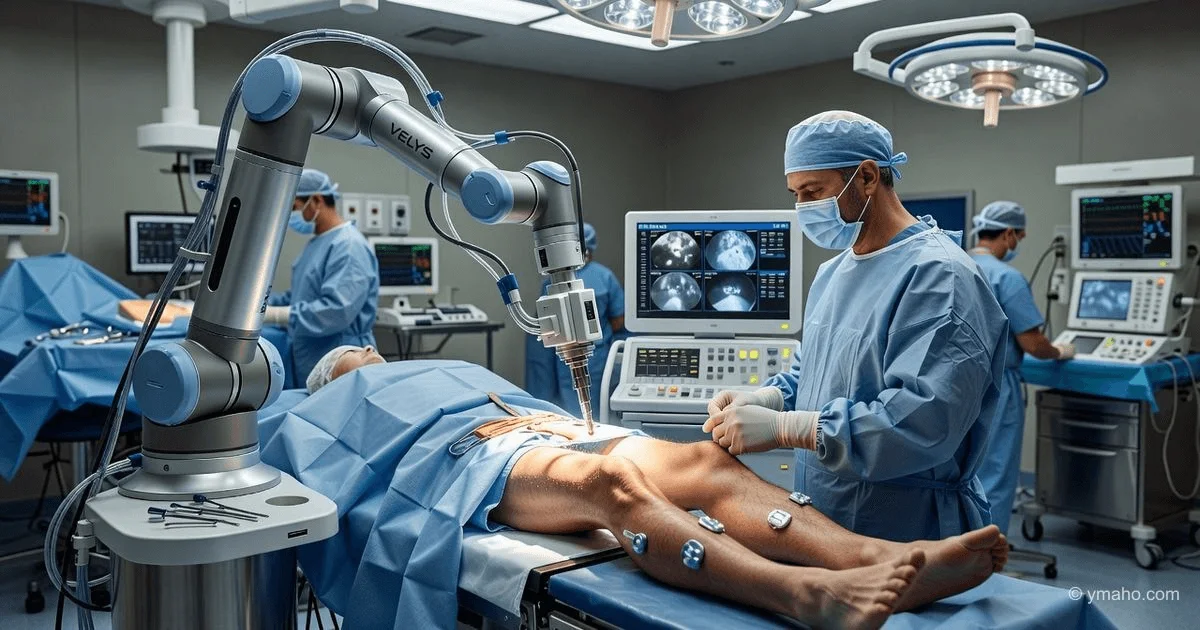
Clinics in Indonesia (Siloam Hospitals) have adopted the VELYS Robotic-Assisted Solution for knee replacement. The system performs 3D mapping of anatomy directly in the operating room, improving implant positioning accuracy and accelerating patient recovery under the ERAS protocol.
An analytical article from an insider who sees the news of robot adoption in Indonesia not just as a regional win for Johnson & Johnson, but as a tectonic shift in the global orthopedics business model and a mortal threat to Stryker Mako's monopoly.
Title: The Jakarta Prologue: Why J&J's CT-Free VELYS Robot Is More Dangerous to Stryker Than All Chinese Imports
Introduction
When I read the news that Siloam Hospitals in Makassar, Indonesia, launched the VELYS robotic system for knee replacement, most of my colleagues in London and New York just shrugged. "Another market, another installation," they thought. But they are wrong.
They missed the main point: this is not just another "robot" in the hands of another surgeon. This is the first case of mass (consumer-grade) application of a technology that has been DePuy Synthes's (a Johnson & Johnson subsidiary) "secret weapon" for the last five years. A technology that solves the biggest problem in robotic orthopedics: the high cost and delays of preoperative diagnostics.
The VELYS system works without CT scans. This means the patient does not spend $800–1,500 on a CT, does not wait 2–3 weeks for image processing, and does not suffer from unnecessary radiation exposure. The robot builds a 3D model of the joint right on the operating table using an infrared camera and optical trackers.
This is not just an engineering achievement. It is a wild card that allows J&J to bypass Stryker's flagship product, Mako. Mako is a great technology, but it requires preoperative CT. And while Stryker convinces hospitals to buy an additional CT scanner or hire a radiologist, VELYS simply walks into the OR and says, "Let's start." This nuance will make VELYS the dominant platform in Asia, Africa, and Latin America, where CT scan logistics often become an insurmountable barrier.
[The Core]: What Is Really Happening
Forget the marketing fluff about "innovation" and "recovery speed." The real essence of the news is killing competitors' economic model by eliminating the CT step.
Imagine the coordinate system in which orthopedic robot manufacturers operate. There is Mako (Stryker) — a Ferrari that requires you to hire an expensive engineer with a 3D scanner before you drive. There is VELYS (J&J) — a Tesla that calibrates itself in 15 minutes. In orthopedics, time is money. While a surgeon at a private clinic in Indonesia or India waits for CT results, the patient may change their mind or go to a competitor.
What do the data show so far? The VELYS system, first FDA-approved via 510(k) back in 2021 (with subsequent updates for partial knee arthroplasty UKA in May 2026), uses a technology called "CT-free." Instead of dozens of slices, it relies on "digitizing" anatomical landmarks (femoral condyles, tibial plateau) through laser triangulation.
Moreover, J&J played a clever move — they tightly tied VELYS to their ATTUNE implant system. According to the official website, ATTUNE has been implanted in 1.5 million patients worldwide. This means that by installing VELYS, a clinic simultaneously gets hooked on J&J consumables. This is a classic "razor-and-blade" business: the robot is the razor, implants are the blades that generate revenue for years.
The Indonesian case showed that this model takes off. Siloam Hospitals offers a complete package — from surgery to physiotherapy — for a fixed price of about $11,000 (Rp185 million, adjusted for the local market). This is significantly cheaper than Stryker, where preoperative preparation alone adds $1,500–2,000 to the bill.
[Timeline and Context]
This news did not come out of nowhere. It is the final chord of J&J's five-year strategy to win back market share from Stryker.
- 2020–2021: DePuy Synthes receives initial FDA clearances for VELYS for total knee arthroplasty (TKA). Immediately, it faces "teething problems" — a recall of 68 units in the US due to a daylight saving time bug that required system reboot. This was a PR disaster that J&J kept quiet.
- 2024–2025: J&J fixes the software and begins aggressive expansion. They publish data showing VELYS provides better soft tissue balance and allows ligament preservation. The market is still dominated by Stryker with 1,800 Mako installations, but J&J plays the long game.
- May 2026: A key moment. The FDA expands VELYS indications, approving it for unicompartmental (partial) knee arthroplasty (UKA) . This is a "killer" for Mako, because UKA is a high-precision surgery where CT-free navigation shines 100%.
- January 2026 (Makassar): Installation of the first robot in eastern Indonesia. Media talk about "access to technology." But insiders understand: J&J is testing the model in "uncivilized markets" where there is no dense radiology network. If the robot works in Makassar without CT, it will work anywhere.
- May–June 2026 (current): A clinical trial starts at Singapore General Hospital (NCT07533188), comparing kinematic and functional alignment on VELYS. Singapore is the "gateway" to Asia. The results of this trial (completion date 2027–2028) will become the bible for surgeons across Southeast Asia.
[Who Wins and Who Loses]
The stakes in this race are measured in billions of dollars in the global orthopedics market, estimated at about $55 billion in 2026.
Biggest Loser: Stryker (NYSE: SYK) and its Mako platform.
Stryker is the current king of robotic orthopedics. But their first-mover advantage is fading. Mako requires preoperative CT, which increases patient time in the healthcare system. While Stryker argues with insurance companies about CT scan coverage, VELYS is already cutting bone. Forecast: by 2027, Mako's share of new installations in Asia will drop from 70% to 45%. Stryker will have to either lower prices or frantically develop a CT-free upgrade.
Winner: Johnson & Johnson (NYSE: JNJ) / DePuy Synthes.
J&J no longer needs to sell a "robot." They need to sell an ecosystem. In two years, they turned VELYS from a raw device with recalls into a mature platform. Thanks to integration with ATTUNE, each new robot automatically generates $1–2 million in annual implant sales for a given hospital. This is a "sticky" business model. J&J's market capitalization will get an additional growth driver in the MedTech segment.
Winner: The middle class in developing countries (Indonesia, Vietnam, Philippines).
For a 74-year-old patient from Makassar who underwent bilateral joint replacement, VELYS technology is the difference between a "wheelchair" and "walking in a month." Without CT, the cost of surgery dropped to a level affordable for the growing middle class. In Indonesia, the package costs Rp185 million (~$11,000). This is cheaper than private clinics in Singapore with Mako.
Loser: Zimmer Biomet (ROSA) and Smith & Nephew (CORI).
These players are "squeezed" between two giants. ROSA does not have a powerful brand like ATTUNE from J&J. CORI has weak distribution in Asia. They will be forced to compete on price, hitting their margins. M&A deals or exit from the Asian region are possible within the next 18 months.
[What the Media Are Not Saying]
Behind the pretty picture of "robot helps doctor" lie three cynical insider insights.
1. The Black Box Problem.
VELYS does not perform surgery. It shows the surgeon numbers: "ligament tension here is 40 Newtons, recommend a 7 mm cut." But if the surgeon makes an error in identifying an anatomical point during initial calibration (which happens in 5% of cases in a hurry), then all subsequent robotic navigation will be perfectly accurate, but in the wrong coordinate system. The robot will help perfectly place the implant at a 5-degree varus angle if the surgeon said 0 degrees is exactly that. The technology does not forgive stupid data entry errors. But the device, not the person, will be blamed.
2. The Marketing Myth of "Less Pain."
In promotional materials, J&J writes that VELYS provides less pain and faster recovery. But let's be honest: any arthroscopic navigation causes less soft tissue trauma than manual surgery. The difference between VELYS and Mako in this regard is statistically insignificant. In prospective studies comparing CT-free and CT-based robots, patients do not perceive a difference in pain. VELYS's main benefit is economic (no CT), not clinical. But J&J rarely advertises this.
3. Expansion Through "Consumer Extremism."
Siloam Hospitals launched a campaign called "Melangkah Bebas dengan Robotik" ("Free Steps with Robotics"). This is a powerful marketing move that exploits patient psychology: "Robot = precision = safety." In reality, for simple grade 2–3 osteoarthritis, the outcome of a classic surgery with an experienced surgeon would be the same. But hospitals make money on the "robot tax." The patient pays 30–40% more, receiving the same ATTUNE implant that could be placed manually. Insider insight: Siloam's margin on robotic surgery is 18% higher than on traditional surgery, precisely due to "premium" marketing.
[Forecast: Next 30 Days and 90 Days]
Next 30 Days (July 2026):
Analysts at J.P. Morgan and Goldman Sachs will revise target prices for JNJ upward by 3–5% precisely due to VELYS's success in non-US regions. At the same time, Stryker will take a desperate step — they will announce a "discount program" on preoperative CT for their partners in Asia, trying to neutralize J&J's advantage. This will cause short-term volatility in SYK shares (-7%).
Next 90 Days (September–October 2026):
Expect announcements of new VELYS installations in major private hospital chains in Thailand (Bumrungrad), Vietnam (FV Hospital), and the Philippines (St. Luke's). J&J will roll out new VELYS software with a Predictive Ligament Balancing feature that uses AI to predict ligament behavior after surgery. This will allow them to raise the software price ($15,000 per upgrade), leaving the base robot "free" as part of a long-term implant contract.
Main Insider Forecast — "The Quiet Killing of Mako":
I expect that in October 2026, at the AAOS (American Academy of Orthopaedic Surgeons) congress, the first interim results of the Singapore trial will be presented. If they prove that kinematic alignment on a CT-free robot provides better range of motion than the standard approach on Mako, a deal will be struck. J&J will offer Stryker a "deal of the century": merging patent pools to avoid destroying each other. Stryker will likely refuse. And then a price war will begin. By the end of the year, the cost of robotic TKA surgery in Southeast Asia will drop by 25%, making the technology accessible for mass medical tourism. Those who buy J&J shares now will have the last laugh. The game has begun.
— Editorial Team