Old Antidepressant Extends Lifespan in Progeria Treatment
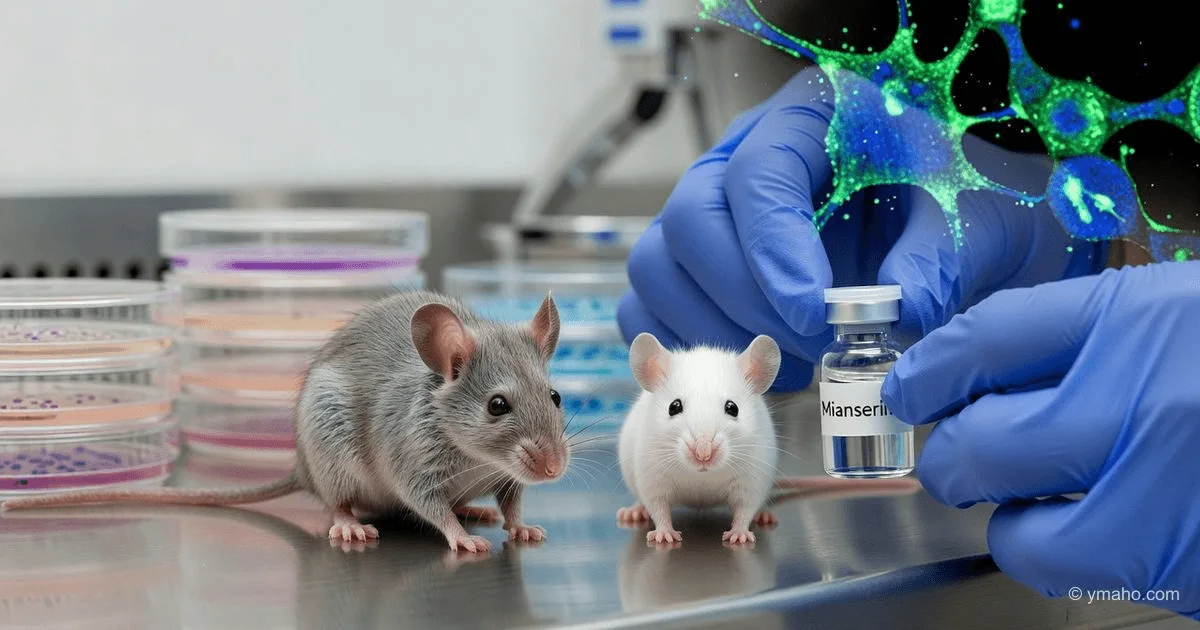
A study in Nature Communications showed that mianserin (MIA) restores calcium homeostasis by suppressing the S100A6 protein and the cGAS-STING pathway. Administration of the drug significantly extended the lifespan of mice with progeria and naturally aging mice, opening new strategies for geroprotection.
An analytical article from an insider who sees behind the publication in Nature Communications not just another "old drug against aging," but a detailed molecular mechanism linking calcium, DNA damage, and immune inflammation—and challenging half of the geroprotector industry.
Headline: The Antidepressant That Knew Calcium's Secret: Why Mianserin's Mechanism Is Scarier for Geroprotection Than the Drug Itself
Introduction
History repeats itself with remarkable regularity: an old, cheap, long-forgotten drug is taken, given to mice—and they live longer. Metformin, rapamycin, acarbose... Now it's mianserin's turn—a tetracyclic antidepressant known since the 1970s. A group of researchers from China (Weifang Xiang et al.) published data on June 5, 2026, in Nature Communications showing that mianserin (MIA) extends the lifespan of mice with progeria (by 27.9%) and, more importantly, normal aging mice—by about 17.5% in median.
Formally, this is good news, but not a shock. Informally, this is the first work where the geroprotective effect of an old drug is broken down to the level of a single molecule (S100A6), a specific pathway (cGAS-STING-NF-κB), and even a specific receptor (HTR2B/2C). Usually, longevity studies show a correlation: "We gave X, mice lived longer, why—unclear." Here, the authors claimed: we know exactly how mianserin works at the molecular level. And this knowledge is more valuable than the drug itself.
I have been analyzing the geroprotection market since 2019, and I hasten to warn you: this publication is not a call to stock up on mianserin at pharmacies (although biohacker forums are already buzzing). It is a roadmap for creating the next generation of anti-aging drugs that will hit the target precisely, not "blindly" through an old antidepressant with its side effects.
[The Essence]: What Is Really Happening
Stop thinking of mianserin as an antidepressant. In this work, it is merely a tool, a probe to uncover the mechanism of aging. And the mechanism the authors revealed turned out to be more complex than expected.
Here is the logical chain assembled by the authors on progeria cells (HGPS) and naturally aging mice:
- Calcium homeostasis disruption—the first link. In aging cells, calcium leaks from its stores into the cytoplasm.
- Cytoplasmic calcium binds to the S100A6 protein (a calcium-binding protein). The concentration of S100A6 in the cytoplasm rises sharply.
- S100A6 recruits CacyBP—an adaptor protein that leads to ubiquitination and degradation of PARP1 (poly-ADP-ribose polymerase 1).
- Loss of PARP1 (a key DNA repair enzyme) leads to accumulation of DNA damage and, consequently, the appearance of chromatin fragments in the cytoplasm (cytosolic chromatin fragments, CCF).
- CCF trigger the cGAS-STING-NF-κB pathway—an immune sensor of foreign DNA that, in this case, perceives the cell's own chromatin debris as a threat and activates chronic inflammation (SASP factors—senescence-associated secretory phenotype).
Thus, the authors have for the first time linked into a single chain: calcium → S100A6 → PARP1 → cGAS-STING → aging. This is not just "a drug extends lifespan," but a full-fledged theory of how a cell senses it is old and activates a program of self-destruction and inflammation.
And mianserin? It acts at the very top of this chain: as an antagonist of serotonin receptors HTR2B and HTR2C, it reduces calcium influx into the cell, thereby restoring homeostasis. Moreover, it works on cells from progeria patients and cells from elderly individuals. This means the target (calcium dysregulation) is common to accelerated and natural aging.
[Timeline and Context]
The history of studying mianserin as a geroprotector spans almost 20 years—and this is the most important context that journalists overlook.
2007: Nobel laureate Linda Buck publishes a paper in Nature showing that mianserin increases the lifespan of C. elegans (nematodes) by 31%. At the time, it was seen as a curiosity: "an antidepressant for worms." The mechanism was unclear, although Buck pointed to serotonin receptors SER-4 and SER-3 (analogs of human HTR2). Then—almost two decades of silence. No one translated these observations to mammals. Too complex, too expensive.
2020-2024: A series of works from China (Xiang et al.) on S100A6 and progeria. They gradually assembled the puzzle, but without therapy.
June 5, 2026: Publication of the final work in Nature Communications. For the first time, mianserin was tested on mice with progeria (Lmna^G609G/G609G) and on naturally aging mice (C57BL/6, treatment started at 20 months, equivalent to ~65 human years).
Numbers to remember:
- Progeroid mice: median lifespan increase of 27.89%.
- Naturally aging mice: median increase of ~17.5%.
Moreover, not only survival numbers improved, but also aging phenotypes: coat condition, mobility, inflammation levels. It was not just "delaying death" but improving healthspan. The authors also conducted analysis on C. elegans, confirming that key molecules (S100A6, CacyBP, PARP1) have evolutionarily conserved analogs, strengthening the significance of the discovery.
[Who Wins and Who Loses]
Winner #1: Researchers of the cGAS-STING pathway.
Until now, cGAS-STING was studied mainly in the context of infections and cancer (when viral or tumor DNA enters the cytoplasm). Now this work definitively establishes cGAS-STING as one of the central drivers of sterile inflammation in aging. All those developing cGAS or STING inhibitors (e.g., IFM Therapeutics, acquired by Novartis, or SpringWorks Therapeutics) gain a new indication: not only autoimmune diseases but also geroprotection. The market potential of these molecules multiplies.
Winner #2: Cheap generics on the black market of longevity.
Mianserin is not FDA-approved and is not available by prescription in the US. But on international markets (UK, EU, Asia), it can be purchased for about GBP 5-15 per pack. This means biohackers (wealthy longevity enthusiasts) will start experimenting on themselves immediately. A monthly dose will cost about $15-30. And, unlike many questionable nutraceuticals, mianserin is a real pharmaceutical with known pharmacokinetics. The Rapamycin News forum is already discussing dosing protocols. This will create a new "gray" market.
Loser #1: Manufacturers of expensive geroprotectors with "unclear mechanisms."
Any startup selling supplements or expensive synthetic molecules as "anti-aging" without clear molecular justification will look like quackery after this publication. Now investors will ask: "Do you have evidence that your drug modulates S100A6 or cGAS-STING?" If not, no funding.
Loser #2: Researchers who did not link their observations to calcium.
For decades, work on calcium homeostasis and aging remained on the periphery. Now this topic will become mainstream. NIH and ERC grant committees will favor projects studying S100A6, PARP1, or calcium channels as targets for geroprotection. Those who continue to "poke in the dark" for an elixir of youth will struggle.
[What the Media Aren't Saying]
As always, the devil is in the details. Three points that won't make it into enthusiastic headlines.
1. Small sample size and only one sex of mice (females).
According to discussions on professional forums, the study used only female mice. Geroprotective effects are often sex-dependent. What works in females may not work in males. Additionally, the number of mice in natural aging groups was limited. A 17.5% median increase is impressive, but replication in larger samples is needed, ideally within independent consortia (e.g., Interventions Testing Program—ITP). Until then, treat the number as preliminary.
2. Serious risk of agranulocytosis and sedation—does benefit outweigh risk?
Mianserin is an old antidepressant with a known safety profile. It has a rare but extremely serious complication: agranulocytosis (drop in neutrophil levels, leading to susceptibility to infections). In clinical practice, this requires monitoring. Additionally, mianserin causes sedation (drowsiness) and weight gain. Extending life by a few years at the cost of chronic fatigue and constant blood monitoring—is that a trade-off a healthy 50-year-old wants? Rhetorical question. The authors sidestep this issue, as their goal was to prove the concept, not assess human risk.
3. Dosage problem when translating to humans (HED—human equivalent dose).
The study used a concentration of 50 µM on cells and a specific dosage in mice. Converting this dose to humans is a separate story. The biohacker community is already discussing that the equivalent dose may be too high and cause pronounced side effects. There is no guarantee that the standard antidepressant dose of mianserin (30-60 mg/day) will provide the same geroprotective effect as a higher dose. And a higher dose may be toxic with long-term use. The authors did not propose a ready protocol for humans—and rightly so, because it still needs to be developed in clinical trials.
[Forecast: Next 30 Days and 90 Days]
Next 30 days (July 2026):
The biohacking market will explode. Wealthy longevity seekers (of Bryan Johnson's caliber) will start including mianserin in their protocols. The first unofficial reports of use, biomarker measurements (particularly cytokine levels and S100A6, though the S100A6 test is not yet commercialized) will appear. Forums like Rapamycin News will fill with questions about dosages and sources of mianserin.
Next 90 days (September-October 2026):
Expect an announcement from some biotech company (likely from China or the US) about the creation of a selective HTR2B/2C antagonist that does not cross the blood-brain barrier. Why? Mianserin acts on both the brain (antidepressant effect, sedation) and the periphery (calcium reduction in fibroblasts, vascular cells). By creating a molecule that does not enter the brain, side effects (drowsiness, risk of agranulocytosis) can be avoided, yielding a pure geroprotector for peripheral tissues. The market for such a molecule is tens of billions.
Also, negotiations will begin for phase II clinical trials in elderly people (65+). Likely, these will be initiated not by Big Pharma (which has no interest in a cheap generic) but by non-profit foundations like the SENS Research Foundation or Bryan Johnson's organization. If trials show positive results on surrogate markers (inflammation levels, physical function), mianserin will get a "second life" and be prescribed off-label for healthy aging.
The main insider takeaway:
Don't look at mianserin. Look at S100A6 and cGAS-STING. These are the next big targets for pharmaceuticals in longevity. The company that first creates a safe S100A6 inhibitor or a small molecule stabilizing PARP1 in aging cells will be worth more than all current longevity startups combined. Mianserin is just the key to the lock. The lock itself is now visible. And the key, unfortunately, is imperfect. But knowledge of the mechanism makes patenting an "anti-aging molecule" no longer fantasy but a matter of engineering. The game has begun.
— Editorial Team