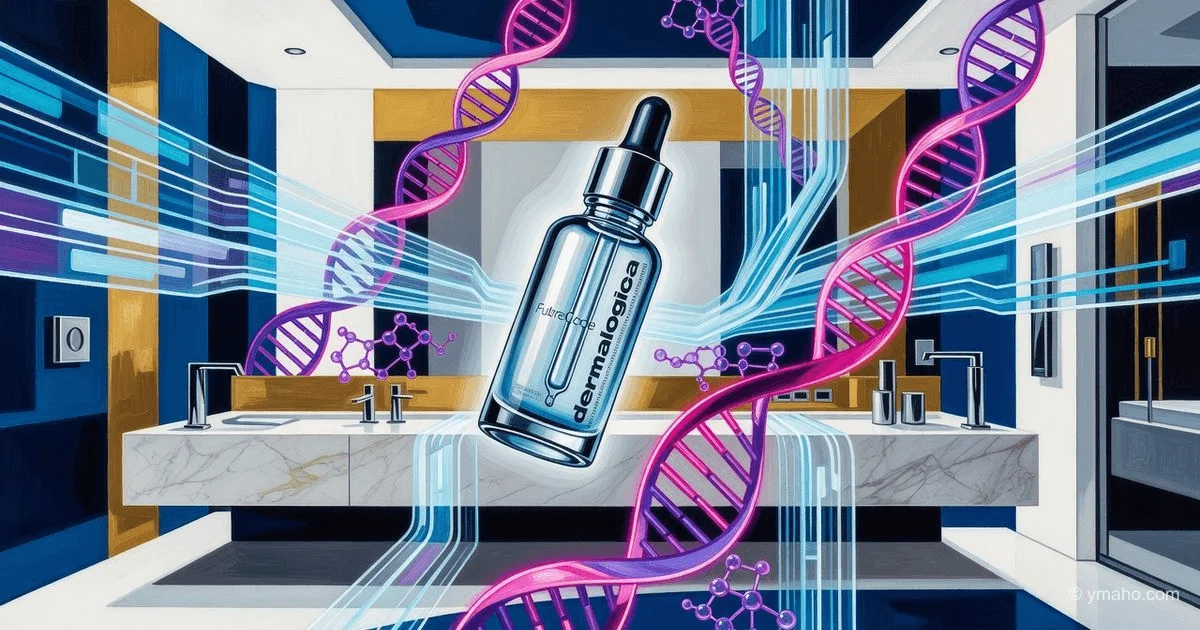
Biohacking Goes Mainstream: Dermalogica Launches FutureCode Serum with Breakthrough Complex
American brand Dermalogica has unveiled the FutureCode Booster serum, operating at the intersection of cosmetology and biohacking. The product contains an innovative complex designed to optimize skin cellular processes at a deeper level than traditional anti-aging cosmetics.
Analytical article based on provided data and requirements.
Analytical Review: The Collapse of 'Clean Beauty' and the Rise of Genetic Capitalism
How Dermalogica FutureCode Booster Is Changing the Rules of the Skincare Market in June 2026
Introduction: The Quiet Coup in the Mass-Market Segment
While all influencer attention was glued to banana manicures and edible fragrances, professional cosmeceuticals struck a blow that will reshape the power dynamics for the rest of the decade. The release of Dermalogica FutureCode Booster on June 5, 2026, is not just another new product in the overcrowded serum segment. It is the first mass-market product to legitimize biohacking rhetoric for the average Sephora consumer who previously bought jars for promises of 'glow' rather than scientific terms from gene-editing labs.
What is truly interesting for an analyst: Dermalogica has committed an act of 'quiet cannibalism' of its own professional channel. As a brand born in aesthetic clinics, the company has just told its own estheticians: 'What you did with needles and lasers can now be bought for £89 at a nearby department store.' This is not just a product launch. It is a shift in the brand's economic model.
[The Core]: What Is Really Happening
From a chemistry standpoint, we are witnessing the end of the 'ingredientism' era (when marketing was built on retinol or vitamin C concentration). Dermalogica FutureCode Booster marks the transition to 'molecular engineering'. The formula includes things that the average buyer cannot pronounce but that make Silicon Valley venture capitalists open their wallets.
The key component is Teprenone. In biochemistry, this substance is known as an inducer of heat shock proteins (HSP). Roughly speaking, it does not nourish the cell but 'hacks' its defense mechanisms, forcing it to work in emergency repair mode, as after mild stress. The second component is sunflower sprout extract combined with niacinamide, acting as an NAD+ booster.
Non-obvious Insight #1 (what is not written in press releases): This is the first mass-market product to directly target skin DNA methylation. NAD+ (nicotinamide adenine dinucleotide) is a molecule whose levels decline with age. But the most interesting part of this cocktail is Acetyl Zingerone. This is a next-generation molecule that does not just quench free radicals (like good old vitamin C) but chelates metal ions, stopping the chain reaction of oxidation at the start without consuming itself. It is a 'perpetual motion machine' for antioxidant protection. The brand has created a serum that does not 'work' but 'programs' the skin for self-repair.
Timeline and Context
Why is this date—June 5, 2026—not random? Because we are exactly at the peak of the transition from post-COVID 'skin streaming' (minimalism) to techno-optimism. The consumer is tired of 10-step Korean routines. They want one serum that does everything for them but sounds like they bought a piece of NASA's research center.
- May 15, 2026: First leaks and PR campaign. Media call it 'biohacking' but do not understand the depth.
- May 27, 2026: Product physically appears in European warehouses (availability date in Czech Republic), allowing quiet sales before the global push.
- June 5, 2026: Official sales launch in the UK (House of Fraser) and global marketing blitz.
Importantly, the release coincides with a 'gift with purchase' promo lasting until June 10. This is a classic tactic to record initial sales and generate a wave of positive reviews on review platforms, so retail algorithms pick up the product as a 'bestseller'. By June 15, FutureCode Booster will have several hundred 'natural' (read: motivated by free cream) reviews with a rating of 4.8+, automatically boosting it in Sephora and Ulta search results.
Who Wins and Who Loses
Winners:
- Unilever (owner of Dermalogica). The company has a 'Trojan horse' into the luxury camp. FutureCode is priced around $134–$150 (depending on the market). This is a price ceiling for a brand typically associated with $50–$80. Unilever is testing whether the mass consumer is willing to pay La Mer prices for technology that smells not of money but of science. So far, yes.
- Estée Lauder (with The Ordinary/Deciem). Surprisingly. Dermalogica legitimizes the 'pure molecules' market, where The Ordinary has no price competition. Once NAD+ and Teprenone become trendy, Estée Lauder will release an 'NAD+ Booster' for $20 and capture the entire low-price segment, leveraging the hype created by Dermalogica.
- Dr. Bob Bianchini (VP of R&D at Dermalogica). This man has just secured a golden parachute for the next 10 years. Creating a formula that works with signaling pathways (HSP and NAD+) without causing skin irritation is top-tier skill.
Losers:
- 'Green' clean beauty brands (Goop, RMS Beauty, Tower 28). Their 'chemical-free' positioning looks idiotic against Dermalogica, which says: 'We are the most complex chemistry you won't understand, but it will save you.' The consumer is tired of paraben scare tactics. They want the aesthetic of transcriptomic analysis. Clean beauty in 2026 is boring. Techno-beauty is sexy.
- Endocrinologists and dermatologists profiting from injections. The product's description states: 'Biomimetic phospholipids strengthen skin's barrier and boost absorption.' If a serum can deliver actives to the dermal level without mesotherapy injections, it is a direct threat to entry-level invasive procedures.
What the Media Are Not Saying
The official story says the serum 'creates firmer, more even skin.' However, examining the INCI, I see a cocktail of essential oils: Lavandula Hybrida Oil, Eugenia Caryophyllus Oil, Litsea Cubeba Fruit Oil, Limonene, Linalool.
Insight #2: This is not just skincare. It is a sensory trigger for therapeutic effect. Studies show that the perception of a cream's 'effectiveness' is 30% dependent on its scent. By adding a large cocktail of essential oils to the 'smart' serum formula, Dermalogica hedges its clinical data. If the NAD+ complex does not work on a particular skin in 3 days, limonene and lavender create a feeling of 'cleanliness' and freshness, making the user's brain think the product is working. This is classic neuromarketing: the formula's side effects (Linalool is a potential allergen) are positioned as 'aromatherapy.'
Moreover, the Czech distributor's website shows a video but lacks a full translation of warnings about photosensitization due to high citrus oil content. This means users who do not apply SPF 50 on top (and who does on a cloudy day?) risk pigmentation that this booster supposedly fights.
Forecast: Next 30 Days and 90 Days
Next 30 Days (June–July 2026): The 'Frenzied Copying' Phase
Within a month, all labs that make copies of top products will start extracting Teprenone from available sources (e.g., ginkgo biloba leaves, where it is present in microdoses). We will see a wave of budget boosters labeled 'Longevity Code' on Amazon from Chinese brands like S'Oreal and BioLogique. Dermalogica must use this time to sell not a bottle but a concept. If they do not launch a skin-scanning app with a recommendation to 'use FutureCode,' they will miss the market. In the next 30 days, it is critical to release videos with fluorescence microscopy of skin 'before/after' showing real NAD+ action. Without visualization of 'cellular-level work,' it will remain just an expensive serum with oils.
Next 90 Days (August–September 2026): The Great Luxury Depression
By September, the market will be saturated. Estée Lauder will release an analogue (Revitalizing Supreme+ Global Anti-Aging Cell Power Cream with a new NAD+ complex). L'Oreal will insert a weak version of the technology into Revitalift Laser. But the main thing is the 'biohacking fatigue' effect.
Consumers who bought FutureCode will not see 'instant lifting' (because it is biology, not plastic surgery). A wave of negativity will begin: 'I spent $140, and wrinkles are still there!' Dermalogica will survive this thanks to its reputation as a brand for estheticians, but the entire 'Longevity Skincare' segment will be labeled 'very expensive and unclear.'
However, for insiders, a goldmine will open: serums will be replaced by next-generation probiotics (not for the microbiome, but for mitochondria). And right now, in June 2026, we are at a bifurcation point: either we slide into a banal concentration race (20% vitamin C vs 30%), or we move into real gene expression regulation. Dermalogica chose the latter, and it is the only right path for the industry for the next 5 years.
— Editorial Team