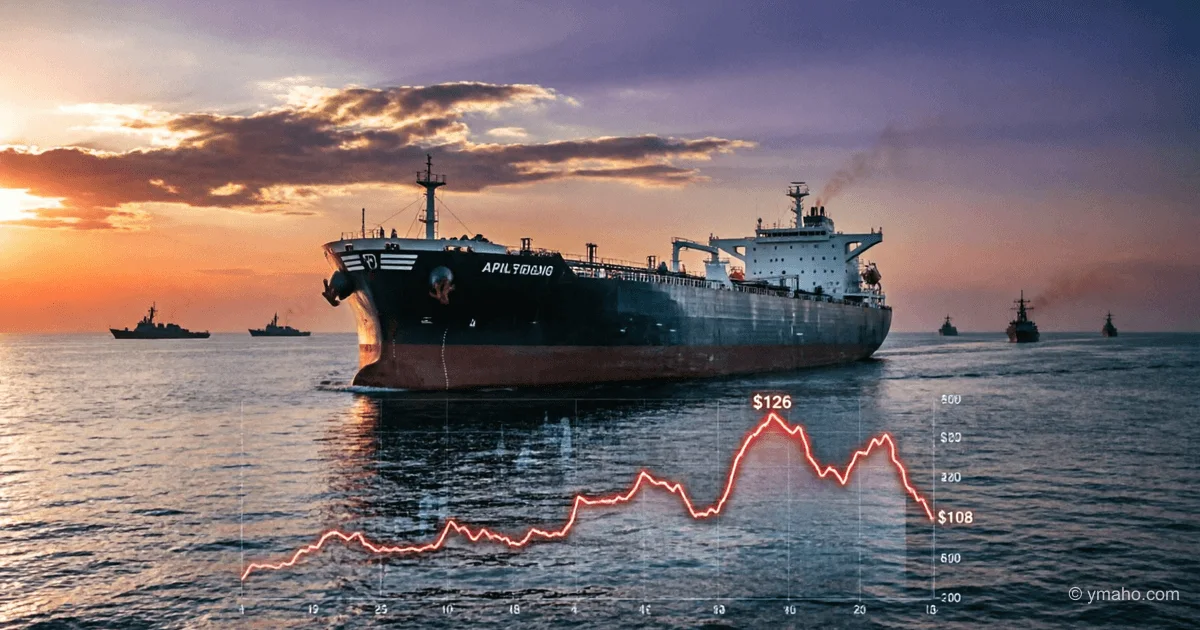
Brent Oil Touches Four-Year High Amid Middle East Conflict
Brent crude prices briefly exceeded $126 per barrel due to the blockade of the Strait of Hormuz, but then retreated to $108 on news of a possible vessel escort operation with US assistance.
Oil on the Brink of a Geopolitical Storm: Analysis of the Situation Around the Strait of Hormuz
Introduction
Global Brent crude oil prices are currently hovering around $108 per barrel this week, after briefly reaching levels near $126. This price spike is a direct consequence of the acute geopolitical crisis in the Persian Gulf, where the de facto blockade of the Strait of Hormuz has threatened the stability of approximately 20-25% of global oil supplies and a significant share of liquefied natural gas (LNG). The situation remains extremely tense, despite statements by US President Donald Trump about his intention to ensure navigational safety, which have somewhat cooled panic on the exchanges. This article provides a detailed analysis of the chronology of events, their impact on the global economy, and a forecast for further developments in the energy market.
Event Details and Chronology
The current crisis originated from a military escalation between the United States and Iran, with Israel's involvement, leading to serious disruptions in the Strait of Hormuz. As early as March 2026, Iran blocked the strait with military forces, triggering an unprecedented drop in production in the Persian Gulf countries. According to OPEC data, production in the region plummeted by 33% (about 8 million barrels per day) in March compared to February, reaching only 16.5 million barrels per day.
The situation attempted to move into a diplomatic channel in April. The parties announced a two-week ceasefire on April 8, and Iran agreed to temporarily open the strait. However, negotiations in Islamabad mediated by Pakistan failed. Moreover, on April 12, US President Trump stated that the US itself would block the strait for Iranian vessels, and a de facto naval blockade began on April 13. By the end of April, vessel traffic had almost completely stopped, except for rare convoys, causing a jump in prices to $119 per barrel.
By May 3-4, 2026, the market saw a new reversal amid verbal interventions. Trump announced the launch of Operation "Project Freedom" to assist in escorting vessels stuck in the conflict zone, leading to a drop in oil prices by about 0.6% to $107.5–$108.1 per barrel. Nevertheless, the key problem remains unresolved: negotiations between Washington and Tehran have reached an impasse without achieving peace, keeping "black gold" above the psychological mark of $100.
Impact and Significance (for the World / Industry / Society)
The blockade of the Strait of Hormuz has become the biggest threat to global energy security in history. International Energy Agency (IEA) Director Fatih Birol described the situation as "the biggest threat to global energy security," noting the growing shortage of diesel and jet fuel in Europe. A similar assessment was given by Russian Presidential Special Representative Kirill Dmitriev, who warned of the risk of "the largest energy crisis in history."
The economic shock extends far beyond oil prices. In Asia, there is a catastrophic depletion of reserves: Pakistan (15 days of supply with 85% dependence on the strait) and Bangladesh (12 days) are on the brink of collapse; India (30 days) and Taiwan (45 days) are in a high-risk zone. In Europe, fuel shortages are growing, leading airlines to prepare for mass flight cancellations, and farmers are protesting due to the unaffordable cost of diesel for planting.
The systemic disruption has also affected LNG logistics. Qatar, which provides a fifth of global LNG production, has halted exports, and missile strikes on the Ras Laffan plant have collapsed gas markets in Asia and Europe. All this creates a synchronous macroeconomic shock to fertilizers, petrochemicals, and semiconductors, making the crisis much deeper than a typical spike in energy prices.
Reaction of Key Players
United States has chosen a strategy of forceful mediation. The Trump administration, on one hand, tries to lower prices by promising to "escort" vessels through the dangerous zone, and on the other, continues the policy of blocking Iranian exports. The launch of Operation "Project Freedom" was perceived positively by the market, but analysts note that without a full-fledged peace agreement, this is only a temporary measure.
OPEC+ shows contradictory dynamics. At a meeting on May 3, seven alliance countries (including Russia and Saudi Arabia) decided to raise production targets by 188,000 barrels per day in June. However, this decision is more symbolic. As Dmitry Alexandrov, an analyst at AVI Capital, noted, an increase of 188,000 barrels per day cannot compensate for losses of millions of barrels, but it sets a general trend of the cartel's readiness to respond to shortages.
The situation within the cartel is complicated by the United Arab Emirates leaving OPEC on May 1. Under normal circumstances, this would be a powerful destabilizing factor, but because UAE production in March had already fallen from 3.4 to 2.1 million barrels per day due to infrastructure attacks, the market barely reacted.
Forecast and Conclusions
Currently, experts agree that until the situation around the Strait of Hormuz is fully resolved, oil prices will remain in the range of $100–$110 per barrel — a kind of "geopolitical premium" for risk. A scenario of a complete blockade of the strait for more than five weeks (the delivery time of a tanker to Asia) could send Brent prices to $150 and above.
A critical factor remains the extremely low capacity of alternative routes. Oil pipelines in Saudi Arabia, the UAE, and Iraq can only replace about 50% of the volumes passing through the strait, making maritime transit indispensable.
The global economy is on the verge of structural changes. Record gold prices and rising US Treasury yields indicate a shortage of dollar liquidity and investors seeking "safe havens" outside Western political control. If the parties to the conflict do not find a diplomatic solution soon, the world risks facing not just expensive oil, but a full-scale crisis of the global financial system caused by a synchronous commodity and logistics shock. The market is frozen in anticipation of news from the Persian Gulf, where the price of a barrel determines the fate of global economic stability.
— Editorial Team









