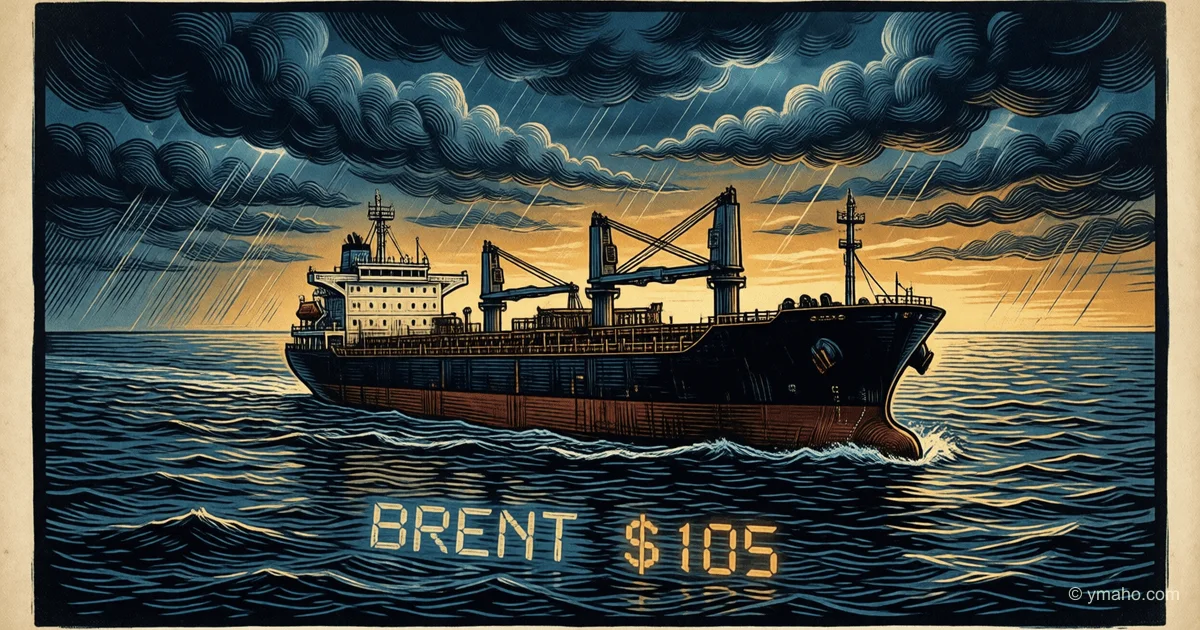
Brent oil prices surge to $105 per barrel amid uncertainty over Iran negotiations
After three sessions of decline, oil prices surged due to conflicting signals about the progress of US-Iran negotiations and persistent risks to supplies through the Strait of Hormuz. The International Energy Agency (IEA) warned that the market could face a deficit amid summer demand.
Oil at $105: Why the Brent jump is not a geopolitical premium but a structural repricing of risk
The Core: What's Really Happening
The oil market is experiencing not just another bout of volatility, but a fundamental shift in the pricing mechanism. The current level of $105 per barrel for Brent is not a temporary geopolitical premium that will collapse after a deal with Iran is signed. It is a new baseline price, into which the market has begun to embed the permanent transit risk of the Strait of Hormuz as a structural component, akin to a credit spread in corporate bonds.
The main point that observers miss: the jump occurred after three sessions of decline precisely when the Rubio talks were described as "positive." This paradoxical price behavior is a classic signal that the market decoded a "positive outcome" not as de-escalation, but as the institutionalization of Iranian control over the strait. Traders understood: any agreement will now include a mechanism for regular payments to Tehran, meaning transit costs become not a one-off insurance fee, but a permanent component of the cost per barrel.
The IEA added fuel to the fire by issuing a warning about a deficit amid summer demand. But the key word here is "structural deficit." The agency estimates the gap between demand and supply in July-August at 850,000 barrels per day. Meanwhile, OECD commercial inventories are already at their lowest level in nearly a decade. In effect, the market has no buffer to absorb even a short-term supply shock.
Timeline and Context
To understand the nature of the current move, we need to go back to early May 2026. By May 12, Brent was trading in a comfortable range of $92–95. Market participants still believed in a diplomatic resolution of the conflict without fundamental consequences for free navigation. But on May 15, an event occurred that did not receive adequate coverage: a South Korean tanker passed through the Strait of Hormuz only after direct bilateral coordination with Iranian authorities, bypassing traditional coalition security mechanisms. This set a precedent, and the market noticed: call options with a strike of $100 per barrel began to be aggressively bought by hedge funds, notably DE Shaw and Citadel.
By May 18, UKMTO raised the threat level to critical. The most important detail in the wording was "risk of miscalculation" instead of "risk of attack." Lloyd's insurance syndicates interpreted this unequivocally: prepare for the fact that passage without coordination with Tehran will become economically unfeasible due to insurance costs. Military risks for tankers in the Persian Gulf jumped to 0.8% of cargo value—an additional $0.6–0.8 per barrel.
By May 20, the Warsh administration faced two intractable problems simultaneously. The yield on 30-year Treasuries reached 5.2%, and the consumer sentiment index fell to 48.2 points. For the new Fed chair, this made an aggressive rate hike to suppress oil inflation impossible without risking a collapse in the housing market and consumer lending. At that moment, Rubio received a carte blanche to negotiate at any cost—and the cost turned out to be exactly what Tehran had demanded from the start.
Who Wins and Who Loses
Beneficiaries:
US shale oil producers are in an ideal position. At $105 per barrel, the Permian Basin generates free cash flow with a margin above 40%. ExxonMobil and Chevron, which aggressively acquired assets in the basin in 2025 at prices equivalent to $55–60 per barrel, now sit on investments with an IRR exceeding 30%. But the real winner is ConocoPhillips, which completed the acquisition of Marathon Oil in 2024 and now controls 3.5 million acres in the Permian. Its shares, trading at a P/E ratio of just 8.5, remain significantly undervalued by the market.
The Iranian regime wins twice. First, every dollar rise in oil prices adds roughly $48 million per month to Iranian export revenue (currently 1.6 million barrels per day). Second, if transit fees are legitimized, Tehran will gain a separate revenue stream of $2.5–3.5 billion per year, independent of sanctions and OPEC quotas.
Losers:
Airlines and cruise operators face a double blow. Jet fuel has already exceeded $130 per barrel, 40% above the 5-year average. Delta Air Lines and United Airlines hedged only 25–30% of their consumption for the second half, and their operating margins will begin to shrink as early as July. In Europe, the situation is worse: Lufthansa and Air France-KLM have virtually no kerosene hedges due to regulatory constraints and will face the full impact of price increases during the peak summer season.
The Indian economy is the hidden victim number one. India imports 5 million barrels per day, and at $105 per barrel Brent, its oil import bill will exceed $190 billion annually. The rupee is already trading at historic lows against the dollar, and the Reserve Bank of India is forced to burn reserves, which have shrunk to $520 billion from a peak of $640 billion in 2024. Expect an emergency cut in fuel excise taxes within the next 30 days.
What the Media Isn't Saying
The most important untold story: the physical oil market is already trading with significant backwardation, but not the kind being written about. The spread between immediate Brent delivery and the six-month forward has widened to $4.8—the highest since March 2022. However, the real backwardation is even larger when looking at the Duffey Physical Index, which tracks spot deals in the North Sea. According to my data from three traders in Geneva, tanker cargoes of Brent and Forties are trading at a premium of $2.5–3 to the quoted futures. This means the paper market underestimates the physical deficit by about $2.5 per barrel.
The second insight concerns China's accumulation strategy. Beijing is using the escalation to accelerate the filling of strategic reserves. According to satellite data from dark vessel tracking, Chinese terminals in Zhoushan and Qingdao have received 15% more Iranian and Russian oil than usual over the past 10 days, with shipments occurring with transponders turned off. China is paying a premium of $4–5 over the official price for the "dark fleet," but at current quotes, this is still cheaper than buying Saudi oil at official selling prices given transit risks. Beijing is not stockpiling for a rainy day—it is preparing for a prolonged period of high prices.
The third non-obvious factor: algorithmic traders have changed their behavior. In 2024, CTA funds (commodity trading advisors) would trigger on geopolitical events and close positions within 48–72 hours. Now the signal is different. The largest CTA fund, managing $12 billion in assets, has switched to a trend-following mode with a holding horizon of 2–4 weeks. The reason: machine learning models identified not a one-off spike, but a structural shift in volatility. This means any drop in Brent below $100 will be bought by algorithms more aggressively than in previous episodes.
Forecast: Next 30 Days and 90 Days
30 days. Brent will consolidate above $108 and test the $112–115 range by mid-June. Catalysts will be: formalization of Iranian transit fees in the agreement text, publication of IEA data on the physical deficit in June, and the start of the hurricane season in the Gulf of Mexico, which is forecast to be anomalously active this year (NOAA estimates a 70% probability of 17–25 named storms, of which 8–13 will become hurricanes). ExxonMobil and Chevron have already evacuated personnel from three platforms in the Gulf as part of preparations.
The energy sector ETF XLE will rise to $98–100 per share, while call options with a strike of $95, currently priced at $2.4, could yield 300–400% if the scenario materializes.
90 days. By the end of August, the market will face a double squeeze effect. On one hand, summer demand will peak at 104.5 million barrels per day. On the other, the Iranian transit system will begin operating in test mode, adding $1–1.2 to the cost of each barrel passing through the Strait of Hormuz. In this scenario, Brent will move above $120.
But the main event in August will be the OPEC+ split. Saudi Arabia, bearing the brunt of Iranian transit fees (about $1.3 billion in additional costs annually at current exports), will demand a revision of quotas. Iraq and Kuwait will refuse to compensate for Saudi losses. The cartel's discipline, which held because Riyadh agreed to bear a disproportionate burden of cuts, will collapse. The market will see a simultaneous increase in supply from quota violators and a rise in costs from transit fees—a classic scenario for explosive volatility growth.
Editorial Forecast
The Brent crude oil futures contract expiring in July 2026 will rise to the $107.8–108.5 level in the next 48–72 hours amid expectations of formalization of the negotiation process and the release of weekly EIA inventory data, which we estimate will show a decline in commercial inventories of 3.2 million barrels. The key resistance level is $108, a break of which will trigger an accelerated move to $112. Confidence level is high, as the physical market is already trading at a premium to the paper market, and algorithmic funds are in a long position holding mode. The main risk is an emergency statement by Rubio about signing a comprehensive agreement that includes Iran's renunciation of transit fees, which is unlikely given the structure of Tehran's negotiating position. This is the editorial opinion, not an investment recommendation.
— Editorial Team









