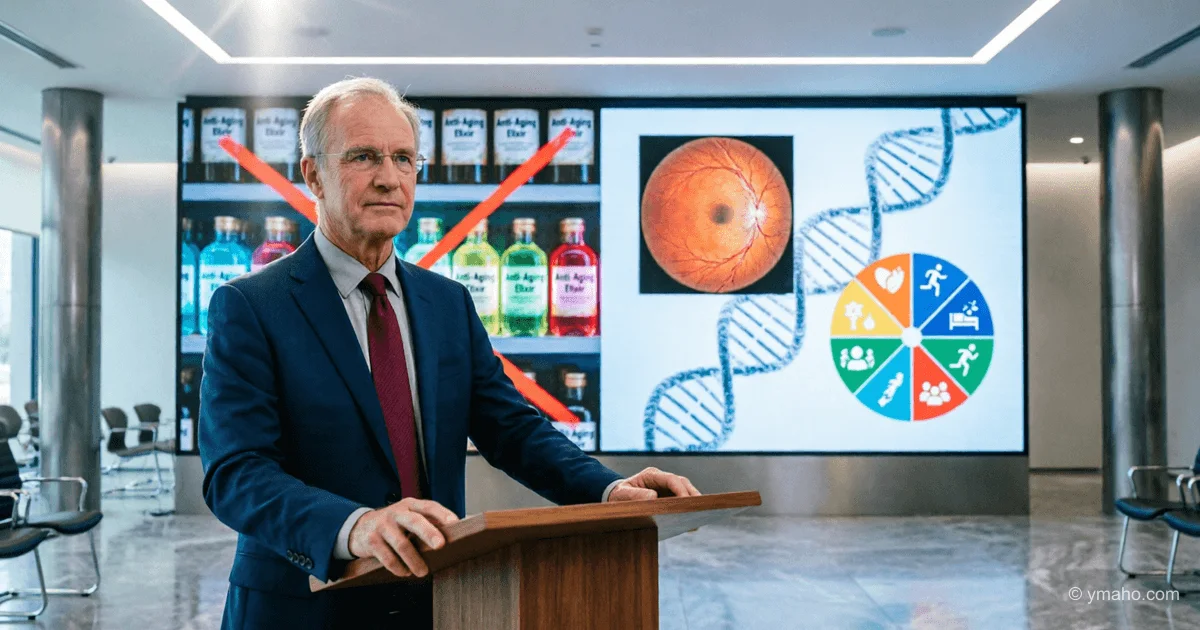
Cardiologist Eric Topol Debunks Anti-Aging Industry Myths
The founder of Scripps Research Translational Institute claims that "super-longevity genes" are a myth, and that healthy aging is determined by lifestyle and prevention. AI tools, such as retinal scans to detect Parkinson's risks, will make preventive medicine technology's greatest achievement.
Healthy Aging Without Magic: Why Cardiologist Eric Topol Has Declared War on the Anti-Aging Industry
Introduction
The anti-aging market is experiencing an unprecedented boom. As of 2025, its value was estimated between $52.21 billion and $85 billion, with projections of growth to $120 billion by 2030. Owning a cryotherapy chamber or subscribing to "peptide protocols" have become status symbols, and private investment in longevity science doubled to $8.49 billion in 2025. It is at this moment that one of the most authoritative voices in global medicine—cardiologist and founder of Scripps Research Translational Institute, Eric Topol—issued a sobering statement: the industry has outpaced science. His book Super Agers, released in late 2025 to early 2026, and the subsequent tour of interviews on leading science platforms have essentially become a manifesto for evidence-based longevity, countering marketing promises.
Event Details and Timeline
The central event that drew attention to Topol's stance in May 2026 was his interview on NPR's TED Radio Hour, aired on May 1. In it, the scientist summarized years of work on the Wellderly project, in which his team at Scripps Research studied the DNA of people over 80 without major chronic diseases. The goal was to find the genetic basis of "super-aging"—and the result was staggering: "The stunning result was that, while there were some small differences, there was nothing else to suggest that this was a genetic story at all. There is no secret DNA that provides a better life in old age," Topol stated.
Alongside public appearances, Topol has institutionalized his approach. In March 2026, Flagship Pioneering, one of the largest biotech innovation engines, announced his appointment as academic advisor to its Preventive Health and Medicine Initiative. This initiative aims to create products and companies capable of predicting, detecting, and preventing chronic diseases before symptoms appear, integrating advances in biology, artificial intelligence, and continuous health monitoring.
The timeline of the scientist's public activity over recent months is telling. In February 2026, he appeared on the Mindsip podcast for a detailed breakdown of the Wellderly Project and the concept of "lifestyle plus." In April 2026, in an interview with The Indian Express, Topol elaborated on the problem of distrust in AI diagnostics due to a lack of real clinical data, while also highlighting the potential of tools like retinal scans that can detect risks of Parkinson's and heart disease long before symptoms. The May NPR interview closed this loop, bringing the discussion to a global audience.
Impact and Significance
For the anti-aging industry. Topol's statement that the anti-aging market is "out of control" and that dubious claims about unregulated products are completely unfounded strikes at the heart of the wellness sector's business model. The market size, by various estimates, ranged from $52.21 billion to over $85 billion in 2025. The anti-aging drug market alone is projected at $65.51 billion in 2026, growing to $91.23 billion by 2030. When a figure of this stature calls peptide injections "a disaster in the works" due to a lack of clinical trials and understanding of long-term risks, it creates a serious reputational challenge for investors and clinics.
For public health. Topol introduces a key diagnostic gap into public discourse: the average life expectancy in the US is about 79 years, but the average healthspan ends around age 64—that's 15 years lived with chronic diseases. The claim that chronic diseases begin developing 20 years before symptoms appear shifts the focus from gerontology to prevention in middle age. Essentially, Topol argues that the most powerful "longevity technology" today is not stem cells or peptides, but lifestyle changes, which, according to available data, can add seven to ten healthy years.
For the tech sector. Topol sees artificial intelligence in medicine as the primary ally of the preventive approach. His recent report in The Lancet, arguing that every mammogram in the world should be analyzed with AI support, is already setting a new screening standard. He calls retinal scans that predict Parkinson's and cardiovascular risks the most impressive direction: "In the coming years, we will consider AI's most important contribution to be its facilitation of prevention." This vision aligns perfectly with the mission of Flagship Pioneering, which he joined in March 2026.
For society. Topol debunks the myth of hereditary fatalism—the belief that parents' diseases predetermine children's fate. The Wellderly project showed that genetics plays a minimal role in healthy aging compared to lifestyle and immune system status. This is a powerful signal to society: healthy longevity is accessible not only to elites with "good DNA" but to anyone willing to work with risk factors.
Reactions from Key Players
The academic and medical community received Topol's book with considerable interest. Reviews range from calling Super Agers "a beacon of evidence-based optimism" to critical remarks about it being overloaded with details. However, the overall tone acknowledges that Topol "clears the pseudoscience" from the discourse on aging, placing lifestyle—nutrition, movement, deep sleep, social connections—at the center.
The corporate sector responded strategically. Topol's appointment at Flagship Pioneering, the company that created Moderna, means that big biotech is ready to invest not in another "elixir of youth" but in preventive prediction platforms. Flagship CEO Noubar Afeyan emphasized that Topol "challenged healthcare to move upstream—to use data and science more wisely."
The anti-aging industry itself predictably did not offer direct counterarguments—but market indicators speak for themselves. Market growth from $52 billion to a projected $76 billion by 2032 (conservative estimate) and up to $120 billion (more aggressive) shows that consumer demand for "quick fixes" has not disappeared. This indirectly confirms Topol's diagnosis: the evidence base lags behind marketing.
Forecast and Conclusions
Eric Topol's intervention marks a turning point in the longevity discourse. His stance is not just a scientist's skepticism toward quackery; it is a coherent program to replace pseudoscience with evidence-based prevention. The program rests on three pillars.
First, lifestyle medicine. Topol emphasizes that even starting in middle age can add years of healthy life. The basics are surprisingly low-tech: resistance and balance physical activity, regular deep sleep, social engagement, time in nature. Notably, he cites emerging data that the shingles vaccine reduces the risk of Alzheimer's and dementia by 20–25%, protecting the immune system.
Second, the biomarker revolution. Topol calls the p-Tau217 blood test, which provides an early signal of Alzheimer's risk, one of the most significant recent breakthroughs in neuroscience—a tool that was unavailable until recently and now allows recruiting patients for preventive clinical trials.
Third, artificial intelligence as a prevention tool. Topol acknowledges the limitations of today's LLMs—lack of real clinical data for validation—but considers them temporary. "Machines keep improving," he says, while highlighting an unexpected aspect: AI demonstrates greater empathy in patient communication than many doctors and can be used to train medical staff.
The conclusion Topol leads to can be summarized as follows: the anti-aging industry sells a dream of immortality, while science offers something less glamorous but real—an additional 7–10 years of life without major chronic diseases. The 15-year gap between healthspan and lifespan is not predetermined by genetics or fate; it is a space for action. And in that space, AI early warning tools, lifestyle changes, and evidence-based medical interventions win over peptide cocktails and cryotherapy chambers.
Topol's main lesson for an audience craving a "pill for aging": "Beware of trendy optimization fads. Stick with evidence-based opinions, not authority-based ones. Invest in habits, not miracles." Healthy aging is not the preserve of a chosen few with lucky DNA or elite resources, but the result of consistent decisions that science can now increasingly support with precise predictive tools.
— Editorial Team









