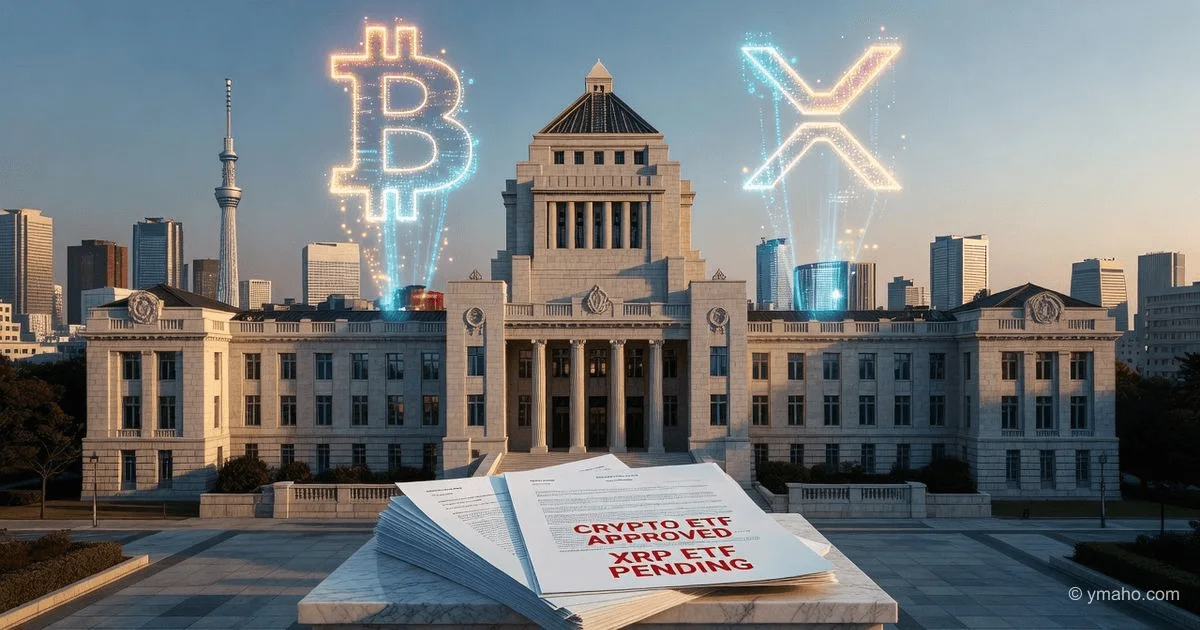
Japan Passes Cryptocurrency Bill, Paving the Way for ETFs
Japan's lower house of parliament has passed a law classifying cryptocurrencies as financial instruments akin to stocks. This creates a legal framework for launching crypto ETFs in the country and includes a reduction in the maximum tax rate on crypto income from 55% to 20%.
Headline: Japan Legalizes Crypto ETFs: A Quiet Revolution That Will Upend Asia Sooner Than You Think
Author: Crypto Desk Analyst (Insider Perspective)
[The Gist]: What's Really Happening
Most headlines scream: "Japan allows crypto ETFs." That's true, but it's just the tip of the iceberg. The reality is far more interesting and dangerous for traditional financial institutions. The law passed by the lower house doesn't just reclassify Bitcoin from a "crypto asset" to a "financial instrument." It effectively legalizes the use of cryptocurrencies on the balance sheets of Japanese brokers and banks, just like Toyota shares or JGB bonds.
The key nuance that Reuters and CoinDesk miss is the simultaneous tax rate cut from 55% to 20%. 55% was a level that killed any retail trading in Japan. At 20%, the country instantly transforms from one of the most hostile jurisdictions for trading into one of the most attractive in the G7. This isn't just a law. It's a reset of the entire Japanese retail market.
Moreover, the law sets a precedent for recognizing crypto derivatives. Note the wording "akin to stocks." This means Japanese exchanges (like bitFlyer and Coincheck) can now launch spot ETFs without needing annual approvals from the FSA for each product. This automates the process. In the US, every ETF application is a legal battle. In Japan, it's a technical regulation. And that difference holds the hidden power.
Timeline and Context
To grasp the scale, recall how Japan got to this day. After the Mt. Gox collapse in 2014 and the Coincheck hack in 2018, the country became ultra-conservative. The FSA strangled innovation with a regulatory chokehold. But since 2022, a quiet revolution has taken place.
| Date | Event | Impact on Tax Rate / ETF |
|---|---|---|
| April 2022 | Revision of the Payment Services Act (PSA) | Crypto recognized as "means of value transfer," tax up to 55% |
| December 2024 | JVCEA (Japan Virtual Currency Exchange Association) lobbying | First proposal to cut tax to 20% |
| March 2026 | LDP ruling coalition wins election | Adoption of "Web3 2.0 Strategy" with ETF clause |
| June 2026 | Lower house passes law | Crypto = financial instrument, tax cut to 20% |
| October 2026 (forecast) | Expected upper house decision | Launch of first Japanese spot ETFs |
Context is critical: Japan is doing this at a time when China has fully banned crypto, and the US and EU are mired in wars between the CFTC and SEC. While Gary Gensler sues Coinbase, Tokyo is already codifying ETF listings into law. This classic "kaizen" strategy—continuous improvement—suddenly yields results faster than Western legal wrangling.
Who Wins and Who Loses
Winners:
- SBI Holdings (Japanese financial giant). They already have a joint venture with BitFlyer and their own XRP currency fund. They will be the first to apply for a spot XRP ETF. SBI shares will rise at least 15-20% by September.
- Large holders of XRP and ALGO. Japanese banks (MUFG, Mizuho) have been testing Ripple and Algorand for cross-border settlements for decades. Now they can package these assets into ETFs for pension funds. Specifically, XRP is the second biggest beneficiary after Bitcoin.
- Binance Japan and Coinbase Japan. They will get a bridge between offshore liquidity and onshore fiat. The 20% tax will let them compete with Tokyo exchanges.
- Yen-backed stablecoins. The bill indirectly allows banks to issue deposit tokens. The most logical step is to create a Japanese equivalent of USDC by end of 2026.
Losers:
- Hong Kong. Hong Kong is trying to become Asia's crypto hub, but it lacks its own currency (HKD is pegged to the dollar) and such a deep pension market (Japan's GPIF is $1.6 trillion). Japan just stole their institutional gold.
- The US SEC. When the largest Asian market (third-largest economy) says "yes," the US regulator looks archaic. This will increase pressure on the US Congress to pass the CLARITY Act or similar.
- Retail traders taxed at 55% in 2025. They missed the bottom. Those who sold Bitcoin in May 2026 due to tax fears will now buy back in at prices 20-30% higher.
What the Media Isn't Saying
The biggest insight I see as an insider: no one is talking about the liquidation of Japanese exchange "hot wallets." The current law requires ETFs to be custodial—meaning keys are held by a licensed bank (MUFG, Sumitomo). This means all current exchange-traded Japanese funds that held real Bitcoin on their balance sheets must either close positions or transfer them to banks. The transfer is a technically complex process that will take months.
Mainstream media writes: "Capital inflow to Japan." But in the first 30 days, we may see a short-term outflow of about $2-3 billion as exchanges restructure their custodial relationships. This outflow coincides with June's seasonal market weakness. Traders unaware of this may mistake the outflow for a negative reaction to the news and sell Bitcoin. In reality, it's a technical shift, followed by a massive inflow from pension funds.
The second hidden factor is the Bank of Japan's interest rate. It's currently around 0.25% after a hike in May 2026. If Japanese ETFs buy Bitcoin and the yen weakens (typical when rates rise), the dollar equivalent of Japanese Bitcoin will grow twice as fast. Hedge funds will start arbitrage between Bitcoin ETFs in Tokyo and Chicago (CME). This will create a "Japan premium"—similar to what happened in 2017, but now legal.
Forecast: Next 30 Days and 90 Days
30 days (to mid-July 2026):
- Bitcoin: $68,000 – $74,000. Sideways with 5-7% volatility. Outflows from Japanese exchange restructuring cap growth.
- XRP token: $0.85 – $1.05. Outperforming the market. Japanese banking lobby (SBI) is already buying OTC packages for the future ETF.
- Nikkei 225 index: up 3-4% driven by SBI shares and crypto mining firms (GMO Internet).
- Main risk: Sudden yen strengthening by the Bank of Japan (if they hike rates again to 0.5%)—this would break the arbitrage.
90 days (to mid-September 2026):
- Bitcoin: $85,000 – $92,000. The launch of the first spot ETF (likely from SBI) in late August will signal pension funds. Japan's GPIF (Government Pension Investment Fund) will start with a pilot allocation of 0.5% of AUM (~$8 billion) into crypto ETFs.
- Ethereum: $4,500 – $5,200. Japanese love staking. They will create ETFs with built-in staking (allowed under the new law, unlike in the US). This will add 3-4% annual yield.
- Yen stablecoins (JPYC): market cap will grow from $200 million to $1.5 billion. Three Japanese banks will announce issuance by September.
- Main risk: Technical glitch during the first ETF settlement. If a calculation error occurs between MUFG and the exchange in August, the FSA could freeze the program for 6 months.
Editorial Forecast
Based on current data, a brief forecast for BTC/USDT over the next 24–72 hours:
- Asset: Bitcoin (BTC). Direction: Weak sideways with a downward bias (-1% / -2%).
- Key levels: resistance $71,800, support $69,200. Expect consolidation as the market digests the Japan news, with real capital inflows starting only 2-3 weeks after the technical adaptation of exchanges.
- Confidence level: medium (60%). The "sell-the-news" factor is strong in the short term, but long-term funds are already placing limit orders below $68,000.
- Main risk: An unexpected statement from the US Fed Chair about another rate hike (even a rumor) would completely overshadow the Japanese positive, as the dollar becomes a more attractive safe haven than any crypto ETF.
— Editorial Team