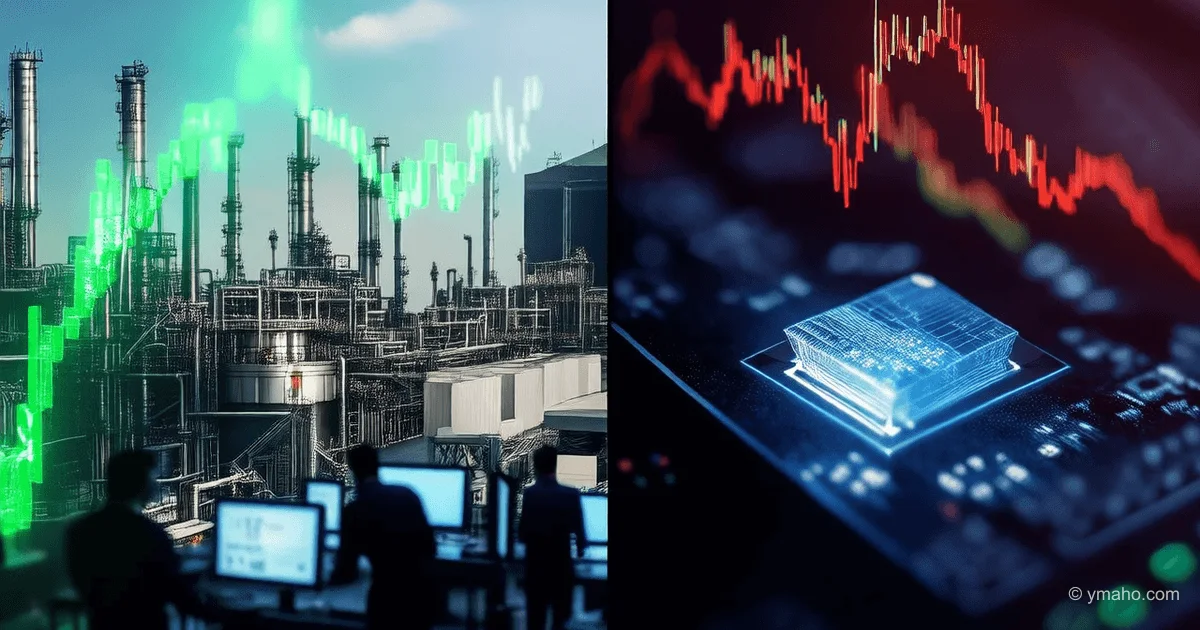
Dow Jones Rises on Oil Stocks, Nasdaq and S&P 500 Under Geopolitical Pressure
U.S. indexes closed mixed on May 18: the Dow Jones gained 0.32% thanks to rising shares of Exxon and Chevron, while the Nasdaq and S&P 500 declined on expectations of Nvidia's upcoming earnings and the Fed's continued hawkish policy.
Below is a detailed analytical piece written from an industry insider's perspective.
Schizophrenic Market: Why the Dow Rises on Oil While the Nasdaq Falls, Looking Not at the Fed but at Jensen Huang
The Gist: What's Really Happening
At first glance on the Bloomberg terminal on May 18, the picture looks like classic sector rotation—a flight to quality and defensive assets. But I see not a smooth rotation, but a desperate attempt to save face for the index. The market has split not just into "old" and "new" economy, but into two completely different asset classes within the same equity space. The tech sector, which always benefited from low rates, is now hostage to a single stock. We have a unique situation where the S&P 500's performance depends 9% on the chip delivery schedule of one company from Santa Clara, and only 91% on macroeconomic reality, including the threat of war and the Fed's frozen rate.
On the surface, the Dow Jones rises on oil stocks Exxon and Chevron, while the Nasdaq falls ahead of Nvidia's earnings. In reality, it's a hedge fund "divorce": institutional investors sell oil volatility, locking in profits in the energy sector, and simultaneously buy volatility ahead of Nvidia's report, dumping overvalued semiconductor stocks like Micron and Western Digital. This is not a thoughtful quarterly strategy, but a tactical two-day trade that distorts the picture for retail investors.
Timeline and Context
The divergence on May 18 did not come out of nowhere. The chain of events leading to this split began forming in mid-April.
April 14, 2026: Christopher Waller, the most aggressive Fed dove since 2024, gives a speech titled "One Transitory Shock After Another." He essentially admits that the energy crisis cannot be ignored. The rate futures market reacts instantly: the probability of a rate hike by year-end jumps to 49%.
Late April 2026: The Magnificent Seven earnings season shows cracks. Hyperscalers (Microsoft, Meta) increase capital spending on AI infrastructure, but direct monetization lags. Goldman Sachs analysts note: with a 10% rise in the S&P 500, 85% of that growth comes from the tech sector. The index without tech grew only 3%.
May 12-14, 2026: PPI inflation jumps to 6% year-over-year, significantly above expectations. The 10-year Treasury yield breaks through 4.5% and settles around 4.61%. This becomes the watershed moment: capital begins to flow out of high-growth companies with negative cash flow into companies with high dividend yields and hard assets.
May 18, 2026: On the closing day, oil giants Exxon ($XOM) and Chevron ($CVX) post strong gains. XOM has a forward P/E of about 14 and a dividend yield of 3.5%, making them an inflation haven. Simultaneously, the semiconductor index falls on fears that Nvidia's May 20 report will trigger profit-taking, and shares of Micron, Western Digital, and Sandisk lose between 5% and 7%.
Winners and Losers
Winners:
- Integrated oil majors (XOM, CVX). Their rise is not just a reaction to oil at $112. It's a revaluation of their role as "bond proxies" with low leverage. Unlike shale minnows, Exxon and Chevron maintain positive free cash flow even with a $15 oil correction. Their shares are bought not so much out of belief in geopolitical collapse, but out of fear of stagflation in the consumer sector.
- Holders of short positions in tech. Funds that shorted before semiconductor sector earnings are celebrating. The 5-7% drop in memory stocks (Micron, Seagate) in one session is a classic "sell the news" that started before the news itself.
- Oil service ETFs (OIH). In the shadow of the majors, service companies are pricing in a revival of deepwater drilling, a direct consequence of long-term expectations of expensive oil.
Losers:
- Retail holders of second-tier AI bubble stocks. Those who invested not in Nvidia but in memory and storage chip companies took a severe hit. This shows the market divides the AI sector into clear beneficiaries and everyone else.
- Old economy industrial sector within the Dow. Although the Dow rose, it was solely due to the oil wing. Home Depot, American Express, and Salesforce came under pressure as high Treasury yields kill their multiples. Consumers can no longer handle credit, and U.S. home prices with mortgage rates above 7% are stagnating again.
- Index investors. Passive broad-market funds show zero performance, experiencing an internal divergence that burns returns on derivatives costs.
What the Media Isn't Saying
The main non-obvious connection today is not geopolitics or oil. It's a process I call "Nvidia's quiet indexation." Most media write about Nvidia's weight in the S&P 500 (8.3%). But no one mentions the number 78%. That's how many active fund managers currently hold Nvidia in their portfolios. This is a record ownership skew. From a risk management perspective, it's a disaster. If Nvidia's May 20 report shows even the slightest slowdown in revenue growth or a decline in gross margin (BofA expects a margin of 75%, already under pressure due to expensive memory), we'll see not a technical correction but an avalanche of margin calls that will affect even the utility sector, tied to data centers.
The second point is the manipulation of the Dow's weighting. The Dow Jones is a price-weighted index. The rise of Exxon and Chevron, whose shares trade around $180-$190 each, mechanically offsets the decline of a dozen other components. The index does not reflect the true market sentiment; it hides that within the "old economy," a full-blown consumer credit recession is brewing. If you look at the equal-weight S&P 500, it has been negative for three days, indicating extremely weak market breadth.
Forecast: Next 30 Days and 90 Days
30-day horizon (through June 18, 2026).
The focus will shift to the Persian Gulf, but the market will count not tankers but HBM memory prices. Nvidia's May 20 report will be the "moment of truth." Forecast: the company will beat consensus by $3-4 billion, as Morgan Stanley expects, but shares will fall 5-6% on profit-taking, as even record earnings are already priced in. The Nasdaq will move into the 25,500 range.
The energy market will continue to support the Dow. Closer to the Fed meeting in mid-June, hawks will finally push to remove the phrase "rate cuts" from the minutes. This will cause a sharp dollar rally and short-term panic in gold, but the energy sector (XLE) will stay afloat, gaining another 3-4% from defensive capital inflows.
90-day horizon (through August 17, 2026).
This will be a summer of "artificial intelligence" in the sense of disappointment. We will see that giant CAPEX on AI is starting to create an oversupply of computing power. Loan rates for startups will remain prohibitive, halting the wave of small AI IPOs. By August 2026, a flight from "speculative AI" (memory, secondary chips) into the real sector—petrochemicals and defense contractors—will begin. The S&P 500 will correct to the 7000 level.
Major capital will move into energy: if geopolitical tensions persist, the XLE sector will match communication services in market cap. Rates will remain high (above 4.5% on 10-year bonds), and we will fully enter a market regime where "no landing" (no recession with high inflation) becomes the baseline scenario. In this scenario, Nvidia has no chance of holding $225 by August; we will see a correction to $200, meaning a complete loss of the Nasdaq's annual gain.
— Editorial Team









