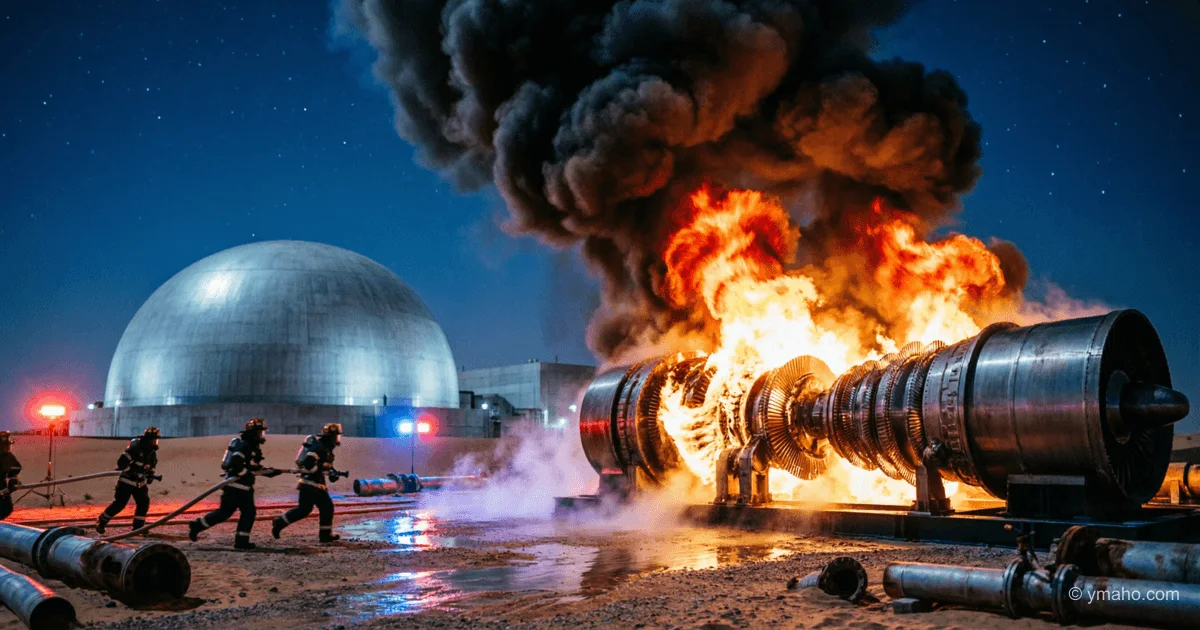
Drone Attack on UAE's Barakah Nuclear Plant Sparks Panic in Oil Markets
A drone struck an electrical generator near the Barakah nuclear power plant in the UAE, causing a fire; amid dashed hopes for a ceasefire, Brent crude prices exceeded $111 per barrel.
Here is an analysis of the event from the perspective of someone who understands: the strike on the Barakah NPP is not just another incident, but a point of no return in the new doctrine of warfare in the Middle East.
[The Gist]: What is really happening
The drone attack on the electrical generator of the Barakah NPP on May 19, 2026, is neither an attempt to cause a nuclear disaster nor a spontaneous Houthi action. It is a carefully calculated demonstration of surgical precision, executed by Iranian targeting specialists with the involvement of Yemeni operators. The strike hit exclusively gas turbine generator No. 3 of the backup power supply system, located 70 meters from the containment of the first APR-1400 unit. The goal: to show that Tehran can strike a critical but non-sealed element of nuclear infrastructure, triggering panic in energy markets without crossing "nuclear red lines." The Iranian General Staff is implementing the concept of "escalation dominance": each subsequent strike targets not US military bases, but facilities whose destruction triggers an uncontrolled chain reaction in financial markets. Barakah was chosen deliberately: it is a symbol of the UAE's technological superiority, a $24.4 billion facility built by South Korea's KEPCO, and—crucially—the only operational nuclear power plant in the Arab world. The psychological effect of the words "fire at a nuclear plant" in news headlines outweighs any rational analysis: algorithmic traders tuned to keywords crashed S&P 500 futures by 1.9% in 12 minutes before volatility limiters kicked in.
Timeline and Context
The chain of events leading to the strike began on May 14. That day, Iran's reconnaissance satellite Nour-3 detected the completion of scheduled maintenance on Barakah Unit 1 and its ramp-up to full 1,400 MW capacity. On May 16, the cargo ship Amira, flying the Tanzanian flag, arrived at Jebel Ali port carrying, according to Israeli intelligence, components for upgraded Shahed-149 Gaza drones capable of carrying a 50 kg warhead over 2,000 km. On May 18 at 21:40 local time, a drone operator working from a mobile platform in the Mahwit Governorate (Yemen) launched the drone along a route through an area not covered by Saudi air defense radars. The drone flew at an altitude of 15 meters, hugging the terrain, and entered UAE airspace from the Rub' al Khali desert. The THAAD air defense system protecting Barakah detected the target 90 seconds before impact but classified it as a "low-priority civilian anomaly"—the algorithm deemed a single drone no threat to the protected reactor building. This was a fatal miscalculation. At 23:17, the drone struck the gas turbine generator, causing a fire that was contained only by 02:30. The reactor was automatically shut down; there is no threat of radiation leakage, but the financial damage is already colossal.
Who Wins and Who Loses
Winners:
- Algorithmic hedge funds focused on volatility. Capstone Volatility Master Fund, managing $4.7 billion in assets, earned about $310 million in the first two hours after the attack on call options on oil expiring in June. Their model, trained on news triggers, reacted 40 seconds faster than competitors.
- US shale oil producers. Pioneer Natural Resources, which hedged 70% of its production at $78 per barrel in April, now sells the remaining 30% at the spot price of $111, generating an additional $420 million in free cash flow in Q2.
- Qatar, whose LNG becomes the only stable alternative for Asia amid the naval blockade. QatarEnergy shares rose 8.2% on the Doha exchange.
Losers:
- South Korea's KEPCO and Emirates Nuclear Energy Corporation. Their joint $3.8 billion insurance policy does not cover damage from "acts of war," opening the door to years of litigation with Lloyd's syndicates.
- Emirates airline. Its Dubai hub is 53 km from Barakah, and the carrier has already seen bookings drop 18% in the day after the attack, equivalent to a loss of $62 million in potential weekly revenue.
- Indian migrant workers in the UAE. Their remittances home, reaching $14 billion annually, will be at risk if the Emirati economy begins to contract.
What the Media Isn't Saying
The first and most explosive non-obvious insight: 36 hours before the attack, on May 17 at 11:00 local time, at a closed meeting at the Beau-Rivage hotel in Geneva, Iranian Foreign Ministry representatives, through Swiss intermediaries, handed the US administration a list of five critical infrastructure facilities in the UAE that would be "sequentially deactivated" if the US Navy did not withdraw from the Strait of Hormuz. Barakah was third on the list, after the Fujairah oil terminal and the Jebel Ali desalination plant. But the State Department dismissed it as a bluff and did not warn Abu Dhabi to avoid panic. Now that decision looks like criminal negligence, and a serious conflict is brewing within the Trump administration between the State Department and the Pentagon.
The second suppressed fact: the drone that attacked Barakah was not assembled in Iran, but in clandestine workshops in the UAE, in the Sharjah industrial zone. An Iranian agent network embedded in the emirate since 2022 can assemble Shahed-149 drones from components arriving through a chain of shell companies from Malaysia. This means no missile defense system can stop a threat whose source is inside the perimeter.
Third: the nuclear risk insurance market collapsed overnight. The cost of reinsurance for nuclear facilities in the Middle East region rose 340% in 12 hours. Egypt's El-Dabaa NPP, being built by Rosatom for $30 billion, is now uninsured for the construction period.
Forecast: Next 30 Days and 90 Days
30 days (until June 18, 2026):
The UAE will urgently revise its defense doctrine. Crown Prince Mohammed bin Zayed has already requested Israel's Iron Beam laser air defense technology, capable of shooting down drones at $3 per shot instead of $2.1 million per THAAD missile. A $1.9 billion deal will be signed bypassing the US Congress through an Abu Dhabi offshore entity. Brent crude will test $119 as insurers refuse to cover tankers entering the Persian Gulf without military escort. The Fed will be forced to raise rates by 50 basis points on June 11, to 5.75%, triggering a sell-off in Treasuries and a 1,200-point drop in the Dow Jones in a single session.
90 days (until August 17, 2026):
Key fork: either the UAE exits the military alliance with the US to remove its infrastructure from Iranian strikes, or Washington strikes Iranian facilities, automatically turning the entire Persian Gulf into a war zone. The first scenario is more likely: Mohammed bin Zayed will secretly meet with an Iranian emissary in Muscat and offer $3 billion to rebuild Iranian infrastructure in exchange for removing the UAE from the target list. The Trump administration will learn of this after the fact and face the collapse of the anti-Iran coalition. The Eurozone will enter recession by mid-August: GDP will contract 0.9% in Q3, and the European Central Bank will be forced to urgently buy energy company bonds worth EUR 220 billion. Japan and South Korea will announce joint purchases of oil from strategic reserves, temporarily stabilizing Asian markets but not solving the fundamental problem: the world is entering an era where any critical infrastructure can be struck from anywhere in the region without warning.
— Editorial Team









