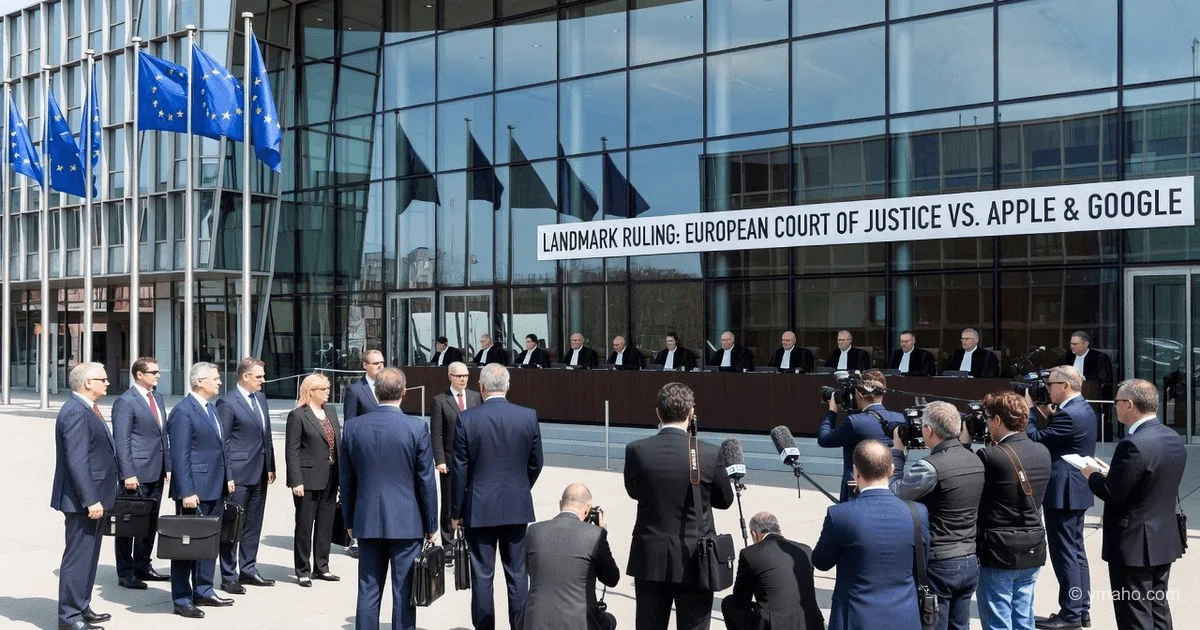
EU Court Rejects Apple and Google Appeals Against Billion-Euro Fines
The European General Court has dismissed appeals by Apple and Google, upholding fines of €13 billion and €2.4 billion respectively for antitrust violations and tax benefits.
Europe's 'Nuclear Option': How the Ruling on Apple and Google Changes the Game for Big Tech
The Gist: What's Really Happening
Formally, the European General Court simply upheld two old European Commission decisions—and left fines of €13 billion for Apple and €2.4 billion for Google in place. But in reality, this is not the end of long legal battles, but the beginning of the end of an entire era. It's not about the money—though the sums are colossal, for Apple €13 billion is roughly 3–4 weeks of net profit. It's about a precedent that dismantles the very architecture of cross-border tax planning that has underpinned global corporations' business models for decades.
Margrethe Vestager, the outgoing EU Competition Commissioner, called it 'a great victory for European citizens and tax justice.' But for insiders, it sounds like the final chord of a decade-long campaign that began back in 2014, when the European Commission first targeted tax rulings between corporations and individual EU countries. At the time, few believed Brussels could win in court—the American giants had too much lobbying power.
However, a tectonic shift has occurred over the years. Vestager lost cases against Amazon, Engie, and Fiat in Luxembourg—but won the big one. And this win is not just about Apple and Google. It's a signal: the EU will no longer tolerate corporations paying effective tax rates of 0.005%, as Apple did in Ireland, paying €50 on every €1 million of profit. It signals that tax arbitrage between jurisdictions—where profits are attributed to where taxes are lowest—is coming to an end.
But there's a nuance that escapes most observers. Ireland, which is set to receive €13 billion from Apple, actually opposed this throughout the legal proceedings! Dublin said it didn't want the money. Why? Because for Ireland, preserving its reputation as a tax haven for foreign investment is more important than a one-time cash windfall. And this position is key to understanding that the EU is not so much attacking the corporations themselves, but the sovereignty of small member states that have long lived off tax dumping.
Timeline and Context
To grasp the depth of what's happening, we need to look at the timeline. This is not a one-off action but a systematic siege.
| Year | Event | Significance |
|---|---|---|
| 2014 | European Commission launches investigation into Apple in Ireland | First shot in Vestager's campaign |
| 2016 | EC rules Apple must repay €13 billion | Start of the legal saga |
| 2017-2019 | Google receives three antitrust fines totaling €8.2 billion | Beginning of parallel attack on the search giant |
| 2020 | EU Court annuls Apple decision—corporate victory | Temporary setback for Brussels |
| 2023-2024 | EC appeals to higher court | Return to the game |
| 2026 (February) | Final EU Court ruling: fines upheld | Current point—end of first act |
Importantly, this is not the first time the EU has won in court. But until now, all major victories were in antitrust regulation (Google Shopping, Google Android), not in tax matters. Here, we're talking about a direct redistribution of fiscal sovereignty within the EU.
A telling moment: the European Commission welcomed the OECD agreement on a global minimum tax (Pillar Two) at a 15% rate back in January 2026. And now, in February, this blow against Apple and Google. Coincidence? No. It's a coordinated strategy: first create an international legal framework (OECD), then cut off escape routes through national tax agreements.
And here's an insight that almost no one discusses. The Apple case is just the tip of the iceberg. While the media buzzes about €13 billion, Brussels is already preparing the ground to require all EU countries to implement Pillar Two into national law without regard for 'special conditions' for corporations. This means that even if Ireland wants to keep low rates, it won't be able to—EU law will override national law.
Who Wins and Who Loses
Winners:
The European Commission and Margrethe Vestager personally. This is her swan song—she leaves office leaving a legacy of case law that cannot be undone. Her phrase 'we will continue to pursue abuses of dominant position' is not a threat but a promise that the next generation of Eurocrats will act even tougher.
Small and medium-sized businesses in Europe. Indirectly, they win because the competitive advantage of giants that paid lower taxes than local bakeries or IT startups for decades is eliminated.
High-tax countries (France, Germany). They gain a tool to pressure Ireland, the Netherlands, and Luxembourg within the framework of EU-wide fiscal harmonization.
Losers:
Apple and Google—not so much because of the money, but because of the loss of invincibility reputation. For investors, this signals that legal risks of operating in the EU are rising. It's not fatal, but it adds a discount to stock valuations.
Ireland. Its business model as a tax haven is undermined. Although Dublin didn't want the €13 billion, it now has to take it, creating internal political tension.
The entire tax arbitrage industry. Thousands of lawyers and consultants worldwide who made a living structuring cross-border deals through Ireland, Luxembourg, or the Netherlands now have to find new jobs. The transfer pricing industry is shrinking.
But there's a third party—American investors. They don't lose directly, but they face an unpleasant side effect: the EU victory strengthens arguments by US Democrats to raise corporate taxes in America. 'If Europe makes Apple pay, why should we give them tax breaks?'—this argument is already being heard in Washington.
What the Media Isn't Saying
First, they're silent about the connection to the Google Gemini and AI case. While the court was handling the tax case, Apple signed an agreement with Alphabet (Google) to integrate the Gemini model into Siri. This means the two tech giants, who were conditional 'allies in distress' in court, are actually deepening their product-level partnership. Why does this matter? Because the EU is simultaneously investigating Google under the Digital Markets Act (DMA) in the AI space. Brussels is checking whether Google is abusing its dominance in search to promote its AI services.
And here's the key insight: the EU is using tax cases as leverage in tech battles. While everyone focuses on €13 billion, Brussels is pushing through the courts a narrative of 'unfairness' of American corporations in general. This creates a political and media cushion for tightening regulation of AI, data, privacy, and digital markets. Fines are just a tool for reputation management.
Second, what the media misses: this is not just about taxes, but about global capital redistribution. Private equity funds have already started reassessing the location of their European offices. Over the past six months, several major hedge funds moved their European headquarters from Dublin to Frankfurt and Paris. They sense that Ireland is losing its 'safe haven' status.
Third, the consequences for Apple shareholders. The company is already facing investor dissatisfaction due to delays in its AI strategy—shares trade at a P/E multiple of 33, significantly above the 10-year average of 23. Investors are waiting for a 'supercycle' of iPhone upgrades based on AI, but it keeps getting postponed. And now tax risk is added: although €13 billion is not a critical sum for Apple with $350 billion in annual revenue, psychologically it's a negative factor that could trigger a correction.
Fourth and most importantly: the court ruling creates risks for Apple's search deal with Google. Recall that Google pays Apple roughly $20 billion a year to be the default search engine on iPhones. This deal is one of the main revenue streams for Apple Services. Now, after the tax ruling, US regulators and EU antitrust authorities could attack this agreement with renewed vigor as a 'hidden form of monopoly rent.' And if the deal is broken, Apple would lose $20 billion in annual revenue—far more serious than a one-time €13 billion fine.
Forecast: Next 30 Days and 90 Days
Next 30 days:
- The European technology stock market (STOXX 600 Technology sector) will experience 3–5% higher volatility than average.
- Google (Alphabet) and Apple shares will show divergence: Google may see a short-term relief rally because its fine (€2.4 billion) is smaller and perceived by the market as 'old news.' Apple, on the other hand, may react more painfully due to multiples and AI pauses.
- Watch for statements from EU finance ministers—discussions will begin on how to distribute the €13 billion from Apple (Ireland will receive it, but there will be redistribution through the EU budget under a common European mechanism).
90 days:
- Likely start of new investigations against other corporations—Netflix, Amazon (already had a case, but could be reopened), as well as Salesforce and Oracle may come into focus.
- The OECD will announce progress on Pillar Two implementation, directly hitting tax jurisdictions like the Netherlands, Luxembourg, and Ireland.
- Shares of European banks that lent to corporations using offshore structures (e.g., some divisions of Deutsche Bank and BNP Paribas) may come under pressure due to risks of declining fee income from tax advisory.
- Key risk: if the Trump administration (or a future US presidential administration) responds to the EU ruling with new tariffs or threats to leave the OECD, it could escalate into a trade conflict. 2026 is an election year in the US, and 'protecting American corporations' will become a popular topic.
Editorial Forecast
Based on current data: we expect Apple (AAPL) shares to decline 2–4% in the next 48 hours after US market open. Key support level is $165, resistance is $172. Confidence level: medium, as the main drop may have already been priced in during previous court hearings. The main risk to the forecast: possible buy-the-dip by institutional investors who view the court ruling as a one-time event that doesn't affect the long-term business model. If the market decides that '€13 billion is the price of entry to the European market,' shares may remain range-bound.
This is an editorial opinion, not investment advice.
— Editorial Team