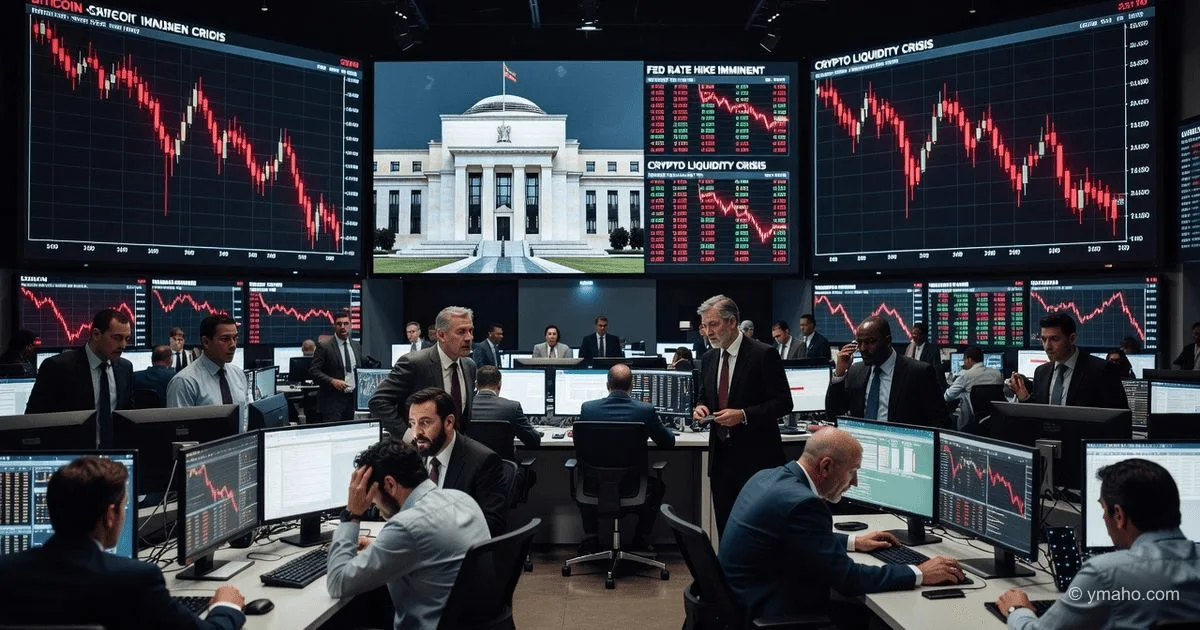
Fed Tightens Rhetoric, Triggering Crypto Market Crash
Amid signals from the Fed about tighter monetary policy and keeping rates unchanged, Bitcoin fell below $63,000 and Ether below $1,700. Positions worth $180 million were liquidated in an hour, and the total market capitalization dropped to $2.15 trillion, reflecting investor flight from high-risk assets.
Brief Analysis: What's Really Happening
The cryptocurrency market is experiencing not just a routine correction but a structural paradigm shift driven by a change in the Federal Reserve's management philosophy. On June 17, 2026, the Fed under new Chairman Kevin Warsh decided to keep the key rate at 3.5%-3.75%, in line with market expectations. However, the devil is in the details, and it is these details that triggered the crypto market crash, with total capitalization falling to $2.15 trillion and Bitcoin breaking the psychological mark of $63,000.
Behind the seemingly neutral decision to hold rates lies a shift in course that can be characterized as a "hawkish" turn. Warsh, known for his skepticism toward quantitative easing, held his first press conference in a style not seen since Alan Greenspan. He didn't just keep rates steady—he dismantled the entire expectation management system built over years. This means markets have lost the "policy anchor" they had grown accustomed to over the past decade.
In his speech, Warsh stated that inflation remains "significantly above" the 2% target and that reaching it is still far off. Moreover, he announced the creation of five working groups to review the Fed's approaches to communications, balance sheet management, data, AI, and inflation. Essentially, this marks the beginning of a full-scale central bank reform that fundamentally changes the rules of the game for all risky assets. Investors, accustomed to Jerome Powell's "caring" tone and clear signals, now find themselves in an information vacuum where prices will be determined solely by macroeconomic data, not official hints.
Timeline and Context
To understand the depth of what's happening, we need to reconstruct the timeline of recent events. On June 17, the Federal Open Market Committee (FOMC) meeting took place—the first under Warsh, who was confirmed by the Senate in May 2026. Although the rate hold was expected (all four 2026 meetings ended with no changes), the market reaction was extremely negative.
The key moment came during Warsh's press conference, which lasted significantly longer than usual. He not only announced the abandonment of "forward guidance"—the practice where the Fed hints at future moves—but also shortened the FOMC statement from 314 words (under Powell) to 132 words. Warsh directly stated that the statement would now contain only facts, not expectations, and that he had nothing to say about how long the Fed would maintain a neutral stance.
The market reaction was immediate. Bitcoin, which was trading around $66,000 before the announcement, fell to $64,800 within minutes and then continued to decline to $63,000 and below. Data aggregator Coinglass recorded position liquidations of $101.68 million for Bitcoin alone over 24 hours, with 71% being long positions. Over four hours, more than $200 million in long positions were liquidated across the crypto market.
This decline was the culmination of a negative trend observed since mid-May. Since May 10, net assets of Bitcoin ETFs have shrunk by about $33 billion—from $109 billion to $77 billion, corresponding to a 27% drop in Bitcoin from its May peak of $81,443. The June correction only accelerated this process, with ETFs losing $2.1 billion in the first half of June, nearly matching May's outflow of $2.4 billion.
Who Wins and Who Loses
In this situation, there are clear losers as well as players who may gain an advantage.
Losers #1: Margin traders and long position holders. Liquidations totaling hundreds of millions of dollars within hours is a classic "bloodbath" scenario for leveraged traders. Warsh effectively crushed hopes for a near-term rate cut, triggering a cascade of forced selling.
Losers #2: Bitcoin ETF issuers and investors. Institutional investors have been pulling capital from spot Bitcoin ETFs for several consecutive weeks. This signals a shift in sentiment among large players who no longer see short-term growth drivers. Particularly alarming is the drop in the Coinbase Premium Index to -0.15%, meaning US institutional buyers are willing to pay less for Bitcoin than retail investors on international exchanges.
Losers #3: DeFi protocols. Lending revenues and fees on decentralized exchanges fell 65% in the week following the June sell-off. Demand for borrowed funds has sharply declined as traders no longer need leverage to build positions. The drop in yields could trigger capital outflows from liquidity pools, adding further pressure on the ecosystem.
Potential winners: Strategic long-term holders. On-chain data shows that in June, long-term holders increased their positions, absorbing about 125,000 BTC during the panic. This is classic "smart money" behavior—buying on fear and sell-offs. Addresses with balances over 1,000 BTC increased their holdings to approximately 7.17 million coins, the highest level since mid-March 2026. They view the current correction as an opportunity to enter at attractive prices.
Winners: Stablecoin and fiat holders. In periods of high uncertainty, capital flows into safe assets. The strengthening of the US dollar following the Fed meeting makes it a more attractive haven compared to volatile cryptocurrencies.
What the Media Isn't Saying
The vast majority of media focus on Warsh's "hawkish" rhetoric but overlook several critical details that fundamentally change the picture.
Insight #1: Abandoning forward guidance is not just a style change but a removal of the "protective barrier" for markets. Previous Fed leadership used forward guidance as a tool to manage volatility. Warsh essentially told the market, "You're on your own now." This means every economic statistic change (inflation, labor market, GDP data) will cause much sharper movements than before. With volatility already high in cryptocurrencies, this could lead to unpredictable swings in the coming months. CME FedWatch analysts have already raised the probability of a rate hike in July to 18%, and the possibility of a rate cut by the end of 2026 is considered "extremely low."
Insight #2: The most dangerous part of Warsh's plan is the review of the Fed's balance sheet. Few noticed that among the five working groups created, there is a group on balance sheet management. Warsh has a long-standing reputation as a critic of quantitative easing (QE) and a proponent of faster balance sheet reduction. If he accelerates the quantitative tightening (QT) process, it will drain liquidity from the global financial system. For Bitcoin, which many consider a barometer of global liquidity, this could mean a prolonged bearish trend far beyond the current correction.
Insight #3: Personal conflict of interest and political game. Warsh has previously invested in over 20 blockchain companies, including dYdX and Solana, and promised to sell these assets after his appointment. This creates an ambiguous situation: on one hand, he is one of the most "crypto-friendly" Fed chairs in history, understanding the industry from the inside. On the other hand, he begins his tenure with one of the tightest monetary policy periods. The irony is that the person who understands Bitcoin best may lead the Fed to create the worst macroeconomic conditions for its growth. Additionally, he must balance political pressure from President Trump (who has not ruled out a rate hike) with objective economic realities.
Forecast: Next 30 Days and 90 Days
30-Day Forecast (July 2026): Consolidation with high breakout risk.
In the coming month, the market will be in a state of "information hunger." Traders will frantically search for new benchmarks in the absence of clear Fed signals. The key level for Bitcoin is the $62,000–$64,000 zone. If this range holds, we will see consolidation with attempts to recover to $68,000, where significant resistance lies. However, any negative macroeconomic surprise (e.g., inflation rising above 4.2% or escalation of geopolitical conflict in the Middle East) could crash Bitcoin to the next important support level around $52,000–$55,000, corresponding to the 200-week moving average. Recovery of the DeFi sector is unlikely until Bitcoin's price stabilizes.
90-Day Forecast (September 2026): Bearish scenario becomes baseline.
If the Fed under Warsh continues its hawkish stance and, moreover, follows through on the threat of a rate hike, it will be a "death cross" for the entire crypto industry. 3.5%-3.75% is already high, and a hike would mean investors continue to pull money from ETFs and high-risk assets. We could see a prolonged downtrend with rare short bursts of "bull traps." However, there are factors that could reverse the situation: passage of the CLARITY Act in the US, which could improve the regulatory environment for XRP and other cryptocurrencies, or successful ceasefire negotiations in the Middle East that could temporarily boost risk appetite. Nevertheless, they are unlikely to outweigh the fundamental macroeconomic backdrop.
Editorial Forecast
Based on current data, we expect that over the next 24–72 hours, Bitcoin will remain under pressure with a high probability of retesting the $62,000 level. The main resistance zone is at $64,800, but without positive news or stabilization of ETF flows, an upward breakout is unlikely. Confidence level is medium, as there remains a risk of worsening geopolitical conditions or unexpected Fed comments that could trigger a new wave of decline. The main risk to the forecast is the sudden emergence of positive regulatory news that could cause a short-term upward correction.
— Editorial Team