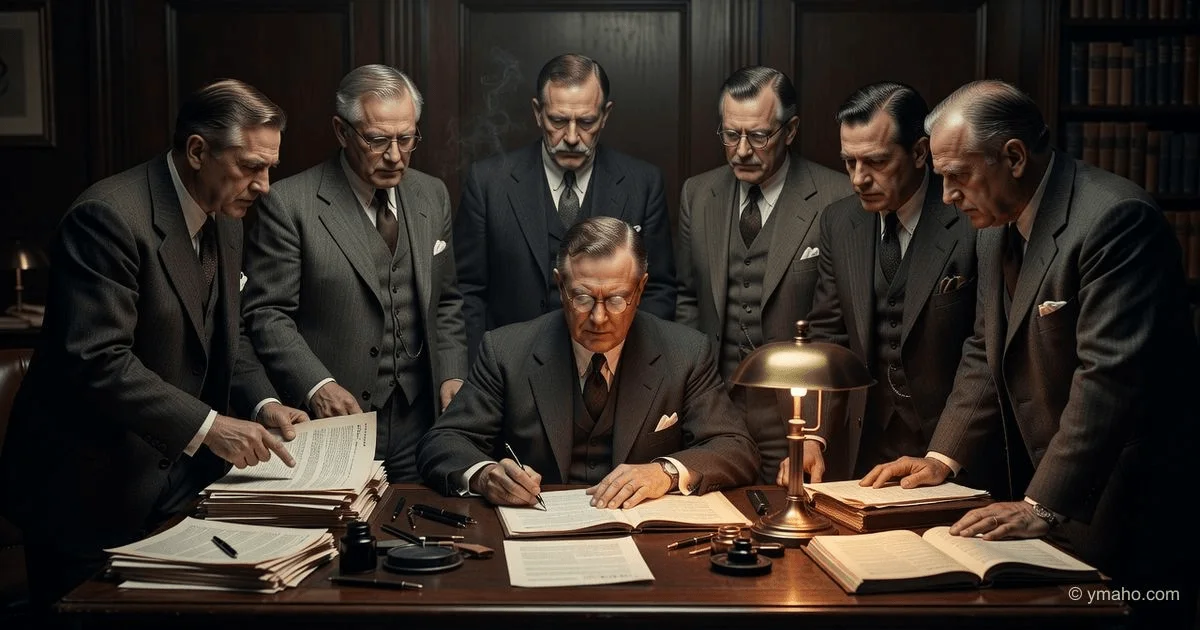
From Depression to Policy: How the 1930s Redefined Economics
The Great Depression was not merely an economic catastrophe; it was the crucible in which modern American economic policy was forged. The unprecedented collapse of industrial production by roughly 50 percent and a decline in wholesale prices of approximately 40 percent between 1929 and 1933 forced a fundamental re-evaluation of the government's role in the economy . To understand how did the great depression reshape economic policy is to understand the very origins of the fiscal and monetary tools that policymakers still wield today.
What You'll Learn
By the end of this article, you'll understand the key policy failures that exacerbated the Great Depression, the revolutionary "regime change" initiated by Franklin D. Roosevelt, and the lasting legacy of this era on modern economic thought. You'll see how the Depression led to the birth of activist monetary policy, the creation of the modern social safety net, and a permanent shift in the relationship between the federal government and the American people.
The Collapse: A Failure of Existing Doctrine
The initial response to the economic downturn was hampered by the prevailing economic orthodoxy. The gold standard, which fixed the value of currency to gold, was a primary constraint. A landmark NBER study by Michael D. Bordo and Anna J. Schwartz argues that the Federal Reserve, despite possessing massive gold reserves, failed to use expansionary monetary policy to avert banking panics, partly due to the belief that a painful "purging" of the excesses of the 1920s was necessary . This inaction, famously documented by Milton Friedman and Anna Schwartz, turned a severe recession into a catastrophic depression. As Federal Reserve Chairman Ben Bernanke noted in a 2006 speech, the Fed’s failure to stabilize the money supply was an important cause of the disaster, with policymakers of the era questioning both their capacity and the desirability of intervention .
1933: A "Regime Change" in Policy
The turning point came with Franklin D. Roosevelt's assumption of the presidency in March 1933. According to economic theory, the U.S. economy was stuck in a "liquidity trap," where conventional monetary policy had become ineffective. Roosevelt orchestrated what economists call a "regime change" by abandoning the gold standard and rejecting the commitment to balanced budgets that had constrained the Hoover administration . This dramatic policy shift altered expectations about future inflation. When businesses and households came to believe that prices would rise rather than continue to fall, they increased spending, generating a self-fulfilling recovery. Industrial production abruptly reversed its collapse, a powerful testament to the power of credible policy management .
The New Deal's Enduring Institutional Legacy
The Roosevelt administration's response was the New Deal, a sweeping set of programs and reforms that permanently reshaped American economic life.
Financial Sector Reform
The banking system, which had collapsed, was stabilized. The creation of the Federal Deposit Insurance Corporation (FDIC) in 1933 restored public confidence in banks, fundamentally altering the relationship between depositors and financial institutions . The Glass-Steagall Act, which separated commercial and investment banking (later repealed in 1999), was another key reform aimed at curbing the speculative excesses that had contributed to the crash . The very collection of monetary statistics, initiated by Lauchlin Currie in the 1930s, provided the Federal Reserve with the data necessary to manage the money supply and stabilize the economy .
The Birth of the Modern Social Safety Net
The Social Security Act of 1935 was perhaps the New Deal's most revolutionary and lasting achievement. It created a national, contributory old-age pension system, a federally-supported unemployment insurance program, and aid to dependent children. This was not a completely new idea—various states had debated similar programs—but the Depression made its passage at the federal level politically possible . Roosevelt was acutely aware of the program's political vulnerability and deliberately designed it to be self-financing through payroll taxes. As he put it, "We put those payroll contributions there so as to give the contributors a legal, moral, and political right to collect their pensions. With those taxes in there, no damn politician can ever scrap my social security program" .
A New Deal for Workers and Labor
The Wagner Act of 1935 (also known as the National Labor Relations Act) was a landmark piece of legislation that gave workers the legal right to form unions and bargain collectively. While the surge in union membership was driven by the economic conditions of the Depression, the Wagner Act prevented a sharp decline in unionization after the economy recovered . However, the New Deal's benefits were not equally distributed. While millions of workers found jobs through agencies like the Works Progress Administration (WPA), African Americans were frequently excluded from skilled jobs and paid lower wages, and many relief camps were segregated. Roosevelt, needing the support of Southern Democrats, was unwilling to challenge segregation .
The "Richest Man in the World" and the "Trilemma"
The shift from a commitment to the gold standard to a focus on domestic full employment had profound international implications. This period saw the rise of the "trilemma" in global economics—the incompatibility of fixed exchange rates, capital mobility, and discretionary monetary policy. Before World War I, fixed exchange rates and capital mobility had provided stability but precluded activist policy. The Great Depression's legacy of domestic policy activism eventually led to the collapse of the Bretton Woods fixed exchange rate system in the 1970s . The U.S. also fundamentally changed its trade policy. The Smoot-Hawley Tariff of 1930 had exacerbated the global depression by sparking retaliatory trade wars. In 1934, the Reciprocal Trade Agreements Act (RTAA) was passed, granting the president the authority to negotiate tariff reductions without congressional approval, marking a permanent shift toward a more open, rules-based international trading system .
A Controversial Legacy: Did the New Deal Work?
The legacy of the New Deal is not without controversy. Historians and economists continue to debate its effectiveness. It is undisputed that the New Deal provided a safety net and restored confidence, but it did not achieve full employment. That was finally accomplished by the massive government spending of World War II. Furthermore, some economic analyses, such as that conducted by Lee Ohanian, a macroeconomist at UCLA, suggest that certain New Deal policies, particularly the National Industrial Recovery Act (NIRA), may have retarded recovery by suppressing competition, raising prices and wages, and thereby delaying the return to full employment .
Despite these criticisms, the Great Depression was undeniably a "defining moment" . It established the expectation that the federal government would actively intervene to manage the economy and shield its citizens from the worst effects of economic downturns. The policy tools and frameworks developed in the 1930s—activist monetary policy, countercyclical fiscal policy, deposit insurance, social security, and a commitment to managed trade—remain cornerstones of economic policy today.
Frequently Asked Questions
How did the Great Depression reshape economic policy regarding the gold standard? The Great Depression fundamentally discredited the gold standard by showing that fixed exchange rates severely constrained a nation's ability to combat domestic deflation and banking crises. By abandoning the gold standard in 1933, the U.S. was able to pursue expansionary monetary policies that helped reverse the deflationary spiral and initiate recovery .
What is the most significant economic policy that came from the Great Depression? While many experts point to the Social Security Act of 1935 due to its lasting impact on American life, the most significant shift in terms of economic management was the birth of "policy activism." This is the idea that the government has a responsibility to use fiscal and monetary tools to stabilize the economy and maintain full employment, a direct reversal of the laissez-faire orthodoxy that preceded it .
Did the New Deal actually end the Great Depression? Yes and no. The New Deal's policies (like abandoning the gold standard and creating a safety net) stabilized the banking system and restored confidence, which were critical first steps. However, it did not lead to a complete return to full employment. It was the massive government spending and industrial mobilization for World War II that ultimately ended the Great Depression in the early 1940s .
Why was the Great Depression such a transformative moment for U.S. economics? Prior to the 1930s, the prevailing wisdom held that free markets would self-correct. The Depression's unprecedented depth and duration, combined with the subsequent success of the New Deal and Keynesian-inspired policies, proved that this was not the case. This led to a permanent expansion in the size and scope of the federal government's role in the economy .
How did the Great Depression influence today's trade policy? The Depression led to a permanent shift away from protectionism. The disastrous global trade war triggered by the Smoot-Hawley Tariff of 1930 directly led to the Reciprocal Trade Agreements Act of 1934. This legislation gave the president the authority to negotiate reciprocal tariff reductions, setting the stage for the post-WWII rules-based international trading system that the U.S. has championed ever since .
Sources
- American Economic Association. "Understanding liquidity traps." AEA Research, 2025.
- Federal Reserve Board. "Monetary Aggregates and Monetary Policy at the Federal Reserve: A Historical Perspective." Speech by Chairman Ben S. Bernanke, 2006.
- Bordo, Michael D., Claudia Goldin, and Eugene N. White, eds. The Defining Moment: The Great Depression and the American Economy in the Twentieth Century. University of Chicago Press, 1998.
- Bordo, Michael D., and Anna J. Schwartz. "Was Expansionary Monetary Policy Feasible During the Great Contraction? An Examination of the Gold Standard Constraint." NBER Working Paper No. 7125, 1999.
- Ohanian, Lee. "The Macroeconomic Impact of the New Deal." Routledge Handbook of the Great Depression, 2013.
- BBC Bitesize. "Judging the New Deal - The New Deal - AQA - GCSE History Revision."
— Editorial Team