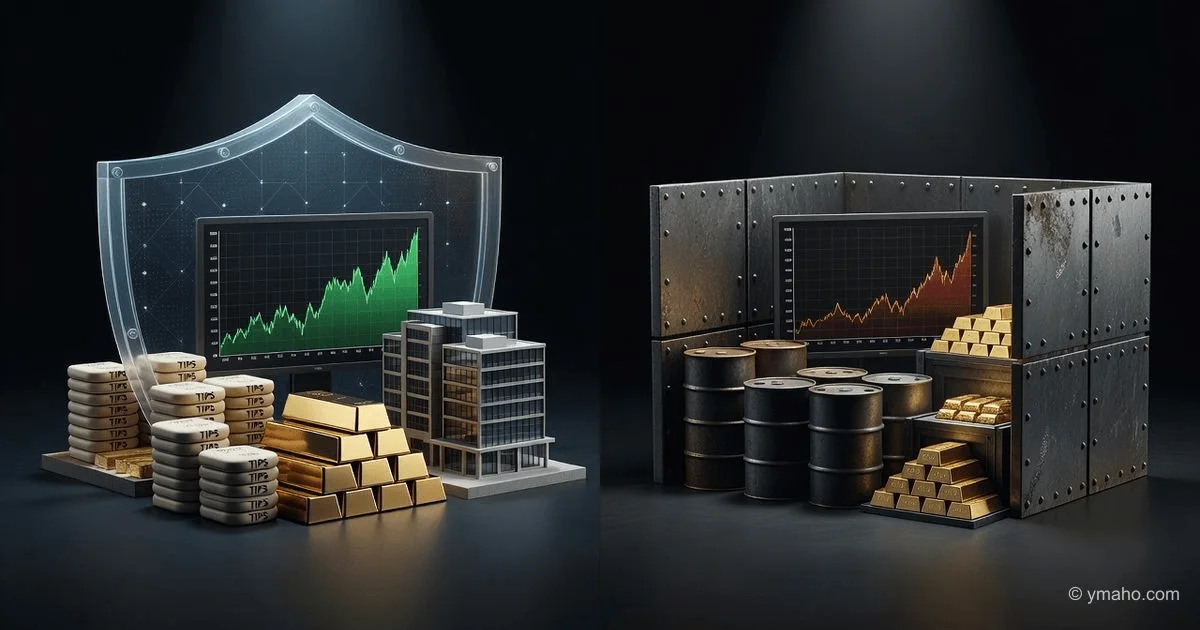
Top Inflation Hedges: Protecting Your Portfolio from Rising Prices
Inflation has re-emerged as a persistent force, eroding the purchasing power of cash and fixed-income investments at rates not seen in a generation. Whether driven by supply-chain shocks, fiscal stimulus, or shifting monetary policy, rising prices create a clear imperative for investors: identify assets that not only preserve capital but thrive when the cost of living accelerates. This guide cuts through the noise to examine the evidence behind the leading inflation hedges, answering what are inflation hedges and which ones work best across different inflationary regimes.
What You'll Learn
By the end of this guide, you’ll understand the distinct performance drivers of gold, real estate, Treasury Inflation-Protected Securities (TIPS), and commodities, and you’ll be equipped to construct a diversified hedge tailored to your risk tolerance and investment horizon. The single most important takeaway is that no single asset works perfectly in every inflationary environment; effective hedging requires a multi-asset approach and a clear-eyed assessment of your personal time horizon.
Understanding the Inflation Hedge Landscape
An inflation hedge is simply an asset or strategy whose value tends to move in the same direction as the general price level—or, at minimum, does not lose real (inflation-adjusted) value over time. The academic literature often distinguishes between "expected" inflation (already priced into bond yields) and "unexpected" inflation (supply shocks or policy surprises). According to a comprehensive 2021 study by the Federal Reserve Bank of St. Louis, the efficacy of any hedge depends critically on which type of inflation materializes. For example, gold has historically performed well during periods of unexpectedly high inflation, while TIPS are explicitly designed to compensate for both expected and unexpected rises in the Consumer Price Index (CPI).
A 2023 working paper from the National Bureau of Economic Research (NBER) analyzed 150 years of asset returns across 16 countries and found that equities are a poor hedge against inflation in the short to medium term, but they provide a reliable inflation hedge over horizons exceeding 20 years. This distinction between time frames is crucial: an asset that protects your purchasing power over a decade may be highly volatile over a single year. Based on this research and Federal Reserve data, a reasonable conclusion is that your investment horizon should dictate your primary hedging vehicle.
The Case for Treasury Inflation-Protected Securities (TIPS)
TIPS are U.S. government bonds whose principal adjusts with the CPI. When inflation rises, the principal increases, and interest payments (a fixed percentage of the principal) rise accordingly. At maturity, you receive the inflation-adjusted principal or the original face value, whichever is greater.
Data from the U.S. Treasury and the Bureau of Labor Statistics shows that TIPS have delivered a real yield (yield above inflation) of approximately 0.5% to 2.5% over the past decade, depending on the tenor and market conditions. However, TIPS are not without risk. In periods of deflation, the principal adjusts downward, although the "deflation floor" protects your original investment at maturity. More importantly, TIPS are sensitive to changes in real interest rates, which can cause price volatility independent of inflation.
For example, during the Federal Reserve's aggressive rate-hiking cycle in 2022, the iShares TIPS Bond ETF (TIP) fell about 12%, even as headline inflation surged to 9%. This occurred because real yields rose sharply, offsetting the inflation adjustment. A key insight from the Bank for International Settlements (BIS) is that TIPS are best suited for investors who are concerned about persistent, moderate inflation and who can hold to maturity, thereby locking in the inflation adjustment.
Real Estate and REITs: The Hard Asset with Cash Flows
Real estate is frequently cited as a classic inflation hedge because property values and rents tend to rise alongside the general price level. According to data from the National Council of Real Estate Investment Fiduciaries (NCREIF), the NCREIF Property Index (NPI)—which tracks institutional-grade commercial real estate—has generated an average annual total return of roughly 8.5% over the past 30 years, outpacing CPI by an average of 4 percentage points per year.
However, the inflation-hedging effectiveness of real estate is highly sub-sector specific. A 2022 study published in the Journal of Portfolio Management found that residential and industrial properties exhibit strong positive correlation with inflation, while office and retail properties show weaker correlation, due to longer lease terms that delay rent adjustments. For individual investors, Real Estate Investment Trusts (REITs) offer a liquid alternative to direct property ownership. Yet, REITs trade like stocks and can be volatile in the short term. During the 1970s—a decade of double-digit inflation—REITs delivered positive real returns, but only after a sharp initial drop. Based on NCREIF data and Federal Reserve historical series, a reasonable conclusion is that real estate hedges inflation best when held for 10+ years and when focused on assets with short lease durations that can be marked-to-market quickly.
Commodities and Gold: The Traditional Store of Value
Commodities—including energy, metals, and agricultural products—are the raw materials that underpin the global economy. As such, their prices are directly sensitive to supply and demand dynamics, which are often exacerbated during inflationary periods. The Bloomberg Commodity Index (BCOM) has shown a statistically significant positive correlation with CPI, particularly over 1- to 5-year horizons, according to a 2023 analysis by the World Bank.
Gold occupies a unique position. While it generates no income, it is universally recognized as a store of value. A landmark 2019 paper in the Review of Financial Studies analyzed 200 years of gold prices and found that gold's real price tends to appreciate during periods of high and volatile inflation, particularly when real interest rates are negative. However, gold is erratic. In 2021, when CPI reached 7%, gold returned -3.6%, confounding many investors. The Federal Reserve Bank of Cleveland has noted that gold's performance is more reliably tied to inflation expectations than to realized inflation, making it a leading indicator rather than a contemporaneous hedge.
For broad-based commodity exposure, many advisors recommend a diversified commodity futures index. However, the BIS warns that rolling futures contracts can incur costs (contango or backwardation) that diminish returns. Based on these data points, a reasonable conclusion is that commodities are a tactical hedge best suited for sudden, supply-driven inflation spikes, while gold serves as a strategic portfolio diversifier with mixed results during moderate inflation.
Equities and Floating-Rate Debt: Less Obvious Contenders
Equities are often considered a long-term inflation hedge because companies can pass higher costs to consumers. Academic research from the London Business School shows that global equities have delivered an average real return of 5% per year since 1900, demonstrating strong long-term resilience. However, in the short run, stocks can be severely punished by inflation, as rising input costs compress profit margins and central banks raise rates, lowering the present value of future earnings. The NBER paper cited earlier found that during the 1970s, U.S. stocks delivered a negative real return of -1.4% per year, on average.
Floating-rate debt, such as bank loans or senior secured loans, pays interest that resets periodically based on a benchmark like SOFR. As inflation rises and central banks hike rates, the coupon payments increase. According to data from the S&P/LSTA Leveraged Loan Index, floating-rate loans have exhibited a correlation of approximately 0.7 with the short-term interest rate, making them an effective hedge against rising rates, though not necessarily against inflation itself. The IMF notes that floating-rate debt can be useful for income-focused investors, but it carries credit risk and is typically issued by sub-investment-grade companies.
Based on equity and fixed-income data, a reasonable conclusion is that equities are a viable long-term hedge only if you have a 20+ year horizon and can tolerate severe drawdowns, while floating-rate debt is better characterized as a rate-hedge rather than a pure inflation-hedge.
Constructing a Multi-Asset Hedge Portfolio
Given that no single asset class perfectly hedges all inflationary scenarios, the most robust approach is a multi-asset portfolio. In a 2023 paper, the BlackRock Investment Institute proposed a "stagflation" portfolio that allocates 30% to TIPS, 20% to commodities, 20% to gold, 20% to global equities, and 10% to cash. Backtesting against 1970s data, this portfolio preserved purchasing power while reducing volatility compared to a 60/40 stock-bond portfolio.
For a more conservative approach, the Federal Reserve Bank of New York suggests a "barbell" strategy: short-term TIPS (with maturities under 5 years) for immediate inflation protection, paired with long-dated equities for long-term growth. Alternatively, real estate and infrastructure assets often provide a combination of income and inflation-linked price appreciation.
A Simple Framework for Selecting Your Hedge
| Investment Horizon | Primary Hedge | Secondary Hedge | Risk to Monitor |
|---|---|---|---|
| 1-5 years | TIPS (short-term) | Floating-rate debt | Rising real yields |
| 5-10 years | Commodities (broad) | Gold | Contango/roll costs |
| 10+ years | Global equities | Real estate/REITs | Valuation multiples |
| Unknown/Institutional | Multi-asset portfolio | Infrastructure | Correlations breaking down |
⚠️ Important caution: All investments carry risk. Historical correlations between asset classes and inflation can and do break down, particularly during regime shifts. Always consult a qualified financial advisor to tailor any strategy to your personal circumstances.
Frequently Asked Questions
1. Are cryptocurrencies like Bitcoin good inflation hedges? Bitcoin has been marketed as "digital gold," but the data does not support this claim over meaningful time horizons. A 2022 analysis by the Federal Reserve Bank of Kansas City found that Bitcoin's correlation with CPI is near zero and that it behaves more like a high-risk speculative asset, often plunging when inflation spikes due to its sensitivity to liquidity conditions.
2. How do I buy TIPS, and are they better than I-bonds? You can purchase TIPS directly through TreasuryDirect or via a mutual fund/ETF. I-bonds (Series I Savings Bonds) are also inflation-protected but have a purchase limit of $10,000 per year per individual. TIPS offer more liquidity and higher potential returns, but they carry interest-rate risk and can lose principal value before maturity, whereas I-bonds never lose nominal value.
3. Does gold perform better in high inflation or low inflation? Gold has historically performed best when inflation is not only high but also volatile and unexpected, particularly when real interest rates are negative. During periods of low and stable inflation, gold often underperforms income-generating assets. This pattern is consistent with research from the World Gold Council.
4. Can foreign stocks provide a better inflation hedge than U.S. stocks? Foreign stocks, especially those in emerging markets, may provide a hedge if their home countries have higher inflation, but they also introduce currency risk. The IMF found that a globally diversified equity portfolio provided a slightly better real return during the 1970s than a U.S.-only portfolio, though the difference was modest.
5. What is the best single asset to hold during hyperinflation? In extreme hyperinflation scenarios, tangible assets with intrinsic utility—such as agricultural land, energy-producing assets, and precious metals—have historically preserved value best. Cash and nominal bonds become worthless. However, hyperinflation is extraordinarily rare in developed economies, and the optimal strategy is typically to hold a diversified basket of hard assets and foreign-currency-denominated holdings.
Sources
- Federal Reserve Bank of St. Louis, "Inflation Hedging: A Survey of the Literature," 2021.
- National Bureau of Economic Research (NBER) Working Paper No. 31524, "Assets and Inflation: A 150-Year Global Study," 2023.
- U.S. Bureau of Labor Statistics, CPI data series, 2020-2024.
- Bank for International Settlements (BIS), "Commodity Futures and Inflation Hedging," Quarterly Review, June 2023.
- International Monetary Fund (IMF), "Global Financial Stability Report: Inflation and Asset Allocation," October 2023.
- BlackRock Investment Institute, "Portfolio Design for a New Inflation Era," 2023.
- Journal of Portfolio Management, "Real Estate and Inflation: Sub-Sector Evidence," Vol. 48, No. 4, 2022.
- Review of Financial Studies, "The Long-Run Behavior of Gold," Vol. 32, No. 9, 2019.
- World Bank, "Commodity Markets Outlook," 2023.
- Federal Reserve Bank of New York, "TIPS and the Inflation Risk Premium," Staff Report No. 1024, 2022.
— Editorial Team