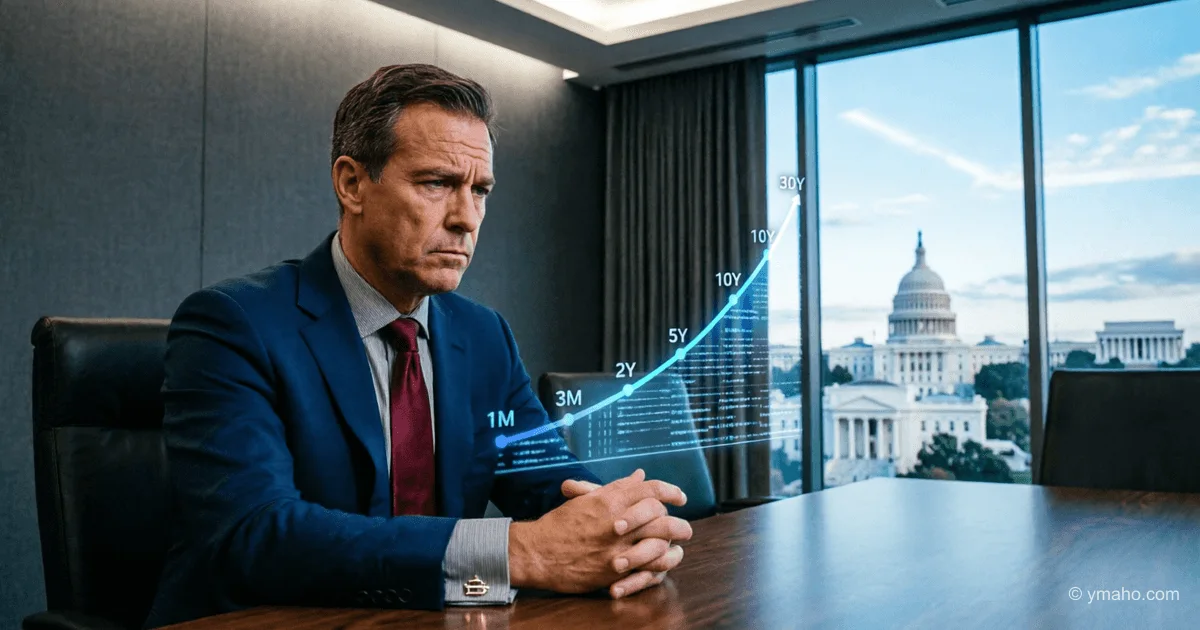
New Fed Chair Warsh Casts Doubt on Market's Expected Rate Cut
Kevin Warsh, confirmed by the Senate as Fed Chair, faces White House pressure to cut rates to reduce the cost of government debt. However, the bond market signals the opposite: the yield on 30-year US Treasuries hit 5.12% — a high not seen since 2007, which may force Warsh to hold off on easing.
Kevin Warsh hasn't held a single meeting yet, but the bond market has already issued a vote of no confidence. The 30-year Treasury yield surged to 5.12% on his first day as Fed Chair. This isn't just a reaction to geopolitics — it's a signal that the fiscal and monetary eras that lasted for decades are entering a fierce clash. Trump, who is clamoring for rate cuts, has actually trapped his protégé: the louder the White House demands cheap money, the higher the "political risk premium" baked into yields, and the less room the Fed has for real easing.
The Core: What's Really Happening
Formally, the market fears that Warsh will yield to Trump's pressure and allow inflation to overheat. But the real problem runs deeper: Warsh's appointment coincides with a moment when "bond vigilantes" have regained control of the long end of the yield curve. Since 2008, markets have grown accustomed to the Fed being a "put option" for all occasions: any crisis is extinguished with rate cuts and balance sheet expansion. Warsh, however, comes with a mandate to break this paradigm: he wants to shrink the Fed's balance sheet from the current $6.7 trillion, end quantitative easing, and abandon "dot plots." But investors don't believe this tectonic shift can be pulled off when inflation exceeds 3% (core PCE at 3.2%) and the budget deficit is bloated to 5.8% of GDP. The conflict between fundamental tightening of financial conditions and the political demand for easing creates a volatile mix of uncertainty.
Timeline and Context
Back in April, when Warsh's candidacy was being discussed in the Senate, futures priced in two rate cuts by the end of 2026. Today, the swaps market points to an almost guaranteed rate hike by March 2027. The turning point was the release of inflation data (CPI 3.8% annual) combined with the Iranian energy shock, sending oil above $111 per barrel. However, the real shock came on May 19, when Warsh officially took office, and 30-year bonds surged above 5.12% — levels not seen since 2007. TIPS yields (inflation-protected securities) hit 2.81% — a high since 2008. Simultaneously, Fitch and economist Ed Yardeni almost in unison stated that holding rates steady or even raising them in July is the only way to stop the selloff spiral.
Who Wins and Who Loses
Losers — the entire spectrum of "long duration." Growth tech stocks, whose future cash flows are discounted at higher rates, lose appeal. Speculative borrowers with high leverage face tighter refinancing conditions. But the biggest victim is the housing market: 30-year mortgage rates are already hovering in the 6.1%–6.3% range and, contrary to Trump's hopes, may not fall but rise if Treasury yields continue to climb.
Winners — the financial sector, especially banks, insurers, and asset managers that profit from high interest margins. Also in the plus are holders of short-term Treasuries and money market instruments: while long-dated securities are in turmoil, "cash" finally yields real returns. In the medium term, value stocks and commodity assets benefit from the break with old rules, as Warsh's new paradigm relies on fundamentals and "real" assets rather than inflated multiples.
What the Media Isn't Saying
The most dangerous insight lies in Warsh's plans to clean up the Fed's balance sheet. Contrary to the view that this is a boring technical procedure, it's about the largest liquidity withdrawal in history. Warsh insists on winding down the portfolio of mortgage-backed securities and Treasuries simultaneously with rate cuts. However, analysts see a deadly trap here: since the Fed's balance sheet has been a key driver of small-cap growth (Russell 2000) since 2008, its reduction could crash this sector by 35–40% relative to the S&P 500, even if the nominal rate is formally lowered. This would create a "two-speed" recession: the mainstream survives on low rates, while highly leveraged companies without access to capital markets begin to go bankrupt.
A second non-obvious point: the fate of Jerome Powell. He doesn't leave the Fed Board of Governors until 2028 and remains in the FOMC meeting room. This creates a historically unique situation of dual power. Any attempt by Warsh to push through a rate cut could be blocked by the "hawkish" wing led by Powell, who considers current policy adequate. This means Trump has essentially gotten a chair whose hands are tied not just by institutional inertia but by the personal presence of his predecessor.
Forecast: Next 30 Days and 90 Days
Within 30 days, we face the June FOMC meeting, which will be Warsh's baptism by fire. Ed Yardeni and Bank of America have already warned: the committee will be forced to remove the "easing bias" from the statement. If Warsh tries to push through a rate cut despite inflation data, 30-year Treasuries could spike to 5.25%–5.50%, triggering a stock market panic. The market will be volatile until the minutes and the new chair's press conference are released.
Within 90 days, by the end of August, the most likely scenario is paradoxical, as described by Yardeni: to save the housing market and please Trump, Warsh will have to act like a "hawk." By raising rates or at least firmly promising to do so in July, he could reduce the "risk premium" in long-term bonds, pushing the 10-year yield back to 4.25% and making mortgages cheaper. This will be a knife-edge balancing act: if he gives in to Trump and eases policy without defeating inflation, the bond market will stage a full-scale "vigilante revolt" by autumn, ending in a dollar crash and a flight from US assets.
Editorial Forecast
Asset: 10-year US Treasury yield (10Y UST Yield); direction — moderate rise over the next 48–72 hours. Amid no signs of de-escalation in the Middle East and pressure on Warsh from FOMC hawks, the yield will likely test the 4.63%–4.75% zone, aiming for the 5.00% target indicated by Yardeni Research. A break above 4.75% will trigger a new correction wave in the Nasdaq and S&P 500. Confidence level — medium. The main risk to the forecast: an unexpected US-Iran ceasefire with sanctions relief, which could instantly crash oil prices, followed by inflation expectations and Treasury yields by 20–25 basis points. This is the editorial opinion, not investment advice.
— Editorial Team









