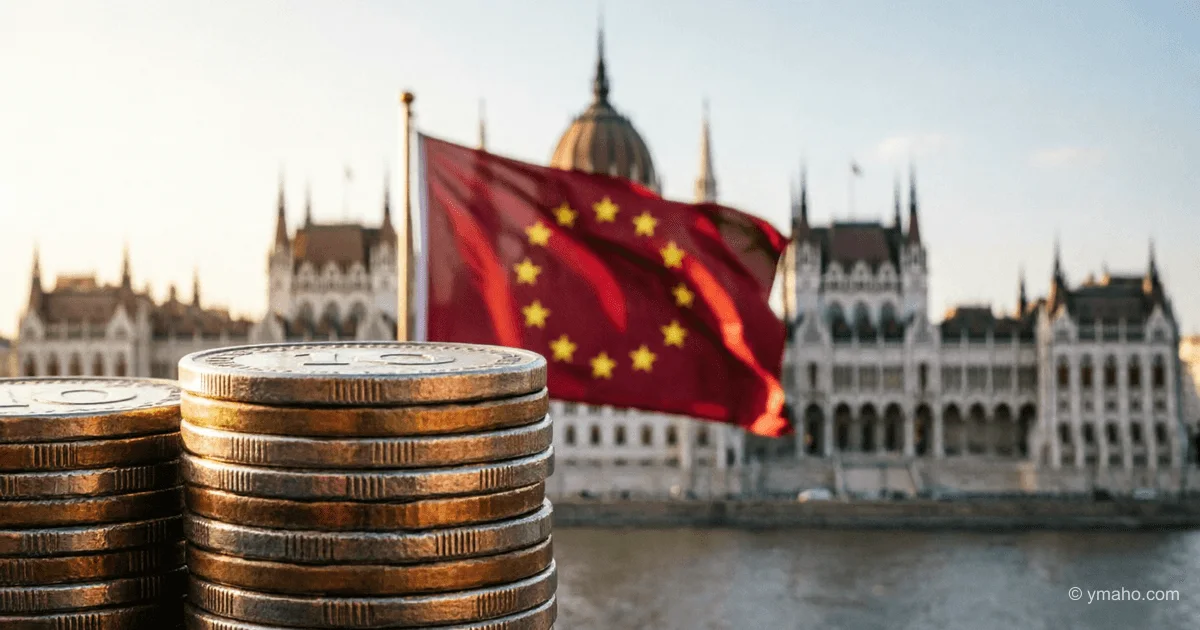
Forint Strengthens at Record Pace: Hungary's New Leadership Aims to Unlock EU Funds
The Hungarian forint rose 8% in two weeks after the opposition's victory in the parliamentary elections on April 12. Markets are pricing in the removal of the political risk premium and hope for normalized relations with Brussels.
Hungarian Forint and Change of Power: Why Markets Applaud the Opposition's Victory
Introduction
A rare case in currency markets: a political event triggered an almost immediate and powerful strengthening of the national currency. The Hungarian forint rose about 8% in two weeks after the parliamentary elections on April 12, 2026, in which the opposition party Tisza, led by Péter Magyar, scored a crushing victory over Viktor Orbán's ruling coalition. This is not a speculative spike or a short-term reaction to surprise—markets are systematically pricing out the "political risk premium" that had been embedded in Hungarian asset prices for years due to Budapest's conflict with Brussels. The forint has become perhaps the most striking example of how a shift in political direction translates directly into currency dynamics.
Event Details and Timeline
The parliamentary elections took place on April 12, 2026, with record turnout of about 77.8% of the roughly 8.1 million eligible voters. Based on 98.89% of votes counted, the Tisza party won 53.21% and secured 138 of 199 parliamentary seats, exceeding the two-thirds threshold for a constitutional majority. The ruling Fidesz-KDNP alliance under Orbán received only 38.26% and 55 seats.
Viktor Orbán himself, who had been in power for 16 consecutive years, conceded defeat on election night, calling the results "painful but clear." Tisza leader Péter Magyar proclaimed a "decisive victory" and promised to restore Hungary's position as a strong ally in the EU and NATO.
The currency market reaction was immediate. Commerzbank analysts revised their forint forecast upward on April 13, noting that the scale of Tisza's victory exceeded optimistic market expectations. The party secured a supermajority sufficient to enact constitutional changes and dismantle institutional structures built during Orbán's years in power.
Importantly, the forint's strengthening began before the elections—throughout 2025, it consistently outperformed regional peers due to growing market optimism about political change. According to Commerzbank analysts, the forint strengthened not only due to the euro's appreciation but also because of expectations of an end to Hungary's isolation within the EU and access to frozen EU funds.
On April 29, Péter Magyar met in Brussels with European Commission President Ursula von der Leyen. Following the meeting, von der Leyen stated that they discussed concrete steps needed to unlock frozen EU funds. Hungary's prime minister described the talks as "extremely constructive and successful" and said a political agreement on unlocking funds could be reached as early as the end of May.
Impact and Significance
The current forint dynamics reflect a fundamental reassessment of the Hungarian economy by international investors.
A key factor is the scale of frozen EU funds. This amounts to approximately €17 billion (about $18.5 billion at current exchange rates), representing nearly 10% of Hungary's annual GDP. This sum is divided into two main parts: about €10 billion from the post-pandemic Recovery Fund, whose deadline expires in August 2026, and roughly €7 billion from the Cohesion Fund for regional development.
The funds were frozen due to Brussels' concerns over two issues: corruption problems and violations of the rule of law. Under Orbán, access to this money was virtually blocked, creating chronic uncertainty for the country's public finances and investment climate.
The political shift changes the entire picture. The Tisza party secured a constitutional majority, allowing it to pass legislation without regard for the opposition. As Euractiv experts note, the new government faces no constitutional constraints like those encountered by reformist cabinets in other EU countries—for example, in Poland after Donald Tusk's victory in 2023. This means that meeting Brussels' conditions for unlocking funds becomes a matter of political will, not legal obstacles.
For the currency market, this means the removal of several layers of risk: the risk of further isolation of Hungary from European institutions, the risk of losing access to billions in EU transfers, and the risk of maintaining corrupt structures that deter foreign investors.
Reaction of Key Players
The European Commission has taken a cautiously constructive stance. Von der Leyen publicly outlined the conditions for unlocking funds, emphasizing that Brussels is ready to assist Hungary's new leadership in returning to "common European values." At the same time, European officials make it clear they are not writing a "blank check" for the new government.
Brussels' skepticism is well-founded. The legal mechanism for freezing funds is complex: the money is divided across different funds with varying procedures for lifting sanctions. According to Jacob Öberg, an EU law professor at the University of Southern Denmark, "there is no simple path for a member state to lift sanctions—it still must fulfill the imposed conditions."
The Polish precedent adds caution. When funds were unlocked after a pro-European government took power in 2023, some promised reforms were subsequently blocked domestically. This drew criticism of the European Commission for "political" unlocking of funds without sufficient guarantees.
Commerzbank, a leading analytical center for currency markets, formally revised its forint forecast upward. According to analysts, the forint receives dual support: from increased confidence in the institutional environment after the change of power and from the prospect of a massive inflow of EU funds that could stabilize public finances and stimulate economic growth.
The winning Tisza party signals readiness for swift action. According to Hungarian experts, 17 of the 27 conditions for access to the post-pandemic Recovery Fund had already been met under Orbán's government. The remaining ten—mainly concerning judicial independence and anti-corruption guarantees—can be addressed quickly given the constitutional majority.
Importantly, Magyar does not intend to blindly follow Brussels' line. He has already stated that "the EU does not set conditions contrary to Hungary's interests" and intends to continue dialogue with Russia, given the country's dependence on Russian energy resources.
Forecast and Conclusions
The forint's 8% strengthening in two weeks is only the first stage of a revaluation of Hungarian assets, and the potential for further gains remains. The key catalyst is an agreement to unlock EU funds, which could be signed as early as the end of May, when Magyar returns to Brussels as prime minister.
However, serious obstacles remain on the path to full normalization. The legal complexity of the sanctions mechanism means that even with full political will, unlocking funds will take months. The timeline for the Recovery Fund is particularly tight—the August 2026 deadline requires prompt fulfillment of the remaining conditions.
A second risk factor is that Orbán is not leaving the political scene. His Fidesz party remains the largest opposition force, with the ability to influence public sentiment. Analysts recall the Polish example: in 2023, the ruling right-wing party lost parliamentary elections, but by 2025 it had regained the presidency. Political volatility in the region remains high.
A third nuance is the degree of real change. Magyar, as a centrist, may face pressure from both sides: Brussels will demand painful reforms, while a significant portion of the electorate, especially outside Budapest, views excessive rapprochement with the EU with suspicion.
Nevertheless, the direction for the forint in the medium term looks unequivocally positive. Regaining access to EU financing of about €17 billion is equivalent to a massive fiscal stimulus program—roughly comparable in size to 10% of GDP. Combined with improved institutional environment and the removal of the political risk premium, this creates a strong foundation for further strengthening of the Hungarian currency. For investors able to accept residual political risks, Hungarian assets look like one of the most undervalued segments of European emerging markets.
— Editorial Team









