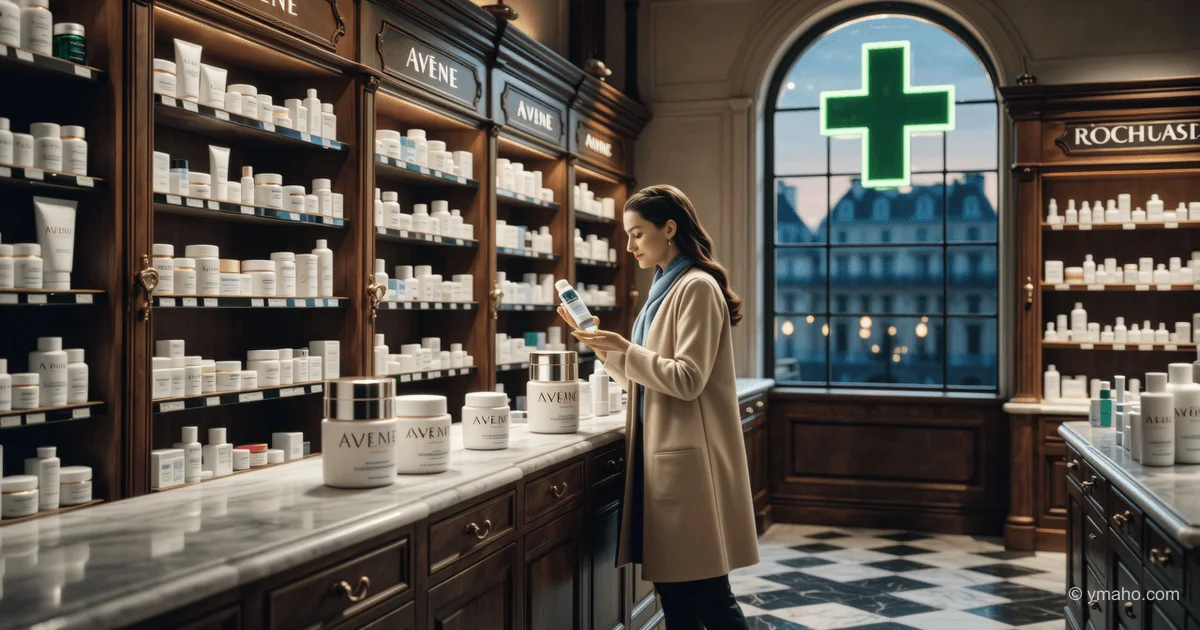
French Pharmacies and Boutiques: Collecting Skincare as the New Lifestyle
Wellness experts from Generation X turn buying skincare into a hobby: Melanie Grant admits she can spend an hour in a Parisian pharmacy and considers Le Bon Marché the best beauty space. French pharmacy brands and niche concept stores (like Violet Grey) are becoming pilgrimage sites in the search for "pharmacy luxury."
The Essence: Pilgrimage as Therapy, Pharmacy as Temple
Melanie Grant's confession that she can spend an hour in a Parisian pharmacy and considers Le Bon Marché the best beauty space is not a cute quirk of an expert. It is a symptom of a profound transformation in how Generation X consumes skincare. We are witnessing the birth of "pharmacy luxury" as a cultural phenomenon: the ritual visit to a pharmacy or concept store becomes a standalone wellness practice, comparable in psychological effect to a spa visit.
In reality, the market is shifting from product to discovery experience. The consumer no longer wants the Sephora algorithm to offer them a "suitable moisturizer" based on 14 filters. They want to find it themselves—in an atmosphere steeped in history, tactility, and the illusion of expert curation. Parisian pharmacy Citypharma on Rue du Four already receives up to 12,000 visitors per day during peak seasons. That's more than the Eiffel Tower in the low season. Le Bon Marché, with its La Grande Épicerie and beauty floor, generates $1.2 billion in annual revenue, of which beauty accounts for about 18%, or roughly $216 million.
This is not shopping. It is secular pilgrimage. And Generation X, with its nostalgia for a pre-algorithmic world and financial means, is the perfect devotee of this cult.
Timeline and Context: From Pharmacy to Concept Store
The phenomenon of the French pharmacy as a beauty destination did not start yesterday. As early as the 1970s, Parisian pharmacies became entry points for brands like Avène, La Roche-Posay, and Bioderma. But back then, it was a strictly dermatological ritual: you went to the pharmacy for treatment, not for pleasure.
The first tectonic shift occurred in the 1990s with the rise of "pharmaceutical cosmetics" as a separate category. The second came in the 2010s, when the French pharmacy became a global phenomenon thanks to bloggers: Embryolisse Lait-Crème Concentré ($26) and Bioderma Sensibio H2O ($15) became must-buy travel trophies.
But what we are seeing now, in 2026, is the third act. The pharmacy has ceased to be a utilitarian space and has become part of the cultural itinerary. Citypharma hires concierges who speak five languages. Some items—like Biafine emulsion or Homeoplasmine ointment—are sold with a limit of three per person due to resellers selling them on Amazon with a 200% markup.
Meanwhile, niche concept stores are developing. Violet Grey (Los Angeles), mentioned by Grant alongside Le Bon Marché, built its business model on curation: the Violet Code team tests thousands of products and only allows approved items on the shelves. The result is an average ticket of $340 and loyalty that department stores envy. Le Bon Marché, for its part, has turned its beauty floor into an immersive experience with art installations and pop-up spaces refreshed every six weeks.
Key insight: both formats—pharmacy and concept store—sell not a product but validation. In the pharmacy, you are validated by pharmaceutical authority. At Violet Grey, by the curation committee. At Le Bon Marché, by the very fact that you are in a historically significant space. The purchase becomes an act of self-legitimization.
Who Wins and Who Loses
Winners: French pharmacy brands that have not invested in marketing for decades. Avène, whose Thermal Water Spray ($14) sells every 7.2 seconds somewhere in the world, gets free advertising from crowds of tourists at Citypharma. La Roche-Posay, owned by L'Oréal, uses this traffic as a funnel to move consumers from Effaclar ($22) to premium lines like Hyalu B5 ($42). Pharmacy brand margins are 60-70% with virtually zero retail design costs: white tiles and a green cross work better than any architecture firm.
Winners: tour operators and concierge services. Specialized "beauty tours" of Paris have emerged, visiting Citypharma, Buly 1803, and Officine Universelle Buly. Prices start at EUR 400 for a half-day with an aesthetician guide. Bookings for 2026 are up 340% compared to 2024.
Losers: American pharmacy chains. CVS and Walgreens tried to copy the model by launching "premium beauty zones" in 2022-2023 with investments of $400 million. The project failed. The American consumer feels no cultural awe toward CVS. No one flies across the ocean to buy Cetaphil for $12 at a pharmacy on the corner of 42nd Street. The reason is not the assortment but the lack of narrative. CVS does not tell a story. Citypharma tells one without even opening its mouth.
Losers also: online giants. Amazon Beauty, with its 280,000 SKUs, cannot replicate the tactile experience and atmosphere of discovery. Sephora tries to compensate with the Sephora Experience format, but its attempt to recreate the "spirit of the Parisian pharmacy" in Times Square looks like a Louvre hall with Rare Beauty ads. Generation X consumers perceive this as fake.
What the Media Leaves Out
Non-obvious insight: French pharmacies, praised as pilgrimage centers, are in deep structural crisis. From 2015 to 2025, the number of independent pharmacies in France fell from 22,000 to 18,400. Margins dropped from 28% to 17% due to government price regulation on prescription drugs. The beauty segment (parapharmacy) is the only category where pharmacies can set free prices and keep customers for more than 90 seconds. Citypharma, generating an estimated EUR 80-100 million in annual revenue, is not a representative pharmacy but a unique phenomenon. 90% of French pharmacies are unprofitable without state subsidies. The pilgrimage to Citypharma is a celebration against the backdrop of a dying primary healthcare industry.
Second omission: Le Bon Marché as a model for beauty retail exists only thanks to LVMH's unique status. It is the only department store that can afford not to chase quarterly profits because its owner (Bernard Arnault) sees it as a brand asset. No one else can invest $12 million in an art installation for "atmosphere." When Sephora (also LVMH) tries to replicate this model across 2,700 stores, the result is a superficial imitation. Grant values authenticity—but authenticity available only in one building in the 7th arrondissement of Paris.
Forecast: Next 30 Days and 90 Days
In the next 30 days, we will see the 2026 tourist season break records at Parisian pharmacies. From May to August, Citypharma expects parapharmacy sales to grow 25-30% year-on-year. Brands like Biafine and Homeoplasmine will disappear from shelves due to resellers, and Instagram will see panicked stories: "I can't find my Biafine in Paris." This will create short-term hype and push Amazon prices to $45 per tube that costs EUR 7 in Paris.
Within 90 days, an institutional response will occur. French regulators (ANSM—Agence Nationale de Sécurité du Médicament) will consider imposing limits on parapharmacy sales per person to combat resellers. This will dampen tourist frenzy but return products to real patients.
Simultaneously, we will see a boom in "pharmacy boutiques"—a hybrid format that tries to merge pharmacy authority with Violet Grey aesthetics. Credo Beauty in the US and Aesop stores with their pharmacy aesthetic (lab furniture, ceramic sinks, white consultant coats) are precursors. The next step is direct collaborations: a pharmacy brand plus a concept store. Imagine a pop-up Avène inside Dover Street Market. It is inevitable, and the first such project will happen before the end of 2026.
Finally, Le Bon Marché as a cultural phenomenon will begin to be replicated through digital channels. Rumors are already circulating that LVMH is developing a virtual Le Bon Marché for the metaverse—not for sales, but for experience. Generation Z, unable to fly to Paris, will be able to "walk" the beauty floor in VR. The irony is that Generation X will despise this imitation, while Generation Z will consider it normal.
Final conclusion: the industry is moving from a "buy and leave" model to a "come, experience, buy, remember" model. It is more expensive, slower, and less accessible for mass retail. But that is precisely what makes the experience valuable. An hour in a Parisian pharmacy is not about a EUR 15 product. It is about the story you will tell while applying that cream for the next six months. And for that story, the consumer pays not with money. They pay with loyalty—the most scarce currency of 2026.
— Editorial Team









