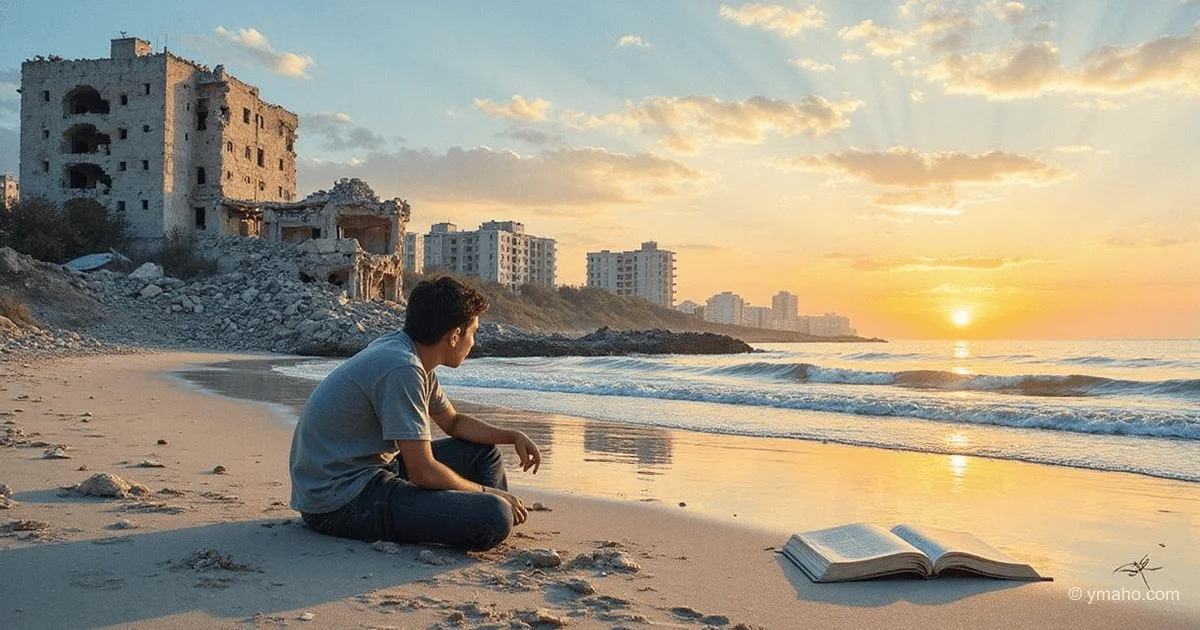
Gaza’s Lost Generation: Young Lives on Hold After Economic Collapse
In Gaza, tens of thousands of young people wake up each day with no school to attend, no job to go to, and no clear path forward. This isn’t just unemployment—it’s the near-total erasure of an economy that once supported dreams, businesses, and education for 2.3 million people. If you’ve ever worried about your future or your children’s chances in life, imagine having every door slammed shut—not by choice, but by war and blockade.
A Future Buried Under Rubble
Before the war, Mahmoud Shamiya was a university graduate training to become a teacher. Today, he spends his days walking to the sea, fetching water, and searching for firewood to cook with. His story isn’t unusual—it’s typical. About 70% of Gaza’s population is under 30, and most now live in tents amid ruins. The United Nations calls this the fastest economic collapse in modern history.
Think of it like this: if your town’s schools, stores, banks, and roads all vanished overnight—and you couldn’t leave—you’d be stuck too. That’s Gaza today. Israel’s military operations have destroyed most universities, schools, and businesses. With borders sealed, even students who earned spots abroad can’t travel.
Mona Al-Mashharawi had been accepted to a university in Algeria and was set to leave in November 2023. But when war broke out in October, Israel closed all crossings. Two years later, she’s still waiting—her education frozen, her potential untapped. “These years are automatically vanishing from our lives,” she says.
When Work Disappears Overnight
Gaza’s private sector used to employ more than half the workforce. Now, 90% of businesses and infrastructure are gone. Total economic losses top $70 billion—equivalent to wiping out over two decades of development in just two years.
Muhannad Qasem owned a gym in Gaza City that welcomed men, women, and people with disabilities. It was more than a business—it supported his whole family. When Israeli forces leveled his neighborhood, his building collapsed. He managed to dig out only 1% of his equipment. Unable to afford rent or import new gear, he sold the broken weights on the street just to buy food.
This isn’t just about lost income. It’s about identity, dignity, and purpose. When work vanishes, so does the sense that your effort matters.
Survival, Not Opportunity
Today, 80% of Gazans rely entirely on humanitarian aid to eat. But even that is unreliable. Aid convoys are limited to two border crossings, and deliveries fall far short of what’s needed. Fresh food, medicine, and fuel are scarce or banned outright.
Without raw materials or electricity, local production has ground to a halt. Farmers can’t plant crops. Factories can’t reopen. Students can’t study online because there’s no power or internet. It’s a cycle where survival blocks recovery, and recovery seems impossible without peace.
Key facts show the scale:
- Unemployment has hit 80%
- GDP has plunged 87% since 2024
- GDP per person is now just $161 a year
- Over 72,000 Palestinians have been killed
- All major universities in Gaza are destroyed or damaged
What Does This Mean for Regular People?
Even if you live far from Gaza, this crisis affects global stability, humanitarian systems, and moral choices we all share. When an entire generation loses access to education and work, it creates long-term instability that can ripple across borders. Moreover, the cost of rebuilding will fall on international donors—including taxpayers in many countries—for decades. Most importantly, it reminds us how fragile opportunity really is when basic safety and freedom of movement disappear.
Key takeaways:
- Gaza’s economy has collapsed faster and deeper than any recorded in modern history.
- Young people—most of the population—are cut off from education, jobs, and travel.
- The destruction of schools, businesses, and infrastructure has erased 22 years of development.
- Humanitarian aid is insufficient due to strict Israeli controls on border crossings.
- Without a functioning economy or open borders, recovery remains out of reach.
— Editorial Team









