Gold Prices Retreat from Highs Amid Hopes for Peace Talks
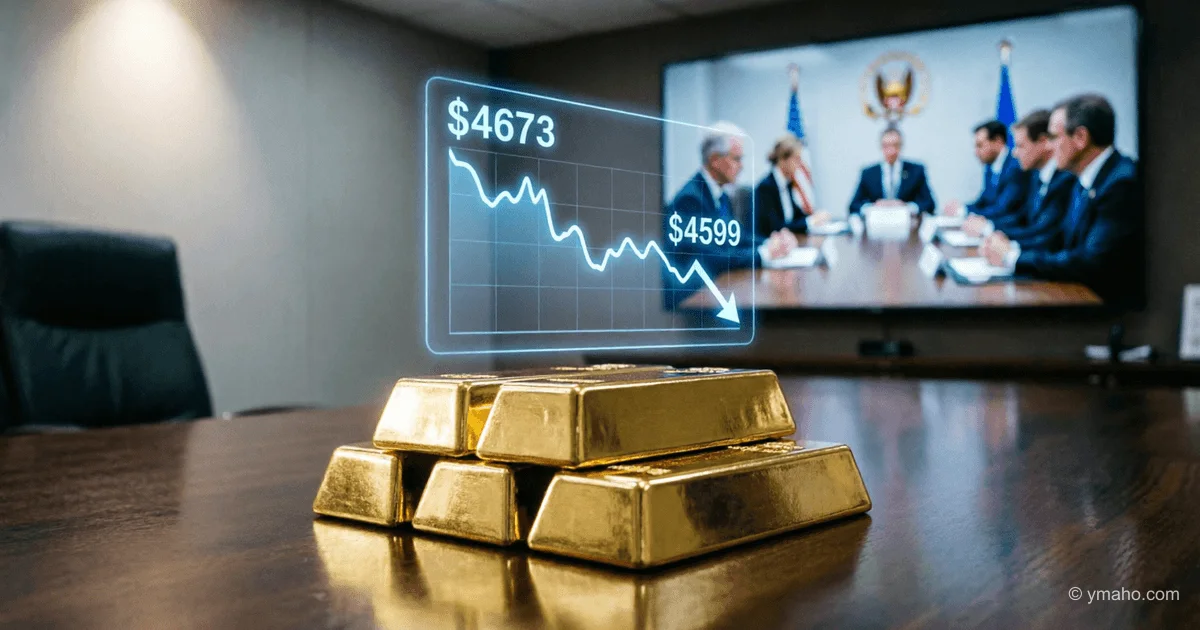
Gold edged lower in early trading on May 4 to around $4,599 per ounce as investors cautiously assess the prospects of US-Iran peace talks and the inflation situation following the Fed's decision. Earlier, COMEX quotes bounced from $4,570 to $4,673 per ounce amid short-term optimism from new diplomatic signals.
Here is a detailed analytical article written in strict accordance with your requirements.
Gold at a Crossroads: Why the Pullback to $4,599 per Ounce Does Not Mean the End of the Bull Market
Introduction
At the start of trading on May 4, 2026, the gold market showed a symptomatic move: quotes edged lower to around $4,599 per troy ounce. This occurred amid cautious optimism among investors regarding the prospects of US-Iran peace talks and an assessment of the inflation situation following the historic Federal Reserve meeting. The day before, COMEX futures exhibited nervous fluctuations in the range of $4,570 to $4,673 per ounce, reflecting the market's swings between hope for a diplomatic resolution of the crisis and fear of further escalation. This price pattern at first glance suggests weakening demand for safe-haven assets, but a deeper analysis shows that gold is not so much losing its appeal as taking a pause before the next potential surge.
Event Details and Timeline
The price dynamics of gold in the last days of April and early May 2026 represent a classic example of market reaction to conflicting signals. On one hand, the macroeconomic backdrop remained exceptionally favorable for the precious metal. US inflation reached 3.3% year-over-year, the core PCE index stood at 3.2%, and the yield on ten-year Treasury notes rose to 4.39%. The consumer price index jumped largely due to a 21.2% surge in gasoline prices, triggered by the collapse of shipping in the Persian Gulf. Additional logistics costs of $4,500–$5,500 per container on alternative routes promise further acceleration of inflation in the coming months. Under normal conditions, such a data set would have sent gold to new all-time highs.
However, a countervailing factor emerged simultaneously. On the diplomatic front, signs of possible easing of tensions appeared. The logic of events itself pushed parties toward negotiations: Operation "Project Freedom," announced by President Trump, faced an Iranian ultimatum requiring coordination of ship movements with the IRGC, and the decision by shipping giant MSC to launch a land route through Saudi Arabia bypassing the Strait of Hormuz demonstrated that the economic costs of the conflict were becoming prohibitive for all participants. It was hints of possible peace consultations between Washington and Tehran that triggered a short-term burst of optimism, pushing COMEX quotes from a local peak of $4,673 to a low of $4,570 per ounce before stabilizing around $4,599.
This dynamic is symptomatic: the gold market did not collapse but only slightly corrected. The decline from highs is characteristic of profit-taking by speculative players, not a fundamental trend reversal. Gold remains near its historical peaks, indicating sustained deep demand for safe-haven assets from central banks, institutional investors, and individuals concerned about the prospect of prolonged stagflation.
Impact and Significance
The behavior of gold at current levels has implications far beyond the precious metals market. The price of gold is a barometer of confidence in the ability of state institutions—primarily central banks—to control the situation. The fact that after a record split in the FOMC, where four members voted against keeping the rate at 3.50-3.75%, gold did not crash but only slightly retreated, points to deep market skepticism about the effectiveness of monetary policy in combating cost-push inflation.
For the global financial system, gold stabilizing above $4,500 per ounce creates a new reality. Central banks of developing countries, which accumulated significant gold reserves in previous years, see their value in USD terms rise, strengthening their balance sheets and providing additional room for maneuver. For private investors, gold is becoming less of a speculative instrument and more a form of long-term preservation of purchasing power in a world where official US inflation is 3.3%, but real inflation felt by consumers is significantly higher due to rising fuel and essential goods prices.
The decline in gold volatility while maintaining high absolute price levels is characteristic of a mature phase of a bull market, where initial panic gives way to recognition of the irreversibility of inflationary processes. Investors no longer expect a quick return to low prices, but they also do not expect an immediate hyper-jump. They are methodically building positions in gold as insurance against long-term depreciation of fiat currencies.
Reaction of Key Players
The Federal Reserve finds itself in a difficult position regarding the gold market. On one hand, the rise in its price signals distrust in the central bank's ability to control inflation, undermining the Fed's credibility. On the other hand, Chairman Powell did not directly comment on the gold market at his last press conference, limiting himself to general remarks about high uncertainty due to events in the Middle East. The new Chairman, Kevin Warsh, who takes office on May 15, will have to develop a communication strategy regarding the precious metal, whose price is a silent reproach to monetary authorities.
Major investment banks are revising their gold forecasts. Most analysts agree that the growth potential is far from exhausted. If the current level of geopolitical tension persists and there is no progress in US-Iran talks, a price of $5,000 per ounce ceases to be a fantasy scenario and becomes a matter of time. Additional logistics costs of $4,500–$5,500 per container, inevitably translating into consumer prices, create a pro-inflationary backdrop that will support gold demand throughout 2026.
Central banks of other countries are also significant players in the gold market. The European Central Bank, facing inflation of 3.0% in the eurozone and preparing for a rate hike in June, remains silent about its gold reserves. However, historically, in periods of uncertainty, central banks tend not to sell but to accumulate the precious metal, creating additional demand that supports prices.
Retail investors, frightened by the 21.2% jump in gasoline prices and the overall rise in the cost of living, are also turning to gold. Sales of gold coins and bars remain high, though somewhat below the record levels seen at moments of peak panic.
Forecast and Conclusions
The dynamics of gold in the coming weeks will be determined by the interaction of two fundamental factors: the development of the US-Iran diplomatic dialogue and macroeconomic data from the US. If peace talks actually take place and lead to tangible de-escalation, gold could correct into the $4,300–$4,500 per ounce range, as the geopolitical risk premium declines. However, even in this optimistic scenario, a return to levels below $4,000 seems unlikely due to persistent inflationary pressure.
A more realistic scenario is protracted and inconclusive talks, where tensions in the Strait of Hormuz persist, and land routes like the Saudi MSC transit become a permanent but expensive alternative. In this case, inflation will continue to accelerate, confidence in the Fed will decline, and gold could test the $5,000 per ounce level as early as the third quarter of 2026.
The most alarming scenario is a breakdown of talks and a new wave of escalation with direct military clashes in the Gulf. In this case, gold could make a sharp jump, potentially reaching levels that currently seem unthinkable. With trade flows of over 150,000 containers per week and the global economy's dependence on Middle Eastern oil, any military incident in the Strait of Hormuz would become a catalyst for panic demand for safe-haven assets.
The main conclusion is that the current pullback in gold prices to $4,599 per ounce is not a trend reversal but a tactical pause. The bull market in the precious metal rests on structural factors: accelerating inflation, paralysis of traditional monetary tools, geopolitical fragmentation, and disruption of global supply chains. None of these factors have been eliminated, and fragile hopes for peace talks could dissipate as quickly as they arose. Gold remains the main beneficiary of an era of uncertainty, and its current price of $4,599 per ounce will likely be remembered as a relatively low point before the next phase of growth. Investors who view the pullback as a signal to sell risk repeating the mistake of those who exited gold at $2,000, considering it an all-time high.
— Editorial Team









