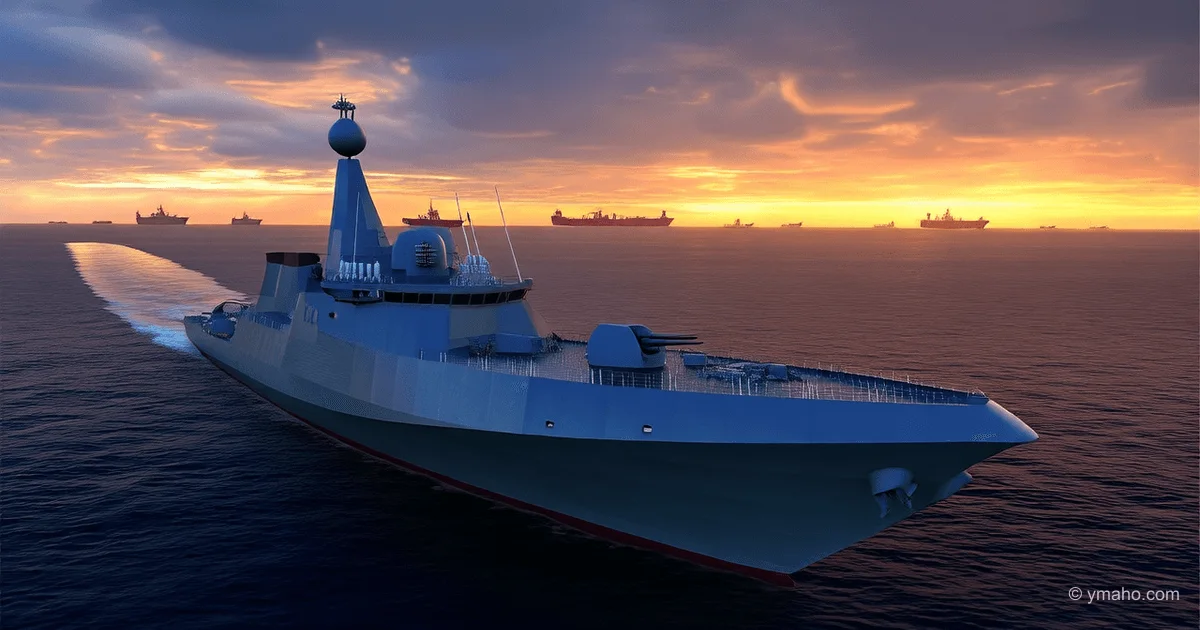
UK Deploys Destroyer HMS Dragon to Persian Gulf Amid Escalation
The UK Ministry of Defence has announced the deployment of the Type 45 destroyer HMS Dragon to the Middle East as part of preparations for a potential multinational mission to protect commercial shipping in the Strait of Hormuz.
The dispatch of HMS Dragon to the Persian Gulf is an operation where military necessity, the technical state of the fleet, and high politics are tightly intertwined. At first glance, London is demonstrating resolve to protect freedom of navigation. However, digging deeper reveals not so much a show of force as an attempt by the UK to maintain its position in the region, balancing on the edge of technical capabilities and political ambitions.
The Core: What Is Really Happening
The real mission of HMS Dragon is not the immediate protection of tankers. It is "pre-positioning." The Strait of Hormuz is de facto blocked not so much by Iranian speedboats as by the decision of insurance companies. Without the resumption of insurance coverage, commercial shipping will not resume, even if the entire combined NATO fleet gathers there.
Thus, the destroyer's deployment to the Gulf is primarily a political signal. Keir Starmer and Emmanuel Macron, who have become co-chairs of this "multinational initiative," are trying to create an appearance of control and guarantee that "Western umbrella" without which private capital will not return to the region.
Timeline and Context
The chain of events reads like a chronicle of forced improvisation rather than planned deployment.
- March 2: An Iranian drone strikes the RAF Akrotiri base in Cyprus, where British forces are stationed. It turns out there is nothing to defend the base.
- March 3-9: London hastily orders HMS Dragon. The ship, which was scheduled to dock only in April, is "squeezed" out to sea in six days.
- Mid-March: The transit turns into a series of breakdowns. First, the power plant fails in a storm, then the water supply system breaks down. Repairs are carried out on the fly.
- April 25: The ship undergoes a series of missile defense drills.
A Defense Express source in April ironically summed up the state of the entire project: it is a "cascade of problems." It is not just about haste, but about the original design: of the six Type 45 destroyers that form the backbone of the fleet's air defense, only two (including HMS Dragon) have undergone power plant upgrades and are actually capable of putting to sea without the risk of a complete blackout.
Who Wins and Who Loses
Winners:
- UAE and Saudi Arabia. The presence of a serious air defense ship with the Sea Viper system enhances the security of their port infrastructure, which could stabilize regional energy markets. This strengthens their position in negotiations with insurers.
- France. By shifting some operational risks to London, Paris reinforces the status of the Charles de Gaulle carrier group as the dominant European force in the region, while sharing responsibility with an ally.
Losers:
- British taxpayers. The cost of the unplanned mission will fall on an already strained budget. The head of the Office for Budget Responsibility has already stated that increased defense spending is inevitable, and each day of deploying such a ship costs the treasury between $150,000 and $250,000.
- The crew of HMS Dragon. 285 sailors are forced to operate far from their home base on a ship that was undergoing a modernization program, not combat drills. Their psychological and technical burden will be extreme.
What the Media Isn't Saying
The key insight concerns the global reshuffling of the marine insurance market.
The press focuses on guns and missiles, but the main battle has already been lost—in the City of London. As soon as hostilities began, private underwriters from Lloyd's of London and clubs like NorthStandard simply withdrew war risks from the Gulf. This ended London's 300-year hegemony as the guarantor of global maritime trade.
The baton was picked up by Washington. The Donald Trump administration, through the International Development Finance Corporation (DFC), announced in March the provision of government guarantees and the creation of a $20 billion reinsurance fund. American insurance giant Chubb became the lead underwriter.
Thus, HMS Dragon is heading to the Gulf not as a master, but as a "gatekeeper" within the American financial scheme. The mission aims to at least partially restore London's reputation as a military power, since the insurance crown has fallen. But the irony is that until the US gives the go-ahead and covers the risks, the British destroyer will be guarding an empty strait.
Forecast: Next 30 Days and 90 Days
Next 30 days (until mid-June 2026):
HMS Dragon will enter the Persian Gulf and join the French group, but will not open the strait. The parties will simulate intense activity. However, due to constant stress and heat, technical failures are likely to reappear on board the destroyer. We will see a short-term 1-2% drop in Brent crude oil prices on news of the ship's arrival, followed by a correction back to $105 per barrel when the market realizes that tankers are not physically moving.
Next 90 days (by mid-August 2026):
The multinational mission will either transform into a permanent patrol under the de facto command of the US Fifth Fleet, or begin trial convoy escorts. The key driver will not be the Pentagon, but Chubb and DFC. If the American insurance program proves effective, the role of the British fleet will be reduced to that of a "junior partner" in the US financial-military scheme. London will maintain a military presence but will finally lose its status as the main beneficiary of global maritime trade, turning into one of many security contractors for the American insurance pool.
— Editorial Team









