Crypto Security 101: How to Buy & Store Safely
The digital asset landscape offers significant opportunity, but it is also a domain where the responsibility for security rests squarely on the individual user. Unlike traditional banking, there is no central authority to reverse a fraudulent transaction or recover lost funds, making the question of how to buy and store cryptocurrency safely the single most critical skill for any participant. This guide synthesizes best practices from cybersecurity frameworks and financial risk management to provide a clear, actionable roadmap for protecting your digital wealth.
What You'll Learn
Safely acquiring and storing cryptocurrency requires a two-pronged approach: using reputable, regulated exchanges for purchase and immediately moving your assets to a private, non-custodial wallet. The most critical security decision is choosing between a "hot" wallet (convenient but vulnerable) and a "cold" hardware wallet (highly secure but less convenient), with the latter being strongly recommended for any significant holdings.
Understanding the Threat Landscape
Before diving into the mechanics of a transaction, it is crucial to understand the risks. The cryptocurrency ecosystem is a prime target for malicious actors due to the pseudonymous and irreversible nature of blockchain transactions. According to the Federal Trade Commission (FTC), over 46,000 people reported losing more than $1 billion in crypto to scams between January 2021 and March 2022, a figure that has likely grown substantially. These threats are not merely technical; they encompass a wide spectrum of tactics.
- Exchange Hacks and Insolvency: Centralized exchanges are lucrative honeypots. The collapse of FTX in 2022, which resulted in an estimated $8 billion in customer funds being frozen or lost, serves as a stark reminder that counterparty risk is a primary concern. NIST (National Institute of Standards and Technology) cybersecurity frameworks emphasize that third-party risk must be continuously assessed, a principle directly applicable to crypto exchanges.
- Phishing and Social Engineering: These are the most common vectors of attack. Malicious actors create fake websites, impersonate exchange support teams, or send deceptive emails to trick users into revealing their private keys or login credentials. A study by Chainalysis found that a significant portion of stolen funds are a result of these human-centric vulnerabilities.
- Malware and Keyloggers: Malicious software installed on a user's device can capture keystrokes or clipboard data, allowing attackers to intercept wallet addresses or passwords.
- Private Key Compromise: This is the ultimate failure. Your private key is your digital signature. If someone else obtains it, they have full, irreversible control over your assets.
Based on these data points, a reasonable conclusion is that the human element remains the weakest link in the security chain. Therefore, a comprehensive strategy for how to buy and store cryptocurrency safely must focus on both technical controls and disciplined personal habits.
Step 1: Choosing a Secure Platform for Purchase
Your journey begins with selecting a platform to convert fiat currency (like USD or EUR) into cryptocurrency. This decision is foundational to your security.
Centralized vs. Decentralized Exchanges
The vast majority of newcomers will use a Centralized Exchange (CEX). They offer user-friendly interfaces and high liquidity. However, they require you to trust the exchange with your funds. Decentralized Exchanges (DEXs), on the other hand, allow peer-to-peer trading without an intermediary, but they are more complex and typically used for trading crypto-to-crypto, not for initial fiat on-ramps.
Criteria for a Secure CEX
When selecting a CEX, prioritize security and regulatory compliance over low fees or a flashy interface.
| Criteria | Why It Matters |
|---|---|
| Regulatory Compliance | Exchanges licensed in major jurisdictions (e.g., US, UK, EU) are subject to anti-money laundering (AML) and know-your-customer (KYC) laws, providing a baseline of operational integrity. |
| Transparent Reserves | A public "Proof of Reserves" audit, especially from a reputable firm, demonstrates that the exchange has sufficient assets to cover customer deposits. |
| Cold Storage Policy | The exchange should store the vast majority of its assets in offline, cold storage. Look for a policy stating that 95-99% of funds are held offline. |
| Strong Two-Factor Authentication (2FA) | The platform must support industry-standard 2FA, such as authenticator apps (Google Authenticator, Authy) or hardware security keys (YubiKey), and ideally, require it for withdrawals. Avoid SMS-based 2FA, which is vulnerable to SIM-swapping attacks. |
⚠️ Critical Warning: Never leave large amounts of cryptocurrency on an exchange. This is a violation of the "not your keys, not your crypto" principle. An exchange is a bank, not a wallet. Use it only for executing trades and as a temporary conduit for your funds.
Step 2: The Purchase Process
Once you have selected a secure exchange, follow these steps with caution.
- Account Creation: Use a unique, complex password that you do not use for any other service. Leverage a password manager (like 1Password or Bitwarden) to generate and store it.
- Enable Security Features: Immediately after account creation, enable 2FA using an authenticator app. This is your first and most important line of defense. As recommended by the UK's National Cyber Security Centre (NCSC), this creates a robust multi-factor authentication barrier.
- Verify Your Identity (KYC): This step is unavoidable for most regulated exchanges. You will need to provide identification documents to comply with anti-money laundering regulations. Ensure you are on the correct, legitimate website before uploading sensitive documents.
- Initiate Your Purchase: Link your bank account or debit card and execute your trade. Be mindful of the fees involved (trading fees, deposit fees) as they can vary significantly.
- Immediate Transfer: Once the purchase is complete, the crypto will appear in your exchange "hot wallet." Your next action must be to withdraw it to a wallet that you control.
Step 3: The Core Decision — Hot vs. Cold Storage
This is where you define your security posture. The decision on how to buy and store cryptocurrency safely culminates in the choice of your wallet. The two primary categories are hot wallets and cold wallets.
Hot Wallets (Software Wallets)
These are applications connected to the internet, available as desktop software, mobile apps, or browser extensions.
- Pros: Highly convenient for frequent trading and transactions. They offer fast access to your funds. Many have user-friendly interfaces and are excellent for managing small amounts or interacting with DeFi (Decentralized Finance) protocols.
- Cons: They are vulnerable to malware, phishing, and hacking. Your private key is stored on a device that is connected to the internet, creating a persistent attack surface. A security analysis from a peer-reviewed computer science paper on "Cryptocurrency Wallet Security" consistently identifies internet-connected private keys as the highest vulnerability vector.
Use Case: Hot wallets are ideal for "spending money" — the equivalent of a physical wallet you carry in your pocket. You should only store amounts you are comfortable losing or need for active use.
Cold Wallets (Hardware Wallets)
These are physical devices that store your private keys entirely offline. They sign transactions without exposing the private key to the internet.
- Pros: The highest level of security. They are immune to online hacking attempts, malware, and keyloggers. Even if you connect them to a compromised computer, the private key never leaves the device.
- Cons: They involve a purchase cost ($50-$200). They are less convenient for quick trades as you must physically connect the device to a computer or smartphone to sign a transaction. You must physically secure the device itself.
| Feature | Hot Wallet | Cold Wallet (Hardware) |
|---|---|---|
| Private Key Storage | Online (device/cloud) | Offline (physical device) |
| Security Level | Moderate | High |
| Convenience | High | Low |
| Vulnerability | Phishing, Malware | Physical theft, User error |
| Primary Use Case | Active trading, small amounts | Long-term storage, large amounts |
Recommendation: For any significant, long-term holdings, a hardware wallet is the standard best practice. This is the consensus view among security experts and independent voices in the crypto space. Treat your hardware wallet like a secure safe or a physical vault, and its recovery phrase (seed phrase) like the one key that opens everything.
Step 4: The Golden Rule — Securing Your Seed Phrase
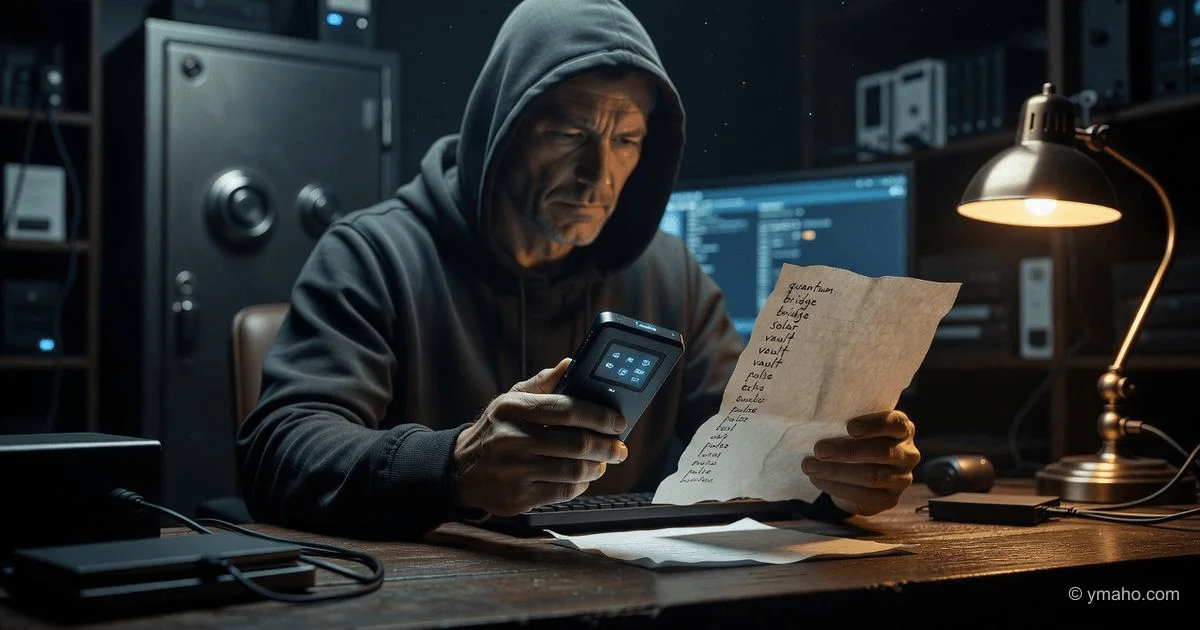
When you set up a non-custodial wallet (both hot and cold), you will be given a seed phrase—typically 12 or 24 random words. This is the master key to your wallet. Write it down on paper or stamp it onto a metal plate. Do not store it digitally (no screenshots, no photos, no cloud storage).
- Never share it: No legitimate employee from any exchange or wallet provider will ever ask for your seed phrase.
- Store it securely: Keep it in a safe location, separate from your hardware wallet if you have one. Consider splitting it into multiple parts and storing them in different secure locations to mitigate the risk of a single point of failure (e.g., fire or flood).
- Use a passphrase (25th word): For advanced security, most hardware wallets allow you to set an additional, user-defined passphrase. This creates a hidden wallet. Even if your seed phrase is compromised, the thief would need your passphrase to access this hidden wallet. This is a powerful security mechanism, as recommended by the hardware wallet's official documentation.
Step 5: Maintaining Your Security Posture
Security is not a one-time setup but an ongoing process.
- Update Software: Keep your wallet software, device firmware, and operating system up to date. These updates often contain critical security patches.
- Verify URLs and Transactions: Before entering any credentials or sending a transaction, double-check the URL of the exchange. It is a best practice to test with a small transaction before sending a large amount. As the World Bank notes in its financial security guidelines, "verification of counterparty details is a non-negotiable step in any financial transfer."
- Stay Informed: The threat landscape evolves. Subscribe to security feeds of your exchange and wallet provider. Be skeptical of unsolicited messages.
- Consider a "Dummy" Device: For significant operations, some practitioners recommend using a dedicated computer or phone that is used exclusively for crypto transactions, minimizing exposure to other web browsing risks.
Frequently Asked Questions
1. Is it safe to store my crypto on an exchange like Coinbase or Binance?
It is safer for short-term convenience and trading, but it is not safe for long-term storage. Exchanges are a prime target for hackers and are also subject to operational risks, such as freezing funds or insolvency, as seen with FTX. The golden rule of crypto is "not your keys, not your crypto." You are trusting a third party with your assets, which violates a core security principle of self-custody.
2. What is the difference between a private key and a seed phrase?
Your seed phrase is the master key that generates all the private keys for your wallet. Think of your private key as a specific key to a single lock (or a single address), while your seed phrase is the master key ring that can generate all of those keys and open every lock associated with your wallet. If you lose your seed phrase, you lose all of your cryptocurrency.
3. Can I use the same wallet for all my different cryptocurrencies?
It depends on the wallet. Most modern software and hardware wallets support multiple blockchains (e.g., Bitcoin, Ethereum, Solana). However, they may not support every single token. Always check your wallet's compatibility for the specific assets you hold before sending any funds. Sending a token to an incompatible address will result in a permanent loss of funds.
4. How do I back up my hardware wallet?
Your hardware wallet is a device that can be broken or lost. The backup is not the device itself, but your seed phrase. As long as you have your seed phrase, you can recover your entire wallet on any new compatible device. The security of your backup is paramount; store it in a secure, fireproof, and water-resistant location.
5. Is it safe to buy cryptocurrency with a credit card?
Buying crypto with a credit card is generally fast and convenient, but it comes with high fees (often 3-5% or more) and additional risks. Most credit card companies treat crypto purchases as a cash advance, which incurs high interest rates immediately and has no grace period. Furthermore, many banks flag crypto purchases as high-risk. For large purchases, a bank transfer (ACH or wire) is usually more cost-effective and, from a security perspective, involves less sensitive financial information being transmitted over the internet.
— Editorial Team