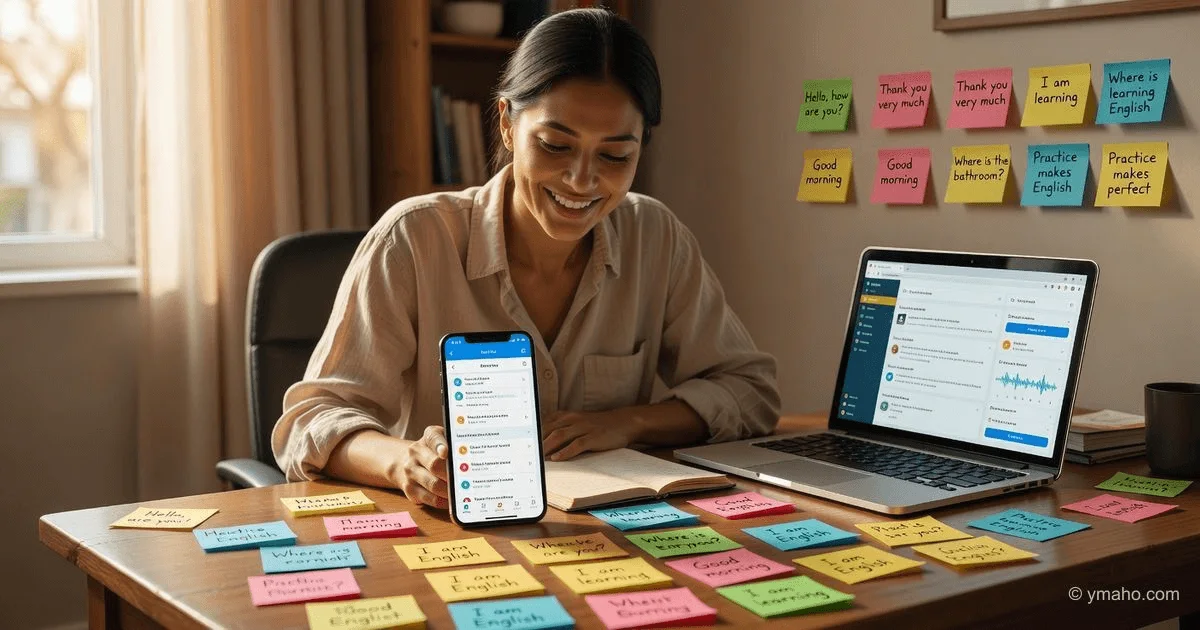
How to Learn English from Scratch Quickly
Niche: Education & Self-Development Content Type: Step-by-Step Guide Why It Matters: A huge audience of beginners is looking for a clear roadmap; here you can provide a realistic plan while debunking the myth of "quick fixes."
How to Learn English from Scratch Quickly: A Step-by-Step Guide That Works in 2026
The Gist: What You Need to Know First
Let's be honest: if school methods worked, you'd be reading this article in the original. The reality is that most adults cycle through "grammar — vocabulary — attempt to speak — failure" for years.
In 2026, the "learn everything" approach is hopelessly outdated. Language is not a dusty stack of textbooks but a utilitarian tool. Like Excel or a driver's license. To master it, you need to shift focus from passive knowledge accumulation to training your speech muscles.
And the main thing you must grasp right now: there are no miracles. If someone promises "fluent English in 2 weeks" — that's marketing, not pedagogy. According to Cambridge University research, going from zero to B1 (Intermediate — the level where you can work and travel) requires 350–400 hours of directed study.
At 2 sessions per week, that's 2 years. At daily one-hour sessions, about a year. With intensive immersion, 3–4 months. You can't cheat this math, but you can optimize it.
Step-by-Step Solution: A Plan for the First 90 Days
Step 1. Diagnosis and Goal Setting (1–2 Days)
Don't start by buying textbooks. Start by answering: why do you need English?
Use the SMART method — an abstract dream of "learning the language" is daunting in its vastness. A concrete goal mobilizes you:
- S (Specific): Pass an interview at an IT company / Watch series without subtitles / Travel without a translator
- M (Measurable): Learn 500 words / Understand 70% of dialogue in "Friends"
- A (Achievable): 30–40 minutes a day is realistic even with a full schedule
- R (Relevant): Needed for work, relocation, or a hobby
- T (Time-bound): Deadline in 3, 6, or 12 months
Take a test right away — for example, the free EF SET — to find out your actual level (A1–C2). You'll be surprised, but many "starting from scratch" already know something from school.
Step 2. First Week: Creating Environment and Habit (Day 1–7)
Your goal in 7 days is not to learn 500 words, but to integrate English into daily life. Without this, you'll quit in a month.
What to do right now:
- Switch your phone and computer interface to English. Words like Settings, Cancel, Apply, Notifications will be learned effortlessly in a day. It's a small but constant workout.
- Find an "anchor" for studying. Tie English to your daily routine: 10 minutes with a word app over morning coffee. 20 minutes of a podcast on the way to work. 5 minutes of a voice diary before bed ("How was your day" in 3–4 sentences).
- Choose 2–3 apps to start, no more. Here are the best for 2026:
| App | Cost | Best For |
|---|---|---|
| Anki | Free (Android, web), $25 one-time (iOS) | Memorizing words with scientific spaced repetition algorithm |
| Busuu | Free, Premium $10/month | Structured course with grammar and native speaker checks |
| Duolingo | Free, Super $13/month | Daily "warm-up" and habit building (but not as a primary tool) |
| TalkPal | Free (limited), Premium $10/month | Speaking practice with AI without fear of mistakes |
Rule: one app for words (Anki/VibeLing), one for grammar (Busuu), one source of living language (podcast or YouTube).
Step 3. Second Week: Basic Vocabulary and Sounds
Now, to the language. Don't learn words from lists. The brain works like this: without proper repetition, we forget 50% of new information on the first day and up to 90% within a week. This is called the Ebbinghaus forgetting curve.
The solution is spaced repetition (Spaced Repetition System). Apps (Anki, VibeLing) show a word exactly when you're about to forget it. The fastest way to load vocabulary into long-term memory.
Which 300 words to learn first:
- Greetings and farewells: Hello, Hi, Good morning, Goodbye, See you
- Politeness: Please, Thank you, Excuse me, Sorry
- Basic verbs: go, come, eat, drink, like, want, have, be, do
- Pronouns and questions: I, you, he, she, it, we, they / what, where, when, why, how
- Numbers and days of the week
Learn words not in isolation, but in phrases. Not "apple," but "I eat an apple." Not "go," but "I go to work."
Separately — pronunciation. Russian speakers are betrayed by three sounds:
| Sound | Typical Mistake | How to Fix |
|---|---|---|
| th (θ, ð) | "s" or "z" (think → "sink") | Tongue tip between teeth, gently blow air |
| v vs w | Confuse "v" and "w" | V — teeth touch lower lip. W — lips rounded |
| r vs l | Unclear distinction | Practice pairs: right / light, read / lead |
Step 4. Third–Fourth Weeks: Activating Methods That Work
Now move from preparation to active training.
Method #1: Shadowing
Play a video with a native speaker (start with YouTube channels for learners). Listen to a phrase. Repeat aloud immediately after the speaker, copying intonation, pauses, and emotions. This is a physical workout for your speech apparatus. You don't think — you do.
Start with clips 30–60 seconds long. Practice one phrase 5–10 times.
Method #2: Immersion Through Content
Forget "I'll start watching series when I learn 5000 words." Start now, but smartly:
- Level A0–A1: cartoons like Peppa Pig, adapted podcasts (BBC Learning English, EnglishClass101)
- Level A2: series you know by heart ("Friends," "The Office") — with English subtitles
- Technique: first 1 minute without subtitles (grasp meaning), then with subtitles (note 3–5 unfamiliar words), then again without subtitles
Method #3: Speaking Without a Partner
Remember: 88% of speaking problems are caused by psychological barriers, not lack of words. The only cure is to speak, even if it's scary.
Your tools until you find a partner:
- Talk to your cat or smart speaker ("Alexa, what's the weather like today?")
- Record voice messages in Telegram's "Saved Messages" — listen back in a week
- Use ChatGPT in voice mode (available in the paid version for $20/month). Ask: "Talk to me like a waiter in a cafe" or "Conduct a job interview in English"
Practical Tips and Important Nuances
How to Fit English into Your Day Without Heroics
You don't need a separate hour and special motivation. Here's what actually works:
| Time | Action | Duration |
|---|---|---|
| Morning coffee | 10 words in Anki + 1 minute shadowing | 10–12 min |
| Commute | Podcast for beginners | 15–20 min |
| Lunch | 1 short YouTube video (with subtitles) | 5–7 min |
| Evening | Voice diary (3 sentences about the day) | 5 min |
| Total per day | 35–45 minutes |
That's enough. Consistency beats intensity.
Resources That Will Actually Help
Free and inexpensive:
- Anki — spaced repetition flashcards (free, except iOS)
- BBC Learning English — podcasts and videos with transcripts
- YouTube channels: English Addict with Steve, Easy British English, English with Lucy
- Tandem / HelloTalk — language exchange with native speakers (free, paid options available)
If you have a budget ($50–100 per month):
- iTalki — tutors from $5 per trial lesson, professionals from $15
- Busuu Premium — $10/month, structured course with checks
- Lingopie — $12/month, learn from Netflix series with interactive subtitles
Is It Realistic to Go from Zero to Conversational in 3 Months?
Yes, if you're ready to invest 3–4 hours a day. That's an "immersion" schedule:
- 1 hour with a tutor ($20 per lesson)
- 1 hour of self-study (Anki, textbook)
- 1 hour of content (series, podcasts, YouTube)
- 30 minutes of speaking practice (tandem, AI, self-talk)
At this pace, 350 hours are accumulated in 3–4 months. But be honest with yourself: most people don't have that much time. And that's okay. It's better to go for a year at 40 minutes a day than to quit after a month from overload.
Typical Mistakes and How to Avoid Them
Mistake #1. Trying to Learn Everything at Once
Grabbing grammar, pronunciation, 50 new words a day, and series simultaneously is a guaranteed path to burnout in the second week.
How to avoid: Focus on one skill per month. Month 1: vocabulary and pronunciation. Month 2: grammar (only Present Simple, Past Simple, Future Simple). Month 3: speaking practice.
Mistake #2. Being Afraid to Speak Because of Mistakes
"Better to stay silent than to say it wrong" — this kills progress. Even native speakers make mistakes. And research shows that students who speak a lot with mistakes progress 3 times faster than perfectionists.
How to avoid: Make this your motto: "Don't be ashamed by your mistakes, they only prove that you try hard and never give up." Made a mistake? Great, now you'll definitely remember the correct version.
Mistake #3. Passive Content Consumption
Watching series with Russian subtitles is entertainment, not learning. The brain reads the native text and ignores the English audio.
How to avoid: Use the "active viewing" technique — 15 minutes of concentration: turn off Russian subtitles, turn on English subtitles, add every unfamiliar word to Anki.
Mistake #4. Comparing Yourself to Others
"Look, Masha started speaking in six months, and I still say 'He go' instead of 'He goes.'" Masha might have 3 hours of free time a day and a month-long trip to London. You have 30 minutes and two kids.
How to avoid: Compare yourself only to your past self. Keep a progress diary and note small victories: "today I understood a joke in a series," "I said a phrase without a pause."
Summary: Key Takeaways and Next Step
You can learn English from scratch to confident communication (B1) in 350–400 hours. That's 12 months at 60 minutes a day or 24 months at 30 minutes. The success formula is simple:
Clear Goal + Consistency (30–60 minutes daily) + 2–3 Good Tools + Speaking Practice from Month One
Your Next Step Right Now:
- Spend 15 minutes: take the EF SET test and write down your SMART goal.
- Spend 30 minutes: download Anki and Busuu (free versions), switch your phone to English.
- Tomorrow morning: learn 5 words over coffee and start shadowing with a 30-second YouTube video.
Don't wait for Monday, the perfect moment, or "when I learn 1000 words." Start today, and in a year you won't recognize yourself. And in a month, you'll be pleasantly surprised when you suddenly understand a phrase from a song or can answer a foreigner in line without panic.
P.S. And yes, forget phrases like "Had I known you would have come, I would have baked a cake." At A2–B1, you don't need them. You need "I like coffee," "Where is the station?" and "Could you speak slower, please?" Everything else will come later.
— Editorial Team