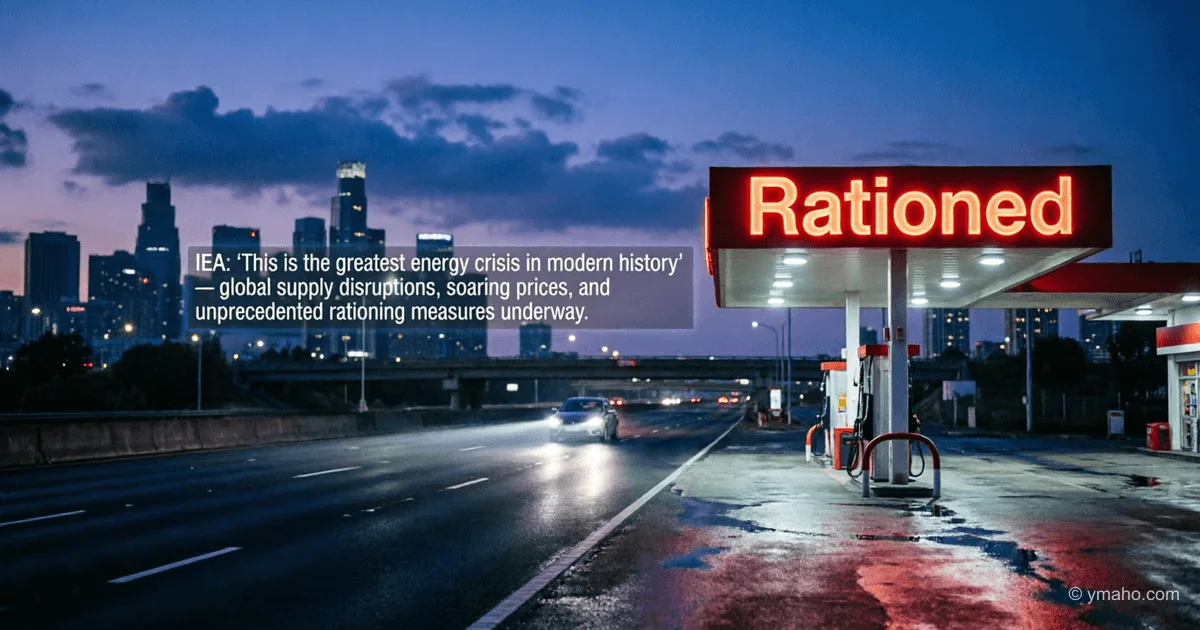
Global Energy Supply Chain on the Brink of Collapse Due to Persian Gulf Situation
The head of the International Energy Agency (IEA) stated that the global energy system is on the verge of collapse due to the military conflict. The agency warns that a blockade of the strait would deal a devastating blow to global GDP, trigger hyperinflation, and could force many countries to ration energy resources.
Analytical article: "Collapse on the Horizon" — Why the IEA Declared the Greatest Energy Crisis in History for the First Time
Statements by heads of international organizations are rarely hyperbolic — diplomatic language implies restraint and balanced wording. Therefore, when IEA Executive Director Fatih Birol announced in mid-April 2026 that the world faced "the greatest crisis in history," surpassing the oil shocks of 1973 and 1979 combined, it was not just news but an emergency evacuation signal for the entire global economy.
According to IEA estimates, the blockade of the Strait of Hormuz and military strikes on energy infrastructure in the Persian Gulf have already taken 13–15 million barrels of oil per day offline — roughly 13–15% of global production. 84 major energy facilities have been damaged, more than a third of them severely. The agency warns: the world is on the brink of supply chain collapse, hyperinflation, and energy rationing on a scale unseen since World War II.
Event Details and Timeline
The scale of the disaster unfolded gradually, but each new IEA report was grimmer than the last.
March 2026: Birol speaks at the National Press Club in Canberra and draws a historical parallel for the first time. "Many remember the two consecutive oil crises of the 1970s," he says. "In each, the world lost about five million barrels per day. Together — ten million. Today we have lost 11 million barrels per day — more than the two biggest shocks combined." This statement does not yet receive widespread resonance, but experts begin recalculating reserves.
April 2026 — France Inter interview: Birol raises the stakes. "This is truly the biggest crisis in history," he declares, now without reservations. He reveals details that had remained classified: 84 energy facilities have been damaged in the conflict. These include oil terminals, gas fields, refineries, and export hubs in Qatar, Saudi Arabia, Oman, Kuwait, Bahrain, the UAE, and Iraq. Even if the strait blockade is lifted tomorrow, restoring production to pre-war levels will take more than two years.
Mid-April — Corriere della Sera interview: The third warning is the most detailed. Birol explains why this crisis differs from all previous ones. "There is now intense competition in Europe and Asia for jet fuel supplies from Nigeria and the United States," he says. "Delays in restoring shipping through the Strait of Hormuz will complicate the production and supply of petroleum products." For the first time, he openly discusses political consequences: developing countries could fall into a "debt trap" like in the 1970s, leading to government changes and social unrest.
Alongside Birol's statements, the practical side of the crisis unfolds. In March, the IEA coordinated a record release of 400 million barrels of oil from strategic reserves of 32 member countries. The US contributed 172 million barrels. This volume — 4.4 million barrels per day for 90 days — only partially compensates for the lost 13–15 million. It is not a solution, but a delay.
Impact and Significance
Global Economic Impact: According to Oxford Economics calculations, the current deficit of 10 million barrels per day has already led to a decline in global GDP. Under a protracted war scenario, the deficit would expand to 13 million barrels per day by the sixth month of the conflict, representing an unprecedented 12% shortfall in global consumption. This would trigger a global recession and slow global GDP growth to 1.4% in 2026.
Inflation and Commodity Shortages: Birol warned that persistently high oil prices would trigger inflation across a wide range of goods — from fertilizers and sulfur to helium and diesel fuel. These are not just abstract numbers. Fertilizers become more expensive — meaning food becomes more expensive. Diesel becomes more expensive — meaning transportation of everything from food to clothing and construction materials becomes more expensive. In Russia, according to expert estimates, the blockade of Hormuz could lead to a 70% increase in prices for industrial goods and a 20% increase for food.
Developing Countries — the Main Victims: Birol particularly emphasized that developing countries in Asia, Africa, and Latin America would suffer the greatest losses. They have no strategic reserves, no financial safety net, and no ability to switch to alternative suppliers. Some are already on the brink of default, and the energy crisis could be the last straw.
Reactions of Key Players
Governments around the world are moving from words to action — and these actions increasingly resemble a wartime economy.
Sweden became the first European country to openly declare its readiness to introduce fuel rationing. Prime Minister Ulf Kristersson stated that authorities do not plan to do so yet but are prepared for such a development. "If necessary, the decision will be announced in advance." These words are the first public signal that gasoline coupons could return to Europe.
The European Union is preparing for a "long-term crisis." Energy Commissioner Dan Jørgensen told the Financial Times: "The rhetoric we use and the words we use are now more serious than during the previous crisis." The bloc is developing plans for "worst-case scenarios," including rationing of jet fuel and diesel, and possible further releases of strategic reserves.
Asia is already in austerity mode. The Philippines has reduced the workweek to four days and declared a "state of emergency." South Korea has restricted car use for government employees. Indonesia has imposed a fuel purchase limit for private cars — no more than 50 liters per day. Malaysia has moved government employees to remote work up to three days a week.
Bangladesh has cut working hours, mandated shopping malls to close earlier, and reduced fuel and electricity expenses in government institutions by 30%. Egypt has limited street lighting and ordered bars and restaurants to close by 9:00 PM.
Slovenia has gone further than any other in Europe: a limit of 50 liters of fuel per day for private individuals, and 200 liters for businesses.
Forecast and Conclusions
IEA Executive Director Fatih Birol made it clear: even if the Strait of Hormuz opens tomorrow, the world will not return to normal life. The 84 damaged energy facilities — more than a third severely — will require "considerable time" to repair. Production in Qatar, Saudi Arabia, Kuwait, the UAE, Bahrain, Oman, and Iraq will not return to previous levels in the foreseeable future.
Scenario A (60% probability): "Prolonged Stabilization." The strait will be partially opened within 4–8 weeks, but export capacity will remain limited due to damaged infrastructure. Oil prices will settle in the $90–110 range, but fuel rationing in the most vulnerable countries will persist through 2026–2027. Recovery will take 2–3 years.
Scenario B (30% probability): "Worst Case." The conflict expands, the strait remains closed for 6–12 months. The deficit reaches 13 million barrels per day, as modeled by Oxford Economics. Rationing becomes global, recession inevitable, and fuel and food cards become a reality for most of the world.
Scenario C (10% probability): "Diplomatic Miracle." Full ceasefire, lifting of the blockade, start of an international recovery program. But even in this case, the legacy of the crisis — destroyed facilities, shattered trust, reoriented trade flows — will shape global energy for years to come.
Conclusion: The International Energy Agency's warning is not hypothetical modeling. It is a diagnosis of the global economy. The world has entered an era of permanent energy crisis, and cheap energy is likely gone forever. As Birol stated, parallels with the 1970s are apt — and those crises led to a decade of stagflation, regime changes, and a radical restructuring of the global economy. The question now is not whether the world will survive this crisis, but at what cost and with what long-term consequences. The rationing systems that countries have begun to introduce are only the first sign of an approaching era where energy becomes not a commodity but a strategic resource distributed by limits and quotas.
— Editorial Team









