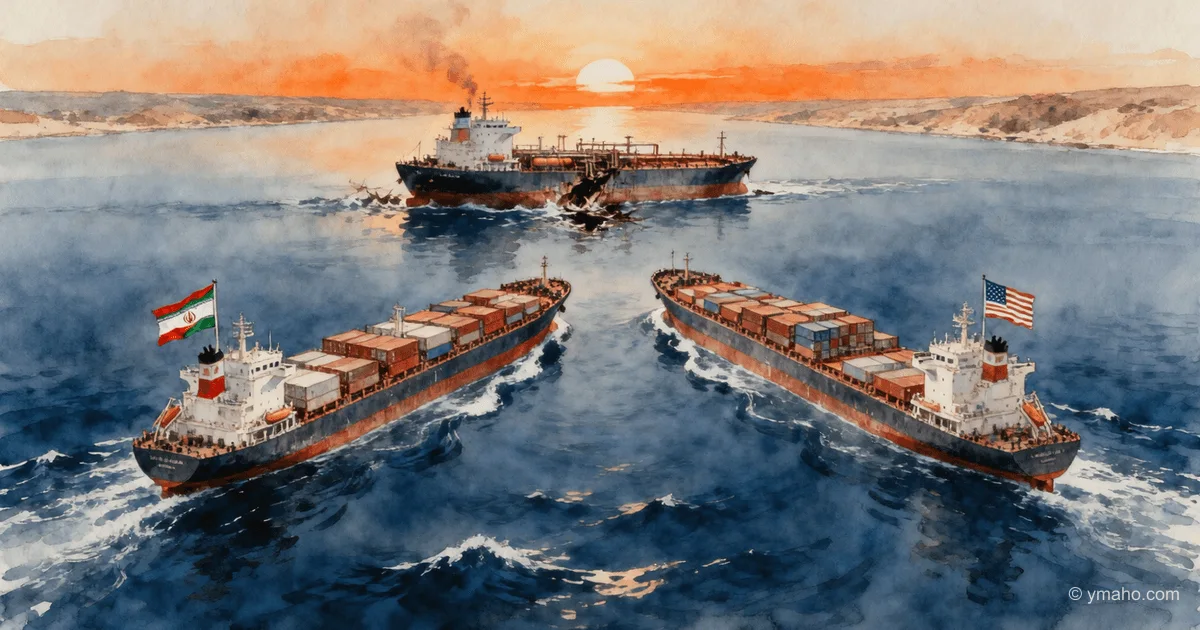
Iran Captures Ships in Strait of Hormuz: What It Means for Oil and Global Trade
Imagine a narrow hallway that 20% of the world's oil passes through every day. Now imagine two people standing at each end, both claiming to control who walks through—and both ready to fight over it. That's exactly what's happening right now in the Strait of Hormuz, a 21-mile-wide stretch of water between Iran and Oman. On April 22, 2026, Iran captured two foreign container ships trying to leave the Gulf through this strait and fired on a third. This isn't just a military incident—it's a move that could affect the price of gasoline, heating oil, and many products you buy, because so much of the world's energy travels through this narrow passage.
The Strait of Hormuz: A Tiny Chokepoint with Huge Power
The Strait of Hormuz is only about 21 nautical miles (39 kilometers) wide at its narrowest point. To put that in perspective, that's roughly the distance from downtown Los Angeles to Long Beach. Yet through this small gap, about 20% of all the oil and liquefied natural gas (LNG) traded globally flows during normal times. Countries like Saudi Arabia, Iraq, Kuwait, and the United Arab Emirates—some of the world's biggest oil producers—must send their tankers through this strait to reach international markets.
Since late February 2026, when the US and Israel began military operations against Iran, Tehran has tried to control who passes through. On March 4, Iran's Islamic Revolutionary Guard Corps (IRGC) announced it was taking full control of the strait. Ships now need permission from Iran to enter or leave. But on April 13, the US imposed a naval blockade around Iranian ports, meaning US forces also control who can approach from the other side. So ships are stuck between two opposing forces, each demanding approval.
How We Got Here: A Timeline of Escalation
- February 28, 2026: The US and Israel launch a war on Iran. Tehran closes the Strait of Hormuz to all vessels.
- March 4: Iran's IRGC says it fully controls the strait and ships must get clearance to pass.
- March 26: Iran says the strait is closed only to "enemy" countries (the US and Israel) but allows ships from other nations if they negotiate with the IRGC and pay a toll.
- April 13: The US begins a naval blockade of Iranian ports, stopping Iran-linked ships from moving freely.
- April 19: Iran tightens its grip, saying no foreign ships can pass until the US ends the blockade.
- April 22: Iran captures two container ships (MSC Francesca and Epaminondas) and fires on a third (Euphoria).
Why Iran's Ship Captures Matter
This is the first time Iran has actually attacked and seized ships since the war began. The vessels weren't even linked to the US or Israel—one was Panamanian-flagged, the other Liberian-flagged and Greek-owned. That's a big deal. It signals that Iran is willing to target any ship, not just those connected to its enemies.
Iran's First Vice President Mohammad Reza Aref made the logic clear: "One cannot restrict Iran's oil exports while expecting free security for others." In other words, if the US blocks Iran from selling its oil, Iran will block everyone else's oil too. This is a classic "tit-for-tat"—each side responding to the other's moves.
The Economic Stakes: Oil Prices and Your Wallet
Oil is the world's most important commodity. When its supply is threatened, prices go up—and that affects everything from the gas in your car to the plastic in your phone. Before the war, Iran was exporting about 1.68 million barrels of oil per day through the strait. In March 2026, that number actually rose to 1.84 million barrels per day, and Iran earned roughly $5 billion from oil exports in just one month—about 40% more than before the war. That's because oil prices have stayed high, often above $90 a barrel and sometimes over $100.
If the strait remains disrupted, oil prices could surge further. Global supply chains would suffer, and countries that rely on Gulf oil—like China, India, Japan, and South Korea—would face shortages or much higher costs. For ordinary people, that means more expensive gasoline, heating oil, and products made from petroleum.
What Does This Mean for Regular People?
The Strait of Hormuz is like a global energy faucet. Right now, two powerful forces are fighting over who controls the handle. If the situation escalates, that faucet could get turned off—at least partially. That would mean higher prices at the pump, more expensive plane tickets, and costlier goods shipped from overseas. For now, the world is watching to see if either side backs down. But with both Iran and the US digging in, the risk of a broader conflict—and its economic fallout—remains very real.
— Editorial Team









