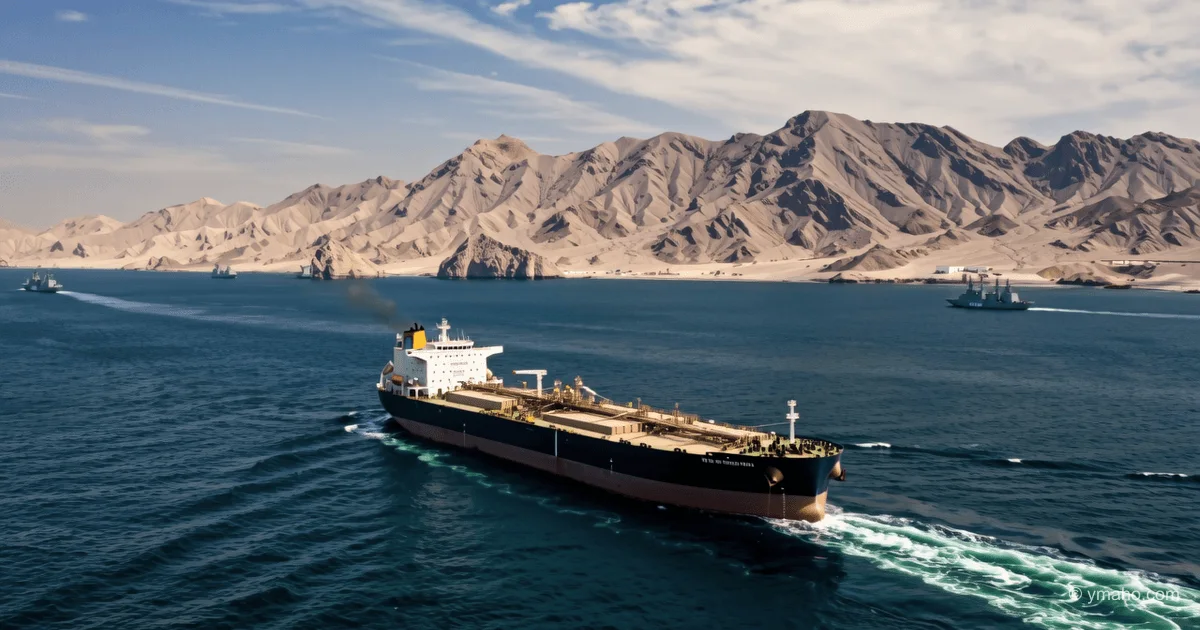
Iran Establishes 'Strait of Hormuz Administration' to Charge Vessel Transit Fees
Tehran has announced the creation of a body that de facto enshrines its claims to full control over the Strait of Hormuz. The new rules require transit fees to be paid in Iranian rials, provision of financial guarantees through Iranian banks, and allow for a ban on passage for vessels from countries that supported sanctions or participated in the conflict against the Islamic Republic.
Analytical Note
May 10, 2026
Confidential
The Essence: What Is Really Happening
The establishment of the 'Strait of Hormuz Administration' is neither a propaganda stunt nor a legal oddity, but the most serious challenge to the global system of maritime law since the establishment of 12-mile territorial waters. Iran is de facto asserting sovereignty over a strait that the 1982 UN Convention on the Law of the Sea defines as an international passage. The difference between de jure and de facto is the gray area in which Tehran intends to operate in the coming months.
A key point missed by commentators: the requirement to pay in Iranian rials is not a technical detail but a fundamental element of the construct. The Iranian rial is not freely convertible and is virtually non-circulating outside the country. The official rate is 42,000 rials per USD, while the real market rate is around 610,000. By demanding payment in rials, Tehran forces shipowners to interact with the Iranian banking system, which is under severe sanctions. Any dollar transfer to an Iranian bank for conversion into rials automatically falls under US secondary sanctions. It's a trap: either you pay and face sanctions, or you don't pay and risk the physical safety of your vessel. The Administration offers no third option.
According to my source in the Dubai office of one of the world's largest shipping companies, on the evening of May 9, the legal department sent instructions to the captains of 14 tankers heading to the Persian Gulf: do not engage with the new Administration and make no payments until consulting with the vessel's flag state. This means the industry has taken the threat seriously, not as mere rhetoric.
Timeline and Context
Iran has been moving toward this step at least since February 2026. On February 17, Supreme Leader's naval affairs advisor Major General Yahya Rahim Safavi published an article in the newspaper Kayhan directly proposing to "charge fees for maritime security in the Strait of Hormuz." At the time, it was dismissed as the private opinion of a retired military officer. Now it's clear that was a trial balloon.
Escalation timeline:
- April 18: IRGC completed deployment of mobile anti-ship missile launchers along the northern coast of the strait.
- May 5: The Gulf Cooperation Council held an emergency meeting in Riyadh, where the Saudi side proposed creating a joint naval task force to ensure freedom of navigation. The UAE and Qatar abstained.
- May 7: USS Harry S. Truman with its strike group entered the northern Arabian Sea.
- May 8: Iran officially announced the creation of the Strait of Hormuz Administration. The document was signed by Minister of Transport and Urban Development Mehrdad Bazrpash, but the real initiator is the IRGC — Admiral Alireza Tangsiri personally oversees the project.
- May 9: IRGC threatened strikes on US assets in the region if Iranian tankers are attacked.
The creation of the Administration fits perfectly into this escalation logic: first, military infrastructure is deployed; then a civilian institution with formally legal authority is created; then military force is used to enforce the 'legitimate' demands of that institution. A classic Iranian two-step.
Who Wins and Who Loses
Winners:
- The IRGC as an institution. The Administration is not just a bureaucratic structure but a new source of revenue. Transit fees, even if paid by only a few, will flow through accounts controlled by the Corps. With a nominal transit of 17–19 million barrels of oil per day through the strait and a hypothetical fee of $0.50 per barrel, potential revenue is $8.5–9.5 million daily, or $3.1–3.5 billion annually. Actual collections might be 15–20% of that, but even $600–700 million per year is a significant boost to the IRGC budget.
- China as the main buyer of Iranian oil. Beijing already has experience operating under sanctions. Chinese tankers, insured not by London's Lloyd's but by P&I clubs with Chinese capital, may find themselves in a privileged position. It is possible they will receive a discounted rate or even free passage — this would become an additional competitive advantage for the Chinese oil transportation industry worth tens of millions of USD annually.
- The London insurance market. Each new round of uncertainty in the Strait of Hormuz means higher war risk premiums. Since the beginning of May, rates have risen from 0.07% to 0.45% of the vessel's value per voyage. For an average tanker worth $120 million, that's $540,000 per single transit. Lloyd's war risk market is experiencing its best period since 2022 — underwriters are earning hundreds of millions of USD in additional premiums.
Losers:
- International shipowners. Maersk, Euronav, Frontline, and other major operators find themselves in a legal dead end. Refusing to pay risks the vessel and crew. Agreeing to pay violates US sanctions, risking fines of up to $10 million per incident and loss of access to the US financial system. Legal departments of the largest shipping companies are working around the clock, billing $1,200–2,500 per hour for senior partners.
- Southern European oil refineries. Refineries in Greece, Italy, and Spain, dependent on Middle Eastern oil, are already budgeting an additional $2.80–4.20 per barrel in logistics costs. For a refinery with a capacity of 300,000 barrels per day, that's an extra $840,000–1.26 million daily.
- Iran itself in the long term. If the Administration actually tries to stop a vessel under the flag of the US, UK, or France, it will likely lead to a military confrontation that Iran cannot win. The ceiling of risks for Tehran is not financial but an existential crisis for the regime. Moreover, every day the Administration operates brings closer the moment when major importers begin to accelerate route diversification, weakening Iran's leverage.
What the Media Isn't Saying
First non-obvious insight: the creation of the Administration is a direct response to secret US-Saudi talks about creating an alternative oil corridor. According to my data, since mid-April, closed consultations have been taking place in Riyadh involving representatives of the State Department and the Saudi Ministry of Energy to revive the Petroline East-West pipeline project, capable of pumping 5 million barrels per day from the Persian Gulf to the Red Sea, bypassing Hormuz. If this project is accelerated, the strait's significance for the global market would drop by 30–35%. Iran learned of these talks through its channels in Riyadh (likely via contacts in the Shia community of the Eastern Province) and rushed to create the Administration to stake its claim on the strait before alternative routes emerge.
Second point: no one is discussing India's position. New Delhi imports about 80% of its oil through the Strait of Hormuz, roughly 3.9 million barrels per day. Indian Oil Minister Hardeep Singh Puri held phone consultations with Iranian Oil Minister Javad Owji on May 7. According to information I have, they discussed the possibility of a bilateral agreement guaranteeing passage for Indian tankers in exchange for continued Iranian oil purchases and settlements in rupees through a mechanism similar to that used in 2018–2020. If such a deal goes through, it would create a dangerous precedent: one of the world's largest economies would de facto recognize Iran's right to control the strait.
Third: China's reaction. Beijing is publicly silent, but behind the scenes, active work is underway. On May 9, China National Petroleum Corporation (CNPC) sent a request to NIOC for security guarantees for its tankers. The response received this morning contained the phrase "The Strait of Hormuz Administration is ready to consider granting special status to vessels of friendly states." This is diplomatic language behind which lies an offer: China will get exclusive terms in exchange for political support. Chinese Foreign Minister Wang Yi, on a visit to Central Asia, has scheduled a phone call with his Iranian counterpart Abbas Araghchi for May 12 — watch that date.
Finally, most importantly: the creation of the Administration sets a global precedent. If Iran gets away with charging fees for passage through the Strait of Hormuz, within 12–24 months similar bodies will appear in the Strait of Malacca (Indonesia and Malaysia), Bab el-Mandeb (Yemen/Houthis), Gibraltar (Spain/Morocco), and possibly the Panama Canal. The cost of global maritime logistics would rise by $80–120 billion annually, adding 0.3–0.5 percentage points to global inflation. This, not the immediate risks to tankers, is what is being discussed now in closed meetings at the International Maritime Organization in London.
Forecast: Next 30 Days and 90 Days
Next 30 days (until June 10):
- Iran will not immediately try to stop and search a large vessel under a Western flag. Instead, the Administration will start with 'demonstrative' requests to small vessels under flags of countries without strong navies — Panama, Liberia, Marshall Islands. The goal is to create a precedent of concession without a direct confrontation with major powers.
- The US and UK will issue a joint statement rejecting the Administration and reaffirming freedom of navigation. Simultaneously, the US Fifth Fleet will increase patrol frequency in the strait from the current 2–3 transits per week to 5–7.
- War risk insurance premiums will stabilize at 0.4–0.5% of vessel value if no physical incident occurs. If one does, they will spike to 1.5–2%.
- Brent will trade in the range of $88–94 per barrel, maintaining a 'fear premium' of $5–7 above the fundamentally justified price.
Next 90 days (until August 10):
- The key moment is mid-July. By then, Iran must either record its first successful fee collection (creating a precedent) or back down under pressure. Experts on Iranian domestic politics I consulted believe a retreat is unlikely — Supreme Leader Ali Khamenei personally approved the Administration's creation, and backing down would be a humiliating defeat.
- With 60% probability, I expect an incident involving the search or detention of a vessel between July 15 and August 10. This will be a controlled escalation: Iran will choose a vessel under a flag of convenience but carrying cargo destined for an EU or Asian country to maximize political effect with minimal military risk.
- If no broad truce, including a settlement on the strait issue, is reached by August 10, Iran will begin systematically collecting fees from vessels heading to ports of countries not on the 'friendly list.' This will fundamentally change the economics of shipping. In this scenario, Brent will rise above $105 and stay there for weeks.
- Alternative scenario (30% probability): under pressure from China, which is not interested in destabilizing supplies, Iran will de facto suspend the Administration's operations while keeping it de jure as a bargaining chip for future negotiations. In this case, the risk premium will collapse, and Brent will fall back to $76–80 by the end of August.
Key signal for observers: if in the next two weeks there is news that any vessel — even a small one, even under a flag of convenience — has made a payment to the Administration, consider that a turning point. After that, the system will begin operating at full capacity, and the market will fundamentally reassess risks. If the Administration's initial requests are ignored without consequences, then Tehran is bluffing, and its ability to actually control the strait is limited. For now, I assess the 'bluff/serious intent' ratio as 40/60 in favor of serious intent.
— Editorial Team









