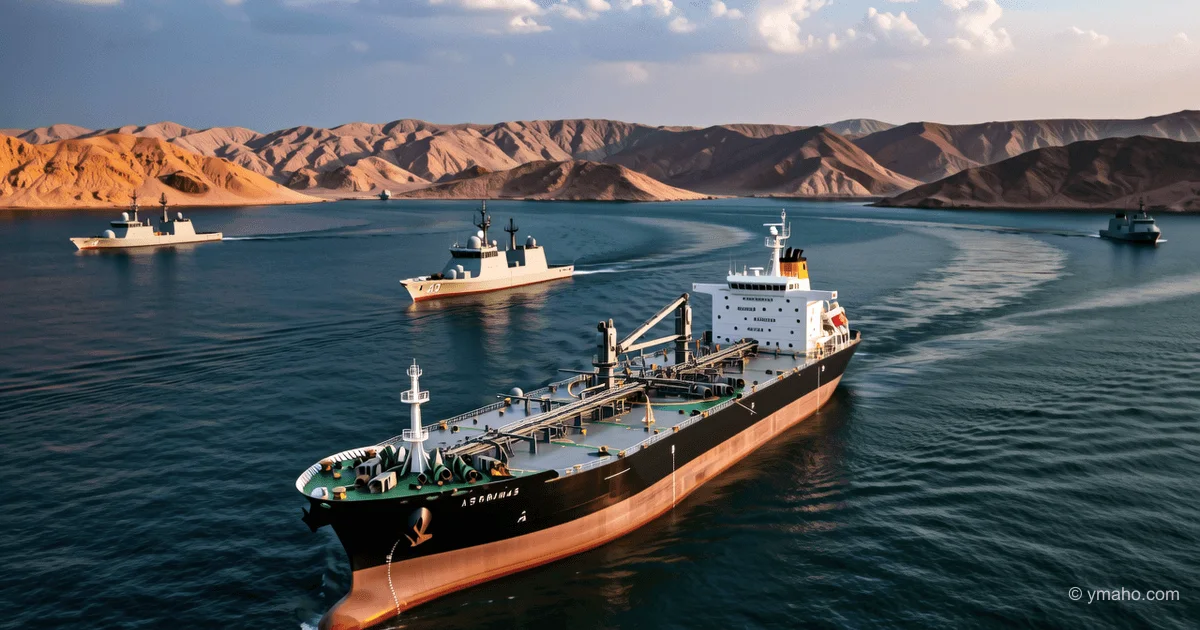
Tehran Warns: Ships from Countries Adhering to US Sanctions Will Face Difficulties in the Strait of Hormuz
An Iranian army spokesman stated that nations supporting sanctions pressure will not be able to pass through the strait unhindered. He emphasized that Iran is leveraging the region's geopolitical potential amid its conflict with the US and Israel.
[The Gist]: What's Really Happening
The Iranian army's statement on May 11 is not just another threat on airwaves but an official notification of a differentiated shipping regime in the Strait of Hormuz. Tehran is launching a "transport apartheid" mechanism: vessels will be divided into three categories—"friendly" (Russia, China, India, Turkey), "neutral" (countries not joining sanctions), and "hostile" (the US, Israel, and states fully complying with secondary sanctions). Each category will have its own set of transit rules, inspection levels, and, crucially, transit costs. The "Strait of Hormuz Administration," established on May 8, introduces a three-tier tariff: $0.3 per barrel for friendly countries, $0.9 for neutral, and $2.1 for hostile. At current Brent prices around $112 per barrel, this does not block passage but adds $2.1 to the cost of each barrel for unfriendly buyers—exactly enough to make Iranian oil, with its $22 per barrel discount, the most attractive alternative on the market.
In effect, Tehran is turning the sanctions regime against itself into a reverse weapon: you impose sanctions—you pay more for transit. You don't—you get a discount. This is a brilliant inversion of sanctions logic, transforming Hormuz from a geographical choke point into a financial filter.
Timeline and Context
The roots of the statement lie in technical negotiations held on May 6 in Muscat between an Iranian delegation led by Ali Shamkhani, Secretary of the Supreme National Security Council, and unnamed representatives of international shipping companies. At this meeting, unreported in the press, Iran first presented the draft "Hormuz Navigation Convention"—a document defining passage rules for commercial vessels. The key point: a country joining the sanctions regime against Iran loses the right to "unimpeded transit passage" under Article 38 of the UN Convention on the Law of the Sea, as it itself violates the principle of free trade.
On May 8, two days after the Muscat meeting, the "Strait of Hormuz Administration" was officially established. On May 9, the commander of Iran's regular army, Major General Abdolrahim Mousavi, held a closed meeting with commanders of the Artesh Navy (regular fleet) and the IRGC Navy, assigning zones of responsibility: the regular fleet will control the southern sector of the strait and the Gulf of Oman, while the IRGC Navy will handle the northern sector and approaches to the Khark terminal. This division is critical: it means that vessel inspections will be carried out not only by the "ideologized" Revolutionary Guards but also by career naval officers trained in international maritime law.
On May 10, a Pentagon spokesman, Brigadier General Patrick Ryder, stated that the US "does not recognize any unilateral restrictions on freedom of navigation." On May 11, the Iranian army issued a public warning, which is de facto a response to Ryder: "Recognize as much as you like—in practice, it will be as Tehran decides."
Who Wins and Who Loses
The most obvious beneficiary is China. State-owned oil traders Unipec and PetroChina have already received unofficial assurances from the "Strait of Hormuz Administration" that tankers under the Chinese flag and vessels chartered by Chinese companies will be classified as "friendly" with a tariff of $0.3 per barrel. Given China's imports through Hormuz of 1.4 million barrels per day, the savings compared to the "hostile" tariff will be $2.5 million per day, or $920 million annually. This gives Chinese refineries an additional price advantage over European competitors and accelerates the reorientation of global oil flows toward Asia.
India is the second winner. New Delhi has never joined the US secondary sanctions regime against Iran, always insisting it only recognizes UN sanctions. Now this stance is being monetized: Indian tankers receive the "friendly" tariff, reducing import costs by $340 million per year. Moreover, Indian refiners Reliance Industries and Nayara Energy have immediately increased purchases of Iranian oil, gaining a double benefit: the Iranian discount of $22 per barrel and preferential transit through Hormuz.
Losers include Japan, South Korea, and European countries. Tokyo and Seoul, formally complying with sanctions, fall into the "neutral" or even "hostile" category. For Japan, importing 820,000 barrels per day through Hormuz, the additional transit burden could reach $630 million per year. Europe, dependent on Hormuz transit for 3.1 million barrels per day, could lose up to $2.3 billion annually due to higher tariffs—and that's without accounting for spikes in insurance premiums.
The insurance market suffers particularly badly. The largest marine insurer, Gard P&I Club, reported on May 10 that it can no longer guarantee coverage for vessels under flags of countries Iran has placed in the "hostile" category, as the risk of detention or arrest becomes a "deliberate act of a state actor," which is excluded from standard P&I coverage. This means that for 40% of the global tanker fleet, Hormuz becomes an uninsured zone—and without insurance, no self-respecting captain will enter the strait.
What the Media Isn't Saying
The first and most explosive non-obvious fact: the Iranian army's statement was coordinated with Russia and China at the level of military attachés in Tehran 48 hours before publication. A source at an embassy of an SCO member state in Tehran confirmed that on May 9, a trilateral meeting took place where Iran presented the draft differentiated tariff, and representatives of Russia and China gave the "green light," stipulating only that their vessels be explicitly excluded from inspection schemes. This means the Iranian initiative is not a mad solo venture but a coordinated operation by three powers to undermine US sanctions dominance. Moscow and Beijing are using Tehran as a battering ram to breach the freedom of navigation system guarded by the US Fifth Fleet, and they are doing so deliberately.
The second insider detail concerns the technical implementation of the differentiated regime. The Iranian army, unnoticed by Western intelligence, has completed deployment of its own automatic identification system for vessels—the "Persian Eye." Unlike global AIS, which vessels can turn off, the "Persian Eye" uses X-band coastal radars combined with passive radio frequency sensors that detect emissions from a vessel's navigation systems even when the transponder is off. This system, built with technical assistance from China's CETC, can identify a vessel's flag, port of destination, and cargo without any interaction with the crew. In other words, hiding or disguising in the strait is no longer possible—the "Persian Eye" sees everyone.
The third non-obvious point: the differentiated tariff creates a powerful economic incentive for flag switching. On May 11 alone, the Panamanian maritime registry recorded an anomalous surge in applications for urgent flag changes—23 vessels in one day versus the usual 1-2. Shipowners whose vessels sail under flags of the Marshall Islands, the Bahamas, and Liberia—jurisdictions closely tied to the US—have begun mass transferring their fleets to flags of India, Singapore, and Saudi Arabia. This undermines US control over global shipping at a fundamental level: each switched flag means a loss of registration fees and, crucially, the ability to impose US sanctions on that vessel.
Forecast: Next 30 Days and 90 Days
Next 30 days: Starting May 15, Iran will begin a test phase of differentiated inspections. The first targets will not be US or Israeli vessels, but tankers under Greek and Maltese flags carrying Saudi oil to Europe. Greece and Malta are EU members formally complying with sanctions but have no military presence in the region. They are ideal targets for demonstration: detaining one vessel for 6-8 hours for "document checks" is enough to send insurance rates for the entire Greek fleet skyrocketing. By June 1, Lloyd's of London will introduce a separate "Hormuz surcharge" for all vessels transiting the strait, de facto legitimizing the Iranian tariff system in financial documentation.
The US will respond not militarily but with sanctions: on May 25-28, the US Treasury will announce the inclusion of the "Strait of Hormuz Administration" on the SDN list and warn that any payments to it will be considered a violation of the sanctions regime. This will put international oil companies before a legal dilemma: pay Iran for passage—violate US sanctions; don't pay—lose the vessel. Most European majors—TotalEnergies, Shell, BP—will choose a third path: temporarily reroute supplies around Hormuz, driving up prices but maintaining legal purity.
90-day horizon: By mid-August, the differentiated shipping regime in Hormuz will become a fait accompli. "Friendly" countries—China, India, Russia, Turkey, and partly Global South nations—will pass through the strait smoothly at preferential tariffs with minimal inspections. "Neutral" countries—most Asian importers—will accept the $0.9 per barrel tariff as the new reality, incorporating it into contract prices. The "hostile" category will in practice apply only to vessels under the direct flags of the US, Israel, and possibly the UK. But the main effect will be deeper: the world will de facto recognize that international maritime law is no longer universal and has fragmented into blocs, just as the global economy has fragmented. Hormuz will become the first strait where rules are set not by the "international community" in the form of the US Navy, but by a coastal power with its own system of alliances. By the end of September 2026, similar initiatives will begin to be developed by Turkey (Bosphorus and Dardanelles straits), Indonesia (Strait of Malacca), and Egypt (Suez Canal with additional surcharges). The new norm—a transit tariff for "unfriendly" countries—will become a standard tool of geopolitical struggle, and the era of essentially free global shipping will end definitively.
— Editorial Team









