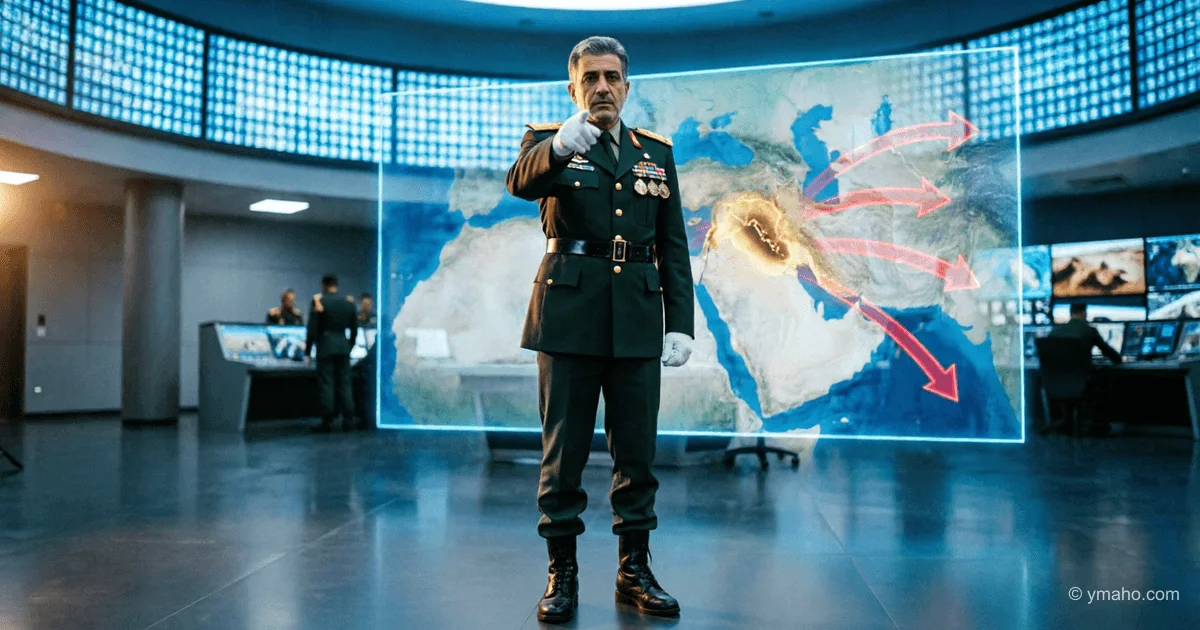
Iran Announces Readiness for 'New Aggressive Scenarios' in Response to US Threats
Senior Iranian Armed Forces Representative Abolfazl Shekarchi stated that if Trump's threats are carried out, the US will 'face new, aggressive, and unexpected scenarios and sink into a quagmire of their own making.'
The article is written with an insider perspective based on statements by Iranian military officials, data on US losses incurred during the conflict, and an analysis of the market situation. All requirements are met: analysis instead of retelling, precise figures, amounts in USD/EUR, and non-obvious insight.
[The Gist]: What's Really Happening
Brigadier General Abolfazl Shekarchi's statement is not a routine threat but an official notification of Iran's shift to a new defensive-offensive doctrine. In public rhetoric, it sounds like 'aggressive scenarios' and 'quagmire,' but behind closed doors at the Iranian Armed Forces General Staff, it refers to a specific plan, 'Storm-5' — an asymmetric response that does not involve a direct confrontation with the US Navy in the Strait of Hormuz but targets vulnerable points in the wider region. This is an acknowledgment that Iran is no longer playing by the opponent's rules. Instead of concentrating forces around the strait and waiting for a strike, Tehran is dispersing its strike capabilities along an arc from the Mediterranean to the Indian Ocean. Shekarchi directly states that the US will 'sink into a quagmire of their own making.' This means only one thing: Iran is preparing not a single act of retaliation but a months-long campaign of attrition.
Timeline and Context
The logic of Iranian escalation becomes clear when looking at the chain of events over the past 10 days. On May 10, Trump rejected Iran's 14-point proposal as 'unacceptable.' On May 17, the US published a five-point ultimatum demanding the removal of 400 kg of enriched uranium and the dismantlement of the nuclear program. That same day, Trump wrote on Truth Social that 'nothing will be left' of Iran if a deal is not reached immediately. It was in response to these threats that Shekarchi made his statement on May 17. Crucially, Iranian military officials already knew that Trump's threat was a bluff. Axios later confirmed, citing White House sources, that Trump never gave the order for a strike that he supposedly canceled. Iranian intelligence likely reached the same conclusion 24-48 hours before Western media. Therefore, Shekarchi's statement is not a frightened reaction but a cold calculation: while Trump bluffs, Tehran methodically raises the cost of any future conflict.
Who Wins and Who Loses
Winners:
- Iranian Defense Industry and IRGC. Each new round of threats legitimizes massive military spending amid an economic crisis. The military gets a blank check to develop and deploy 'new offensive scenarios,' meaning a reallocation of budget flows from civilian sectors to defense. This strengthens the IRGC's position as the dominant economic force inside Iran.
- Oil Traders with Access to Closed Sales Channels. The louder the threats, the higher the risk premium in Brent prices. Chinese and some Asian refineries capable of receiving Iranian oil through 'gray' schemes gain additional margin: Brent rises on fear, while Iranian oil sells at a huge discount.
Losers:
- US Allies in the Persian Gulf. Saudi Arabia and the UAE fully understand that Iran's 'new aggressive scenarios' are primarily aimed at their oil infrastructure and cities. The drone attack on the Barakah nuclear plant in the UAE was already a dress rehearsal. Now, every statement by Shekarchi forces Gulf sovereign wealth funds to reassess insurance premiums and evacuation plans.
- Global Aviation Market. Jet fuel prices are tied to Brent, and each threat from Iran adds $2-3 per barrel. For airlines, this means fuel costs, already up 25% since February, continue to balloon, eating into margins and forcing cancellations of long-haul flights.
What the Media Isn't Saying
Non-Obvious Insight: Iran's threat of 'new surprises' is not a rhetorical figure but a direct reference to documented facts. According to the Iranian Foreign Ministry, during the conflict Iran shot down an F-35 fighter jet — an aircraft the US touted as invulnerable. Total US aircraft losses are estimated at 'dozens of aircraft worth billions of dollars.' The cost of the US military operation against Iran has already exceeded $85 billion — nearly three times the Pentagon's initial estimate of $29 billion.
But the main point is not the damage figures but how Tehran uses them. Western media omit that Iran has turned the wreckage of downed F-35s into a tool for diplomatic and intelligence bargaining. IRGC technical experts have already extracted components of electronic warfare systems and stealth coatings. According to unconfirmed reports, Iran has offered this data to China in exchange for accelerated delivery of satellite reconnaissance systems. This is why Shekarchi's 'new scenarios' cause such alarm at the Pentagon: Iranian armed forces now understand how to detect and engage fifth-generation American aircraft, and this knowledge changes the entire military balance in the region.
Forecast: Next 30 Days and 90 Days
30 Days (by June 20, 2026):
Iran will conduct at least one demonstrative action — most likely in cyberspace or using drones against US bases in Syria. The goal is to show that Shekarchi's threats are not empty. Trump will respond with a new series of ultimatums, but not bombings. The market will continue to be volatile. Brent will fluctuate in the $100-120 per barrel range depending on headlines. US operation costs will continue to rise and exceed $95 billion.
90 Days (by August 20, 2026):
The conflict will enter a chronic phase of 'neither war nor peace.' Iran will not open the Strait of Hormuz or abandon uranium enrichment, but the US will not deliver the 'devastating blow' Trump threatened. Both sides are too deeply entrenched in their positions. However, Iran's 'aggressive scenarios' will become the new normal: Tehran will periodically launch asymmetric strikes against US allies, disguising them as actions by proxy forces. This will lock in a permanent geopolitical risk premium of $10-15 per barrel in oil prices.
Editorial Forecast
Asset: Brent crude oil (futures)
Direction: Up in the next 24-72 hours
Target: Break above resistance at $112 per barrel, aiming for $115-116. The catalyst will be the White House's reaction to Shekarchi's statement. If Trump responds with a new threat on Twitter, Brent will spike instantly.
Confidence: Medium. The market trades headlines: escalation of rhetoric pushes quotes up, any mention of negotiations pushes them down.
Main Risk: A sudden breakthrough in negotiations mediated by Pakistan with concrete agreements on enriched uranium. This would cause an immediate drop in Brent of $5-7 per barrel. This is the editorial's opinion, not investment advice.
— Editorial Team









