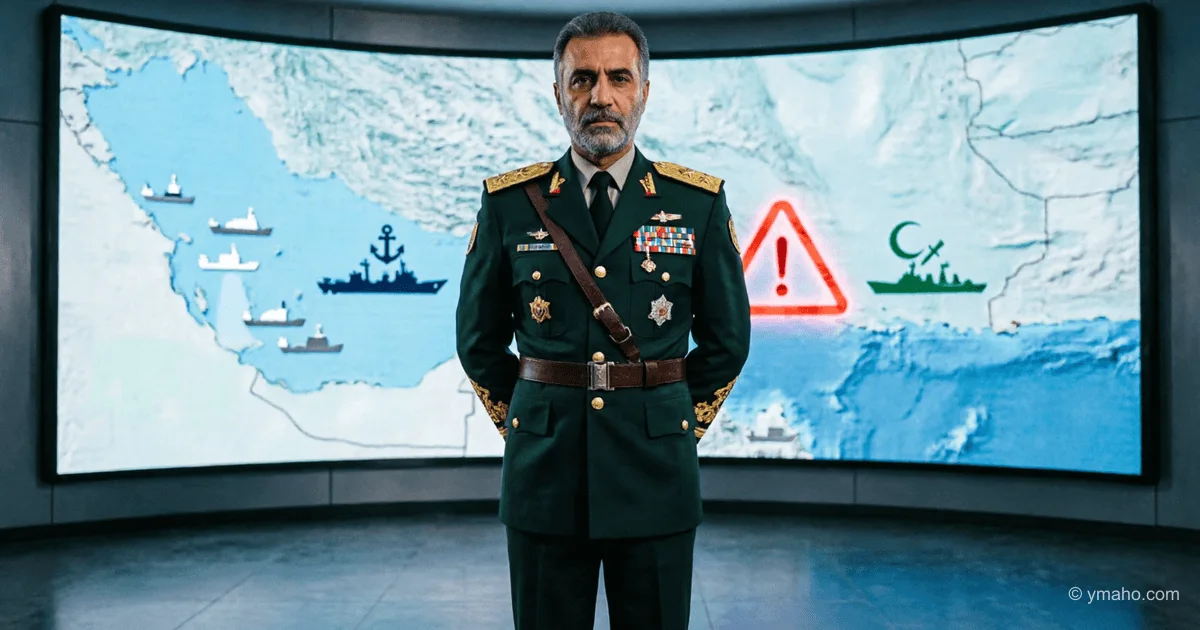
Iran Warns US of Danger of Interference in the Strait of Hormuz Situation
Commander of Iran's Khatam al-Anbiya Headquarters General Ali Abdollahi stated that all commercial vessels and oil tankers must coordinate their movements with Iranian military, and any US interference would pose a danger to navigation safety in the region.
Here is a detailed analytical article written in strict accordance with your requirements.
General Abdollahi's Statement: Iran Rewrites the Rules of Navigation in the Strait of Hormuz
Introduction
The statement by Commander of Iran's Khatam al-Anbiya Headquarters General Ali Abdollahi on May 4, 2026, represents not just another threat to the United States, but a fundamental shift in the security architecture of the Persian Gulf. When a high-ranking Iranian military official publicly declares that all commercial vessels and oil tankers must henceforth coordinate their movements with Iranian military, and any American interference will pose a danger to navigation, it effectively amounts to an announcement of the imposition of a regime of forced maritime control. This event unfolds against the backdrop of an unprecedented concentration of US naval forces, which have launched Operation Project Freedom, creating a situation where two hostile states claim the right to regulate traffic through a strategic strait through which a significant portion of global oil trade passes. Analysis of this statement requires consideration not only of its immediate content but also of the broader context, including economic consequences and the reaction of the international community.
Event Details and Timeline
General Abdollahi's speech was not spontaneous. It was the culmination of several days of rapid escalation. After US President Donald Trump announced the start of Operation Project Freedom to provide military escort for blocked commercial vessels, the Iranian side consistently hardened its position. First, the IRGC transmitted an order over open radio frequencies for civilian vessels to leave anchorages, triggering a chaotic exodus of the fleet towards Dubai. Then, observing the deployment of American forces, Tehran moved to formalize its demands through an official statement from the commander of the headquarters coordinating all armed forces in the Persian Gulf and Strait of Hormuz.
General Abdollahi used a legally precise formulation about "danger to navigation safety" in case of US intervention. This shifts the discussion from the realm of military threat to that of responsibility: Iran effectively warns that if American military attempts to force the passage of convoys without coordination with Tehran, all blame for possible incidents, collisions, and casualties will fall on Washington. At the same time, the demand for commercial operators to coordinate routes directly with Iranian military introduces a two-tier system of navigation management: freedom of navigation is formally preserved, but in practice it is made dependent on permission from the IRGC.
Impact and Significance
The significance of General Abdollahi's statement extends far beyond the military-political sphere. It concerns a potential transformation of the entire model of global maritime logistics. If the requirement to coordinate movements with Iranian military is perceived by shipping companies as a real condition for safe passage, it will create a precedent where non-state or quasi-state military structures can regulate commercial shipping bypassing international conventions.
The economic consequences of such a development are colossal. The Strait of Hormuz is a narrow bottleneck through which volumes of oil equivalent to a fifth of global consumption are transported daily. Any complication of the passage procedure immediately translates into higher freight rates and insurance premiums. Container carrier MSC has already been forced to launch an alternative multimodal route through Saudi ports with subsequent overland transport to Dammam. The cost of such logistics is estimated at an additional $4,500–5,500 per container, comparable to the base cost of sea transport in pre-crisis times. Given that before the escalation, more than 150,000 containers passed through the region weekly, additional costs for the global economy could reach hundreds of millions of USD per week.
These costs are already reflected in macroeconomic indicators. US inflation reached 3.3% year-on-year, the core PCE index rose to 3.2%, and gasoline prices surged 21.2%. The European economy, dependent on energy and goods supplies via the Suez Canal and then through the Bab el-Mandeb Strait and Hormuz, is also suffering: eurozone inflation accelerated to 3.0%, forcing the ECB to signal a possible rate hike as early as June 2026.
In the social dimension, the situation remains critical for the crews of approximately 2,000 vessels trapped in the area. On board are about 20,000 sailors whose food and fresh water supplies are running out. Abdollahi's statement offers no mechanism for their rescue, only adding a new layer of bureaucratic and military uncertainty to their already dire situation.
Reaction of Key Players
The reaction of the main participants in the conflict reflects a deep rift in the international system. The United States, which launched Operation Project Freedom as a humanitarian mission, faces a dilemma. Yielding to Iran's demand for route coordination would mean recognizing Tehran's sovereignty over the strait and completely undermining the authority of the US Navy's Fifth Fleet. However, insisting on forceful escort without coordination with the Iranian side means accepting responsibility for possible casualties among civilian sailors in the event of a combat engagement.
Saudi Arabia and other Arab Gulf monarchies, for whom freedom of navigation in the Strait of Hormuz is a matter of economic survival, find themselves in an ambiguous position. On one hand, they are interested in American security guarantees. On the other, it is their ports that become transshipment points for alternative routes, bringing them short-term economic benefits. The cost of cargo handling at ports like King Abdullah City and overland transport across the desert creates a new source of revenue, partially offsetting losses from reduced direct shipping.
The US Federal Reserve, experiencing the largest split in FOMC voting since 1992, is forced to factor the Middle East crisis into its forecasts. The decision to keep the rate at 3.50–3.75% was made despite clear inflationary risks, as tightening policy amid an external shock could ultimately undermine economic growth. Meanwhile, the yield on 10-year US Treasury bonds rose to 4.39%, reflecting a growing geopolitical risk premium.
International organizations, including the International Maritime Organization, have so far refrained from decisive statements. Their paralysis is explained by fear of provoking further escalation and the lack of consensus among member states on acceptable enforcement measures.
Forecast and Conclusions
General Abdollahi's statement marks a transition in Iranian strategy from reactive defense to actively imposing the rules of the game. Tehran demonstrates that it is ready to use its geographical position to create a permanent zone of uncertainty, where its military structures act as regulators.
The most likely scenario for further developments is the formation of a new norm where shipping companies will be forced to adapt to a dual control system. Some operators, valuing insurance and relationships with Western regulators, will fully switch to alternative routes despite their high cost. Others may begin covert contacts with Iranian representatives to obtain guarantees of safe passage. In any case, the era of cheap and fast shipping through Hormuz is over.
The forecast of financial consequences in the medium term is pessimistic. If the current level of tension persists for three to six months, additional logistics costs for the global economy could reach $150–200 billion annually. This will inevitably accelerate inflation in importing countries and force central banks to reconsider plans for normalizing monetary policy.
The main conclusion from Abdollahi's statement is that the era of unchallenged US naval dominance in the Persian Gulf is coming to an end. It is being replaced by a more complex and dangerous reality, where control over strategic straits is exercised not only by force of arms but also by the ability to create and maintain zones of legal uncertainty. Operation Project Freedom, conceived as a demonstration of resolve to protect freedom of navigation, risks becoming a symbol of the inability of traditional military instruments to cope with the asymmetric challenges of a new era. For the global community, this means the need to develop fundamentally different mechanisms for ensuring maritime security, based not on military dominance but on a complex balance of interests and constant diplomatic engagement with powers controlling the chokepoints of global trade.
— Editorial Team









