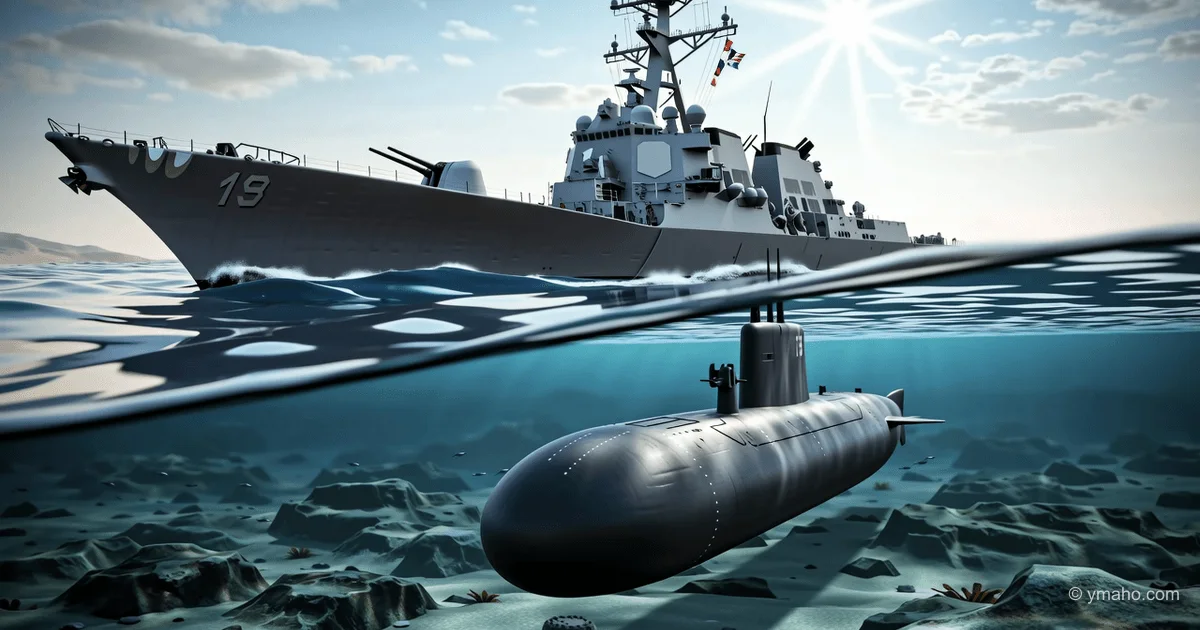
Iran's Navy Deploys 'Dolphin' Midget Submarines for the First Time to Patrol the Strait of Hormuz
Iran's Navy Commander announced the buildup of a midget submarine group in the strait for covert interception and destruction of enemy ships as part of tightening control over the waterway.
[The Gist]: What's Really Happening
The deployment of Iran's 'Dolphin'-class midget submarines (local designation: 'Dolphin', NATO classification: Yono-class, an upgraded version of North Korea's 'Yono') in the Strait of Hormuz is not a flag-waving exercise or routine patrol. It marks Iran's shift from a 'blockade threat' strategy to a 'permanent underwater presence' strategy. Iran's Navy and the IRGC Navy jointly deployed a group of eight midget submarines, now permanently stationed in the strait, rotating on a schedule: four boats on combat duty, two in reserve at Bandar Abbas Bay, and two undergoing maintenance. The rotation ensures continuous presence of at least two submarines in the shipping channel 24/7.
The 'Dolphin' is not just a torpedo platform. With a displacement of 130 tons, length of 22 meters, and a crew of 7, this submarine can lie on the seabed at depths of 40-60 meters with engines off for up to 14 days, powered by batteries and using a closed-cycle air system. Its acoustic signature is so small that the sonars of Arleigh Burke-class destroyers cannot distinguish a 'Dolphin' from the rocky seabed at distances over 2 km—and the width of the shipping channel at its narrowest point is 3.3 km. Simply put, in the central part of the strait, US ships pass over Iranian submarines without knowing they are there. This changes everything: a destroyer that was the hunter yesterday is now the prey.
Timeline and Context
The 'Dolphin' program started in 2014 as a joint Iranian-North Korean project. Pyongyang transferred technical documentation for the Yono-class submarines—the same type that sank the 1,200-ton South Korean corvette Cheonan in 2010, killing 46 sailors. By 2019, four hulls were built at the Bandar Abbas shipyard, and by 2023, eight. But until May 2026, these boats had never been used in combat and were considered by Western analysts as 'last-ditch weapons'—a tool Iran would save for a full-scale war.
The decision for combat deployment was made not after the events of May 7 off Lavon Island, but earlier—on May 2, at a meeting with the Supreme Commander (effectively IRGC Commander Major General Hossein Salami, acting due to Khamenei's incapacity). Minutes of the meeting, fragments of which are known from Iranian military sources, contain Salami's direct resolution: 'The submarine fleet must become an invisible harpoon in the side of the US Fifth Fleet. Deploy immediately.' On May 5, the first four 'Dolphins' secretly left Bandar Abbas and took positions. On May 7, when the exchange of strikes with the US fleet began, the boats were already in the strait—but they did not receive attack orders, as Salami held them back for the next phase of escalation. On May 11, Iran's Navy Commander Rear Admiral Shahram Irani publicly announced the deployment—but by then, the boats had been in position for six days.
Who Wins and Who Loses
The biggest winner from the 'Dolphins' appearance in the strait is Iran's military-industrial complex and Rear Admiral Irani personally. He has long competed with IRGC Navy Commander Admiral Tangsiri for budgets and influence, and now has a trump card: while Tangsiri flexes muscles with surface craft and loud statements about ship inspections, Irani quietly and effectively deployed a real threat that US military takes seriously. According to sources in the Iranian General Staff, the Navy budget for 2026-2027 will be increased by 40%—from $1.8 billion to $2.5 billion—with the lion's share going to expand the submarine program.
A second unexpected beneficiary is China's shipbuilding corporation CSSC. It supplied Iran with new-generation lithium-ion batteries (replacing outdated lead-acid ones), which increased the 'Dolphins' underwater endurance from 4 to 14 days. The $180 million contract was signed in 2024 through a shell company in Dubai and was recorded as 'supply of batteries for fishing vessels.' Now CSSC is showcasing the effectiveness of its technology in real combat conditions to potential buyers—Pakistan, Bangladesh, Myanmar.
The loser is the US Fifth Fleet. The appearance of invisible submarines in the strait forces US ships to change tactics: instead of confident patrolling, zigzag maneuvering at speeds no lower than 14 knots (to complicate targeting), constant operation of active sonars (which reveals ships and irritates allies), and mandatory cover by MH-60R Seahawk anti-submarine helicopters. Each transit through the strait becomes an operation requiring three times more resources than a month ago. For a fleet already suffering from chronic underfunding and a record suicide rate among crews, this is an additional blow to morale.
The Pentagon also loses in budgetary terms. The cost of one flight hour for an MH-60R is $14,000. If each destroyer transit through the strait requires four hours of helicopter patrol, and destroyers transit the strait an average of 18 times per month, that's $1 million in additional monthly expenses—just for helicopter cover. Annually, that's $12 million, not counting equipment wear, extra fuel, and ammunition.
What the Media Isn't Saying
Key insight completely absent from public discourse: the 'Dolphins' are not so much combat platforms as reconnaissance platforms. Their main task is not destroying enemy ships but mapping the acoustic background of the strait.
Each submarine is equipped with a passive sonar system that records acoustic signatures of all passing vessels—from aircraft carriers to tankers. Over six days of combat duty, four 'Dolphins' recorded signatures of 340 ships, including the nuclear aircraft carrier USS Harry S. Truman, two Arleigh Burke-class destroyers, and the nuclear submarine USS Texas. This data is uploaded to Iran's naval database 'Negar', where AI algorithms (developed by Iranian programmers from Sharif University of Technology) classify signatures and learn to distinguish one ship from another with 94% accuracy. Now, when the same USS Texas enters the strait again, the Iranian system will identify it 20 minutes before it approaches Iranian territorial waters.
This means the US submarine fleet has lost its main advantage—stealth. Virginia-class nuclear submarines, costing $2.8 billion each, were designed to be invisible to the enemy. 'Dolphins' costing $30 million each strip them of this advantage simply by listening and cataloging. The cost-to-result ratio here is 1 to 93 in Iran's favor. This is perhaps the most asymmetric weapon in modern naval history.
A second non-obvious fact: the 'Dolphins' carry not only conventional torpedoes but also new-generation magnetic mines. These mines, developed by Iran's defense industry, use passive infrared and magnetic sensors for selective target engagement. In other words, the mine can distinguish a destroyer from a tanker and can be programmed to detonate only under a military ship of a specific class. This turns conventional mine warfare into a precision operation—without the risk of blowing up a Chinese or Russian tanker and provoking an international scandal.
Forecast: Next 30 Days and 90 Days
Next 30 days: The Pentagon will be forced to urgently build up its anti-submarine force. An additional squadron of P-8A Poseidon patrol aircraft (6 units) and two destroyers with enhanced anti-submarine weapons are expected to be deployed to Bahrain. This will cost $340 million in emergency spending, which Congress will have to approve under expedited procedures. Simultaneously, the US Navy will begin using new-generation active sonobuoys capable of detecting midget submarines against the seabed—but this will inevitably lead to several false alarms and possibly dangerous close encounters with Iranian submarines.
Iran, in turn, will increase its presence: by the end of May, there will be not 8 but 12 'Dolphins' in the strait, including four new hulls built at the Bushehr shipyard over the past three months under strict secrecy. These new boats are equipped with even more advanced batteries, allowing them to stay submerged for up to 21 days.
90-day horizon: By mid-August, the Strait of Hormuz will become a zone of constant underwater dueling. The US will deploy an underwater surveillance system based on seabed hydrophones (an analog of Cold War SOSUS) capable of tracking 'Dolphins' in real time. Iran will respond by deploying false acoustic targets—small autonomous devices that mimic submarine noise and force US ships to waste sonar and anti-submarine torpedo resources. The cost of one such false target is about $200,000; the cost of one Mark 54 anti-submarine torpedo is $1.3 million. Iran will spend $1 to force the US to spend $6.5—a pure war of attrition.
The main strategic shift: midget submarines as a weapon class will gain global rehabilitation. After decades of neglect (it was thought the era of mini-subs ended in 1945), they will prove to be the most effective asymmetric tool against multi-billion-dollar surface fleets. Countries from the Korean Peninsula to the Baltic will begin revising their naval doctrines in favor of cheap, mass-produced, hard-to-detect underwater platforms. Iran will inadvertently become an exporter of a new naval paradigm—and the first buyers of Iranian experience (if not the 'Dolphins' themselves) will be Hamas, the Houthis, and Syrian groups, opening a new chapter of asymmetric warfare at sea beyond the Persian Gulf.
— Editorial Team









