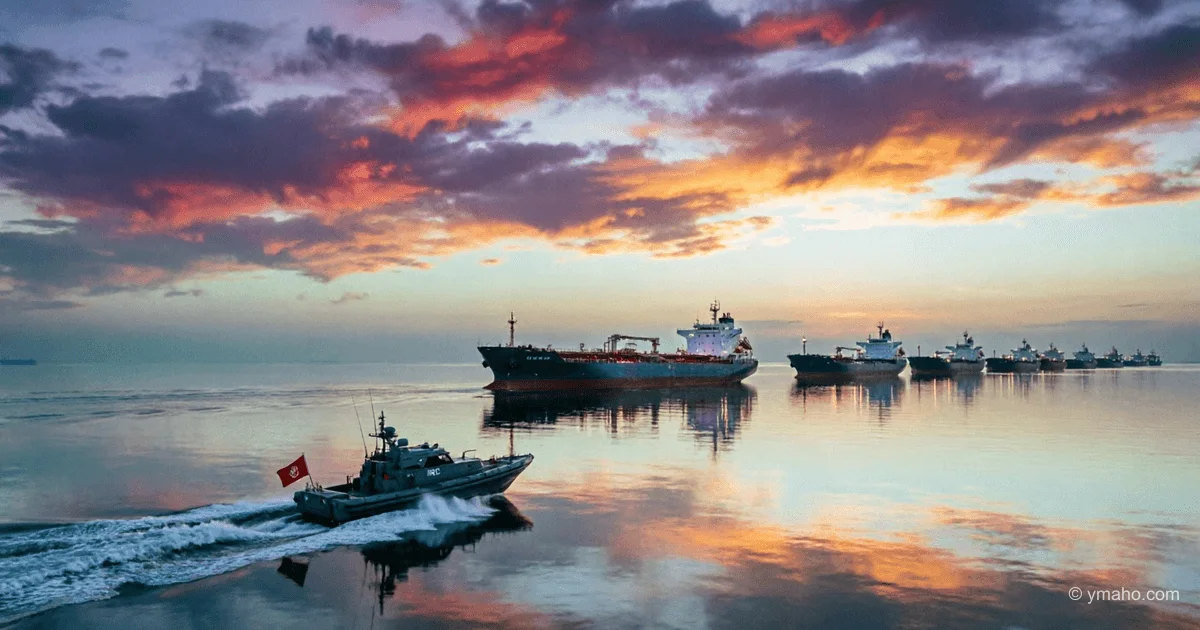
Iran's IRGC Orders Commercial Vessels to Leave Persian Gulf Amid Talks Breakdown
Iran's Islamic Revolutionary Guard Corps (IRGC) issued a warning for commercial vessels to leave the Persian Gulf, triggering a "mass exodus" toward Dubai after US and Iran failed to agree on ceasefire terms.
This is not just another round of escalation in the Persian Gulf. What happened in the last 48 hours is a fundamental shift in the regional security architecture, where water and logistics become weapons more fearsome than ballistic missiles. I analyze what remains behind the scenes of official reports.
The Essence: What's Really Happening
The IRGC's order for a "voluntary-compulsory" exodus of the commercial fleet from the Persian Gulf is not a spontaneous reaction to the talks breakdown. It is a carefully prepared operation to reshape maritime trade flows. Iran no longer needs to physically block the Strait of Hormuz with mines or speedboats. It is enough to make staying in the Gulf commercially unviable: insurance premiums skyrocket, and the risk of losing a vessel de facto exceeds any freight rates. Using its naval bases in Bandar Abbas and the Sirri Islands, the IRGC has essentially imposed a no-fly zone for civilian tonnage without firing a single shot.
The IRGC's true goal is the dismantlement of the UAE's hub model. Dubai has spent decades building its economy as a "safe haven" in the middle of a turbulent region. Now that status is being destroyed. Fujairah, as the only UAE port outside the Strait of Hormuz, is becoming not an advantage but a congested bottleneck that cannot handle the region's re-exports. Abu Dhabi and Riyadh have bet on economic integration as a counterbalance to Iran, but the paralysis of shipping in the Gulf hits them harder than any cyberattacks on Aramco.
Timeline and Context
To understand the scale, you need to rewind not days but months. As early as February 2026, Lloyd's List and the International Chamber of Shipping recorded a steady increase in informal requests from Iranian forces to ship captains in the eastern Gulf. Shipowners were "advised" to avoid certain areas. It was not a public demand, but it set a precedent.
Then, on May 3-4, 2026, a round of indirect talks in Oman failed. The sticking point, contrary to statements from the Trump office, was not the release of previously detained vessels but Iran's demand to legalize a new inspection mechanism for cargo bound for the UAE—to check for potential military use. The US considered this an unacceptable infringement on freedom of navigation. The IRGC's response was immediate: "If we cannot inspect cargo, the Gulf must be cleared."
On May 5, the IRGC Navy began broadcasting warnings on VHF Channel 16 (the international distress and calling frequency), declaring "high-risk zones." Unlike past incidents, there were no seizures this time. It was worse: collective expulsion. AIS tracks (Automatic Identification System data) show that by the morning of May 6, the number of large-tonnage vessels anchored or drifting in the narrowest part of the Gulf had dropped by 62% compared to the previous month's average. Dozens of ships simultaneously set course for Fujairah and the port of Sohar in Oman.
Who Wins and Who Loses
As cynical as it sounds, the winners are operators of overland pipelines and Red Sea logistics hubs.
The first beneficiary is the Saudi East-West Pipeline (Petroline) and the Abu Dhabi strategic pipeline (HABSHAN-FUJAIRAH). The capacity of these arteries instantly increased in value with the start of the fleet's exodus. Saudi Aramco got a carte blanche to increase discounts on oil shipped via the Red Sea to maintain market share in Europe, bypassing the Hormuz bottleneck.
The second less obvious beneficiary is China. Yes, China. Beijing, the largest buyer of Iranian oil, has long suffered from huge discounts on the fleet due to sanctions and surveyor risks. Now, as the "gray fleet" of shadow tankers effectively legitimizes its existence as the only carriers in Iranian waters (under IRGC protection, of course), logistics costs for Chinese refineries with independent processing quotas (teapots) may even decrease relative to the new market benchmark.
The main loser is not the US or Israel. It is Iraq. Iraq's economy is 90% dependent on exports through the southern terminals of Basra and Khor al-Amaya, located in close proximity to Iranian territorial waters. The Iraqi navy cannot secure a safe corridor for tankers, and the war risk insurance premium for vessels entering Basra reached 8% of cargo value this morning. This paralyzes the Iraqi budget faster than any embargo.
What the Media Isn't Saying
Everyone is now discussing "missile strikes" and "drones," overlooking the most destructive aspect—the insurance collapse. The Lloyd's Joint War Committee has not yet listed the entire Persian Gulf as a war risk zone (JWLA), limiting it only to Iranian waters. However, underwriting syndicates in London act faster than politicians. Three leading insurance syndicates (including Hiscox and Lancashire) have already privately notified their brokers that any K&R (kidnap and ransom), war risk, and P&I (protection and indemnity) coverage for vessels that do not leave the Gulf within the next 24 hours becomes void. This is a commercial decision, not a political statement. It was this call from Lloyd's, not the IRGC's threats, that triggered what captains call the "mass exodus."
The second unspoken fact: the vulnerability of the US Navy. The US Fifth Fleet has long boasted of its ability to ensure uninterrupted navigation. Now we see the opposite. US Arleigh Burke-class destroyers physically cannot escort every tanker. And when they try to create a "protective umbrella" over a convoy, they become vulnerable to asymmetric attacks from Iranian underwater drones costing less than $500,000 each. This is a classic trap: protecting trade is so prohibitively expensive that it is easier to temporarily stop it than to maintain it. The Pentagon understands this but cannot admit it publicly.
Forecast: Next 30 Days and 90 Days
30-day horizon (by June 5, 2026).
Logistics will be restructured, but not broken. We will see the birth of a "convoy system by necessity." The largest oil traders (Vitol, Trafigura) are now urgently negotiating to create a pool of vessels ready to enter Kuwait and Saudi Arabia under the cover of US military assets. This will be slow, costly due to downtime, but oil will continue to flow to market. However, for non-energy cargo (containers, grain), the Persian Gulf will be lost: shipping lines (Maersk, MSC) will declare force majeure and redirect container ships to Jeddah. The Brent crude oil market will test the $120 per barrel mark as soon as speculators realize that insurance in its usual form no longer exists.
90-day horizon (by August 2026).
We are not facing a direct Iran-US war, but a "quiet" Iran-UAE battle for Dubai. If shipping does not return, the IRGC will start pressuring Oman to restrict vessel reception at ports outside the strait, fully blocking alternative routes. In response, the UAE may take an unprecedented step: ask the US for offensive operations not against Iran but to clear the psychological barrier imposed by the IRGC, which would effectively amount to a declaration of war against a non-state actor or the IRGC fleet in international waters.
For the US Federal Reserve, this will become a nightmare. An inflationary spike from $120 per barrel combined with the collapse of electronics supply chains from Abu Dhabi (where key GlobalFoundries plants are located) will leave the Fed no choice. Instead of the rate cut markets dreamed of in March, the September 2026 meeting will have to consider an emergency rate hike of 25 basis points, to 3.75-4.00%. And this will happen not because of economic strength, but from fear of a return to 1970s inflation—this time caused not just by oil, but by the physical impossibility of delivering it.
— Editorial Team









