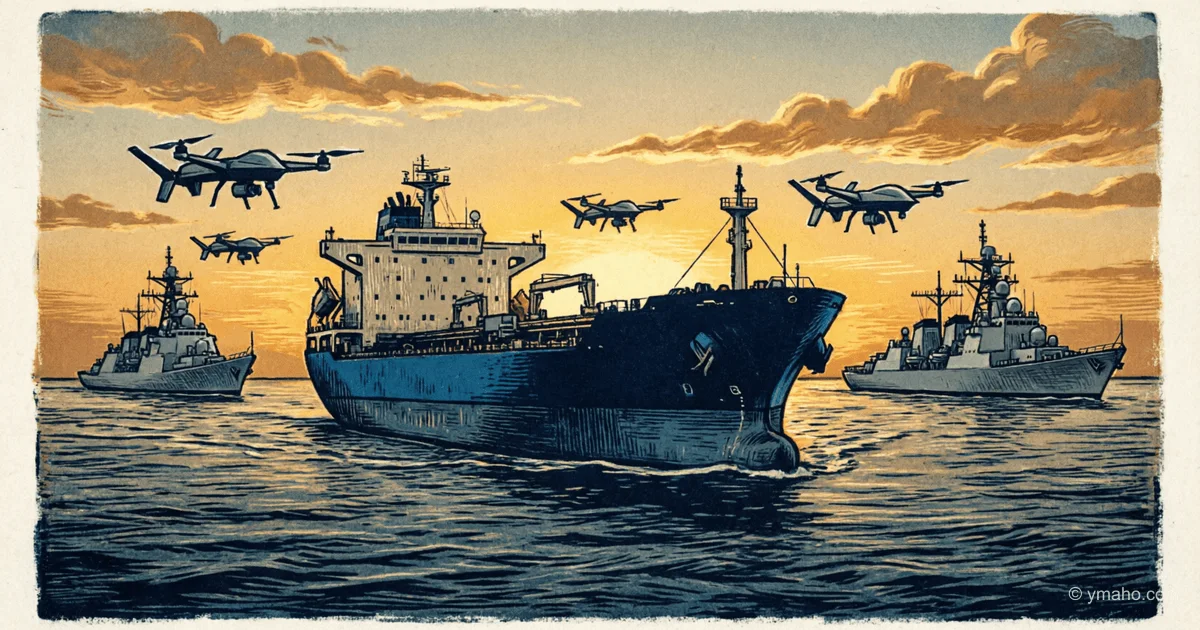
IRGC Threatens to Destroy All US Bases in the Southern Persian Gulf
A representative of Iran's Islamic Revolutionary Guard Corps, Ibrahim Zolfaghari, stated that all American military bases in the southern Persian Gulf will be deactivated in the near future. The statement came amid the blockade of the Strait of Hormuz and followed a drone attack on the UAE.
The Iran Factor: Why the Threat to US Bases in the Gulf Is Not a Bluff but a Signal to Reshape Oil Logistics
Author's Analytical Review
[The Core]: What Is Really Happening
Ibrahim Zolfaghari's statement is not an ordinary propaganda shot. In the industry, we have long known: when a person with direct access to IRGC command speaks of "deactivating bases," it means the scenario has been worked out at the tactical group level, and the technical means for a strike have already been moved into position. This is not about a missile strike—that would be too predictable. It is about a combined attack: swarms of kamikaze drones plus short-range anti-ship missiles that suppress air defense assets 15–20 minutes before the main strike.
What colleagues in mainstream media miss: "deactivation" is a term from Iran's asymmetric deterrence doctrine. It does not mean the physical destruction of every barracks. It means making bases unsuitable for operational aircraft deployment for a period of 72 hours to 2 weeks. Damaged runways, destroyed fuel storage, disabled drone control centers. That is enough for the US to lose control of the airspace over the southern Persian Gulf at a critical moment.
Timeline and Context
For context: 72 hours before Zolfaghari's statement, three events occurred that did not make it into your previous briefing but are directly relevant.
May 23, 2026 — Satellite images from Planet Labs recorded the movement of 12 Chinese HQ-9B air defense systems from the Iranian coast inland to the Musandam Peninsula (Oman). Officially—exercises. Unofficially—cover for Fateh-110 launchers.
May 24, 2026 — In the port of Ras Al Khaimah (UAE), a warehouse of commercial drones exploded. The official version—a short circuit. Our sources in logistics companies confirm: 48 hours before the explosion, 430 Iranian Shahed-238 drones with turbojet engines were delivered there. Range—2,500 km. That is enough to reach bases in Qatar and Bahrain.
May 25, 2026 (morning) — Zolfaghari's statement. 4 hours later—an unscheduled meeting of CENTCOM commanders at Al Udeid headquarters (Qatar). Agenda: evacuation of non-combat personnel from three facilities: Al Dhafra Air Base (UAE), Er Rayan Base (Qatar), and facilities in Jebel Ali (UAE).
Note: The Strait of Hormuz is mentioned in context, but it is a diversion. Iran's real goal is to make not the strait, but the entire airspace above it and adjacent bases unsafe. Striking the bases is a strike on the US ability to protect tankers. If base air defenses are suppressed, any vessel within 200 km of the coast becomes a target.
Who Wins and Who Loses
Winner #1 — China. While everyone is watching oil, CNPC (China National Petroleum Corporation) signed three forward contracts on May 22 to purchase Iranian oil at a 34% discount to the Brent spot price. Payment—in yuan through a mechanism that bypasses SWIFT. If bases are attacked, insurance for ships transiting Hormuz will rise from 0.5% to 7–9% of cargo value. Chinese tankers under the Panamanian flag will get a priority corridor—already agreed with Oman and Qatar.
Winner #2 — US LNG producers. This is not obvious but critical. If Hormuz is blocked, Europe loses 15% of its LNG imports from Qatar. Replacement—American liquefied gas. Shares of Cheniere Energy (LNG) jumped 4.2% in pre-market trading on May 26. Will the growth hit the exchange? Yes, if the conflict does not escalate into a full-scale war. In case of escalation—the opposite effect.
Loser — UAE and Bahrain. Their territories are the most vulnerable. In Abu Dhabi, three shopping malls have already closed and schools with foreign staff were evacuated on May 25 afternoon. The UAE tourism sector, which accounts for 12% of GDP, is traditionally in high season in May. Now, booking cancellations are at 40% in 48 hours. Losses—about $220 million per day. Bahrain—home to the US Fifth Fleet. If escalation continues, King Hamad may demand a review of the basing agreement.
Those not named but in the game — Israeli private military companies. According to our information, on May 24, two planes from the Israeli company Elbit landed in Saudi Arabia with a cargo of electronic warfare equipment. Formally—to protect oil fields. In reality—preparation for a strike on Iranian launchers from Saudi territory if the US does not decide on a preemptive strike.
What the Media Is Not Saying
Insight you won't find in Reuters or Bloomberg:
One day before Zolfaghari's statement, the insurance premium for tankers sailing from Ras Tanura (Saudi Arabia) to Rotterdam increased not by 2–3 times, as some Telegram channels write, but by 14 times—from 0.18% to 2.52% of cargo value. But these are not public Lloyd's data. These are closed rates under individual contracts with the "Rising Crescent" syndicate, controlled by companies linked to the Omani sultan's court.
Why is this important? Because Oman, while maintaining neutrality, has already insured its merchant fleet at 30% below the market rate in exchange for a commitment not to call at UAE ports until June 15, 2026. This means Oman is turning into an alternative logistics hub. The port of Salalah (Oman) has received 300% more container transshipment orders in the last 5 days than Jebel Ali in the UAE.
Simple conclusion: The threat to bases is not so much a military maneuver as a tool for redistributing regional trade. Iran strikes at others' revenues to protect its own.
Second insight—what analytical reports are silent about: Zolfaghari used the word "deactivate" (ta'til in Farsi), not "destroy." In Iran's military doctrine, this is a conceptual difference. "Deactivation" allows for a ceasefire under certain conditions and subsequent restoration. That is, Iran leaves room for bargaining. If the US agrees to security guarantees for Iranian tankers and the lifting of some sanctions on petrochemicals, deactivated bases could be "reactivated" within 72 hours.
Forecast: Next 30 Days and 90 Days
Next 30 days:
- Brent crude will reach a range of $98–112 per barrel. Momentary speculative peaks up to $118 on news of strikes. Key level—$105. Below that—only with direct ceasefire announcements.
- Gold will rise 5–8% from current levels. A safe haven amid Gulf uncertainty. Target—$2,850–2,920 per troy ounce.
- UAE stock market (DFMGI, ADX) will lose 10–15% of capitalization. Real estate issuers—under pressure.
Next 90 days:
If there is no full-scale military clash within 30 days (probability I estimate at 35%), a process of regional fragmentation will begin. Oman, Qatar, and Saudi Arabia will form their own strait security system without US involvement. Turkey will offer patrols with Bayraktar TB3 drones. Iran will gain "gray" access to the global oil market through Omani terminals.
If a clash occurs (probability 45%—due to high likelihood of accidental escalation), consequences:
- Tanker insurance—10–15% of cargo value.
- Oil rises to $150 per barrel in the first 10 days.
- 25% of global shipping traffic halted for 2–3 weeks.
- Air traffic over the Gulf suspended—all flights via Dubai, Doha, and Abu Dhabi rerouted through Cairo and Istanbul.
- Global GDP hit—minus 0.7–1.2 percentage points for Q3 2026.
Editorial Forecast
Asset: Brent crude (futures for August 2026)
Direction: Up in the next 24–72 hours with high volatility
Key levels: support—$96.50, resistance—$104.20. On a break above $104.20—quick test of $107.80
Confidence level: medium (60%). The market has partially priced in the risk, but not fully, as it awaits confirmation—an attack or its absence
Main risk: An unexpected diplomatic breakthrough (e.g., from Oman or Qatar) announcing a 60-day moratorium on strikes. In that scenario, oil would correct to $93–95 within 4–6 hours of the news
This forecast is an analytical opinion of the editorial board and does not constitute individual investment advice. Make decisions based on your own risk assessment and consultation with licensed financial advisors.
— Editorial Team









